Summary
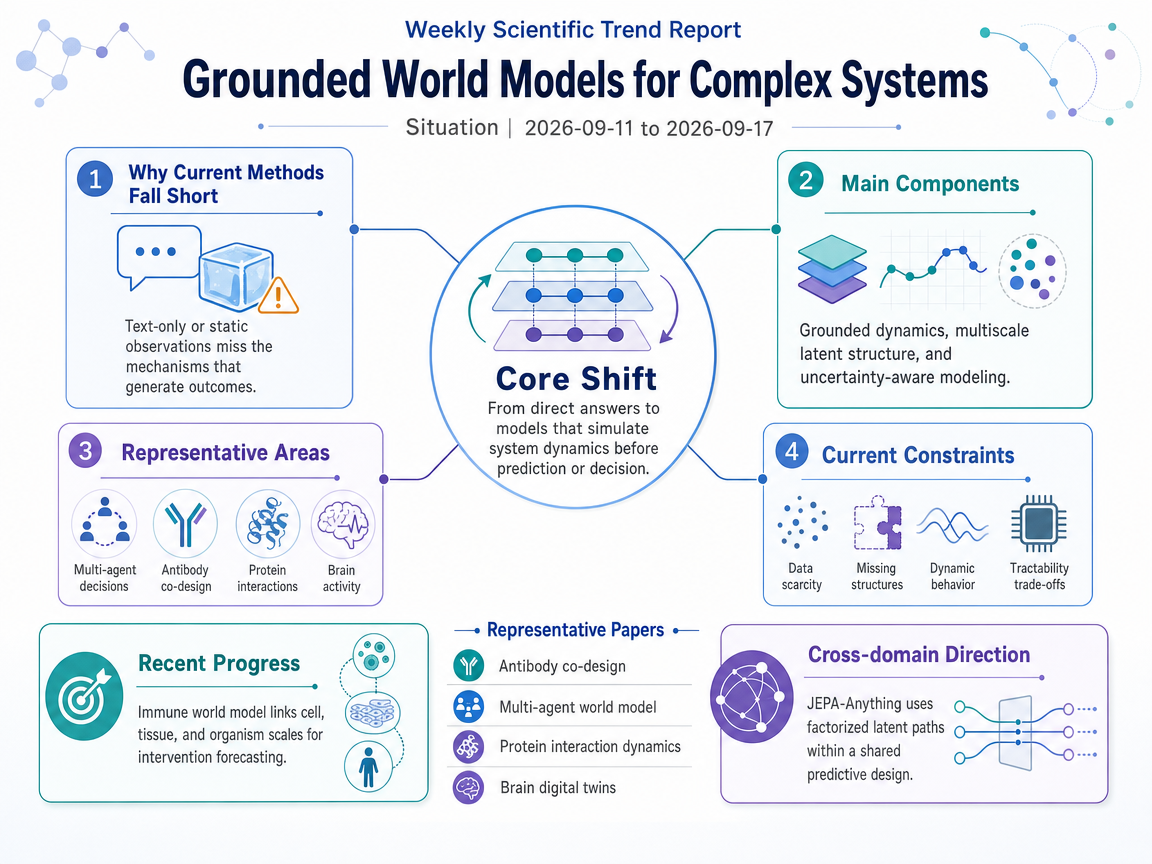
This theme centers on moving beyond direct answer generation toward models that simulate underlying system dynamics before making decisions or predictions. Across multi-agent reasoning and biological modeling, the representative papers argue that grounded, multiscale, and uncertainty-aware world models are needed when text-only or static-structure methods are insufficient.
Situation
Representative-paper introductions describe a common limitation of current generative or predictive systems: they often produce answers from language or static observations without actually modeling the mechanisms that generate outcomes. In 2410.02664v1, this motivates Learning before Interaction, where a world model simulates dynamics and rewards for multi-agent decision problems so policies can be trained in imagined experience, addressing the weakness of sketchy LLM-style answers and the relative lack of multi-agent world-model work.
The biological representatives make a parallel argument that faithful prediction requires richer latent structure and multiple scales. HTP (2311.16126v1) frames antibody co-design as data-scarce and therefore benefits from hierarchical training across broader sequence and structure resources, while Refine-PPI (2601.06214v1) argues that mutation-effect prediction must account for missing mutant structures and protein dynamics rather than a single static complex. As fresh evidence, "Towards a faithful stochastic model for brain digital twins" (2609.13973v1) extends the same logic to neuroscience, combining complementary stochastic mechanisms—Random Neural Networks for network-level interactions and Markov-modulated processes for firing dynamics—to model neuronal activity across neuron- and network-level scales while remaining computationally tractable.
Infographic (English)
Progress
An immune world model for multiscale forecasting and therapeutic hypothesis generation <See Details on Fugu-MT>
This paper extends the theme to immunology with an action-conditioned immune world model that learns state transitions across cell, tissue, and organism scales. Compared with prior static or single-scale prediction, it connects multiscale immune simulation with intervention forecasting and testable therapeutic hypothesis generation.
JEPA-Anything: Learning Predictive Models across Different Worlds <See Details on Fugu-MT>
JEPA-Anything introduces a domain-agnostic predictive-model framework evaluated across seven domains including biology, clinical trajectories, control, and molecular dynamics. Compared with earlier domain-specific grounded models, it introduces factorized latent prediction paths that decompose targets into complementary factors and recombine them within a shared predictive design.
Outlook
Outlook Summary
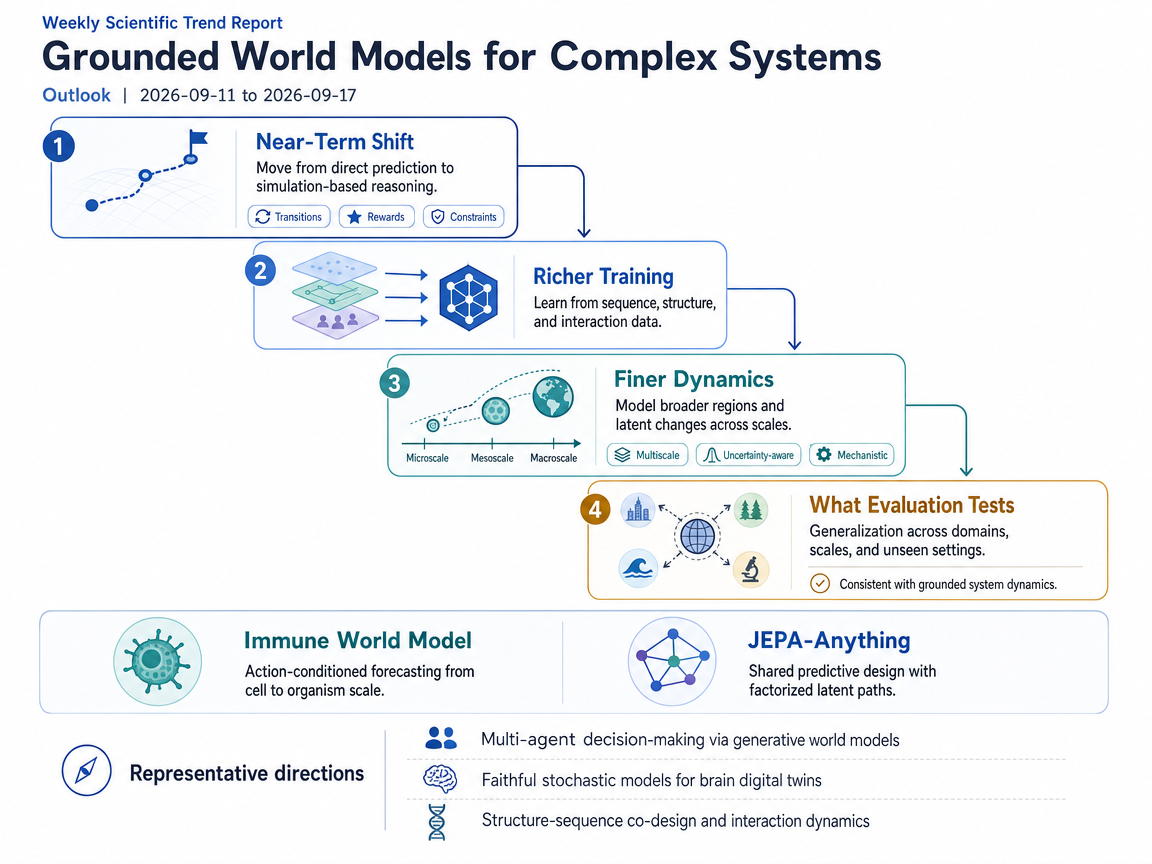
The next step is likely richer world modeling rather than direct prediction, with simulation built into reasoning and previously separate components trained together. More diverse data could move single-domain prototypes toward systems that connect changes across scales while learning outcomes and constraints. Near-term work would expand modeled regions, draw on larger structure databases, and capture hidden influences such as side-chain changes in proteins. Evaluation should test whether these models remain consistent with underlying mechanisms across unfamiliar domains and scales, rather than merely improving prediction scores in familiar settings.
Infographic (English)
Three-Year Movement
The outlook points toward richer world models that explain how systems change, rather than producing one-shot predictions. In multi-agent AI, this means learning how interactions unfold and which outcomes are rewarded. In biological design, it means connecting sequence and structure with interaction evidence while acknowledging uncertainty. Broader training data and joint tuning of previously separate components could make both approaches more useful.
The central question for the three-year horizon is whether this added detail improves intervention choices when conditions change. Progress would therefore be judged by better choices in unfamiliar settings, not only higher scores on familiar prediction tasks. This week's editorial signals around action-conditioned immune simulation and prediction across domains suggest that direction, but the supplied evidence does not independently validate those broader claims. The scenario provides no year-by-year deployment path; its key distinction is between a richer representation of a system and demonstrated usefulness in deciding how to change it.
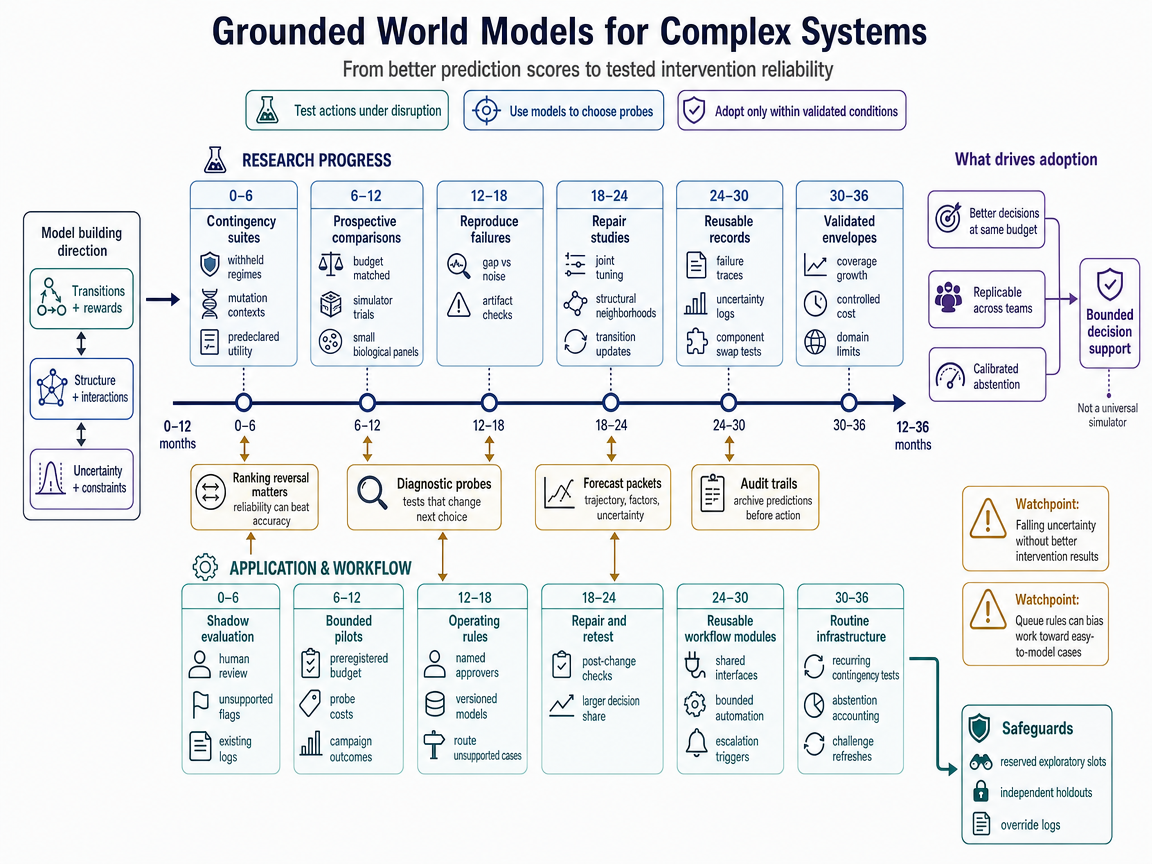
Richer world models could become tools for deciding what to measure next, even before comprehensive simulation across scales becomes possible. In the first year, researchers would add experiment selectors to existing models, choosing tests where competing explanations imply different next actions. The mechanism is dual control: an action both pursues a useful outcome and reveals information that can improve a later choice. Early work would move from historical replay to small prospective studies, with humans reviewing recommendations that mix promising candidates with tests designed to distinguish competing explanations.
By the second year, successful pilots would become repeatable workflows in which a diagnostic result revises the model and changes the next intervention ranking. Teams would preserve model versions and experiment records so another laboratory or related simulator task could test whether the selection method transfers. Continuation would depend on better final decisions within the same total experimental budget than direct optimization or ordinary active learning, which mainly selects measurements to improve a model.
By year three, successful replication could support limited automation of inexpensive, reversible experiments, while consequential biological choices remain under human authority. Research would increasingly examine whether all available explanations are wrong, using repeated failures to identify missing mechanisms rather than merely adjusting confidence. Independent challenge experiments would test whether additions such as protein side-chain changes actually improve intervention accuracy under conditions not used during development. Software would coordinate testing and model updates, but pause or request review when observations move outside the conditions in which it was validated.
A useful monitoring cue would be reproducible improvements in candidate rankings across teams without rebuilding the selection process from scratch. The main caveat is that measurements may not distinguish the mechanisms that matter, and biological systems cannot always be reset for another test. Falling uncertainty without better intervention results, or delays that prevent timely updates, would weaken the case for using models as experiment directors.
Richer world models could acquire an organizational role as well as a scientific one: simulation evidence might become a condition for access to scarce experiments. In the first year, researchers would package predicted changes and uncertainty with an example intervention trajectory, making their forecasts easier for reviewers to inspect. They would test these forecast packets on unfamiliar tasks and withheld mutations, checking whether added structural detail improves accuracy rather than presentation. The decisive threshold would be a facility changing queue priority or blocking a costly experiment because a packet was missing or inadequate.
In the second year, crossing that threshold would create a feedback loop in which access requirements encourage packet production and reviewers demand comparable evidence. Laboratories would archive predictions before experiments and compare outcomes against them, exposing missed mechanisms and uncertainty estimates that were too confident. Shared validation checks could then support reusable modeling components, with simulated trajectories becoming a common basis for deciding which proposed actions proceed.
By year three, the relationship could partly reverse, with researchers adapting proposals to accepted simulators rather than adapting simulators to scientific questions. Hard-to-model mechanisms could receive less experimental attention, so researchers would need to test whether packet requirements systematically favor easy-to-model proposals over scientifically valuable alternatives. A few reusable modeling systems might support experiment planning and review, but unresolved joint learning would favor smaller, inspectable subsystems over a universal world model.
Monitoring should focus on documented queue rules and independently reused tests, alongside evidence that failed predictions actually lead to model revisions. Reserved experimental capacity for poorly modeled hypotheses would help prevent accepted simulators from narrowing the range of questions that researchers can investigate. This path remains uncertain because the fields lack standardized outcome histories and a shared authority for accepting models, while biological conditions can change. If reviewers reject packet requirements or prospective failures never improve validation, the gatekeeping scenario weakens even though simulator-assisted research could still advance.
1-Year / 3-Year Research-Application Infographic
References
- A Hierarchical Training Paradigm for Antibody Structure-sequence Co-design - Authors: Fang Wu, Stan Z. Li / <See Details on Fugu-MT> / License: CC-BY-4.0
- Grounded Answers for Multi-agent Decision-making Problem through Generative World Model - Authors: Zeyang Liu, Xinrui Yang, Shiguang Sun, Long Qian, Lipeng Wan, Xingyu Chen, Xuguang Lan, / <See Details on Fugu-MT> / License: CC-BY-4.0
- Dynamics-inspired Structure Hallucination for Protein-protein Interaction Modeling - Authors: Fang Wu, Stan Z. Li, / <See Details on Fugu-MT> / License: CC-BY-4.0
- Towards a faithful stochastic model for brain digital twins - Authors: Abdelhamid Rouatbi, Alexandre Muzy, Eugene Syriani / <See Details on Fugu-MT> / License: CC BY 4.0