Summary
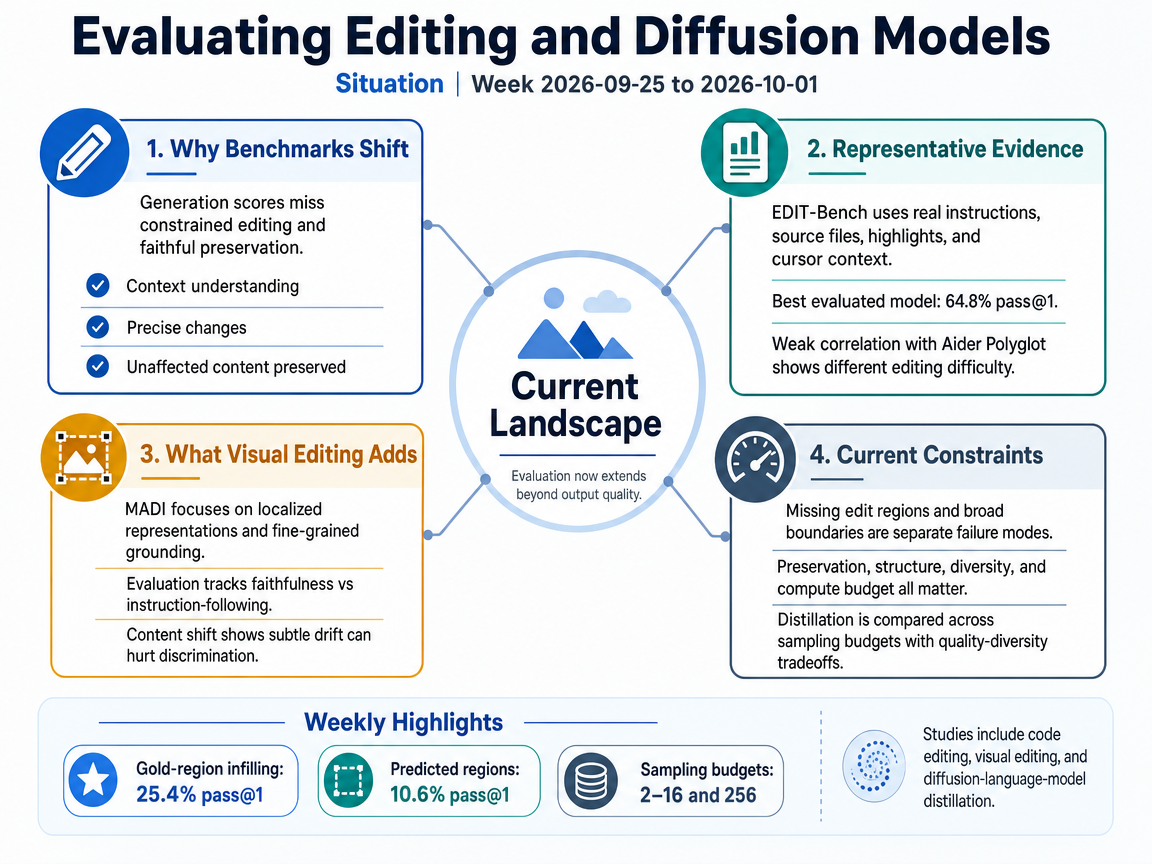
This week's evidence emphasizes evaluation beyond aggregate generation quality: realistic editing requires interpreting context, making precise changes, and preserving unaffected content. New diffusion-language-model studies add diagnostics for edit localization and compare distillation methods across sampling budgets while accounting for quality–diversity tradeoffs.
Situation
The representative papers show why generation benchmarks alone are insufficient for evaluating constrained editing and faithful representations. EDIT-Bench draws on real developer instructions, source files, highlighted regions, and cursor positions. Its best evaluated model reaches 64.8% pass@1, and its weak correlation with Aider Polyglot suggests that realistic editing exposes different difficulties. In visual editing, MADI emphasizes localized representations, fine-grained instruction grounding, and inference-time capacity, and its evaluation captures the tradeoff between faithfulness and instruction-following. Suppress Content Shift identifies a related preservation problem: reconstructed diffusion features can drift from the input, harming discrimination even when the differences are visually subtle.
This week's supplemental evidence sharpens these requirements. How Should Diffusion Language Models Edit Code? distinguishes known-region infilling from autonomous editing and identifies missing edit regions and overly broad boundaries as separate failure modes. The current-week paper Distribution Matching Distillation for Continuous Diffusion Language Models (2609.40235v1) targets sampling cost with continuous-relaxation and categorical-sampling distillation methods, evaluated on OpenWebText with generative perplexity–entropy frontiers across network-evaluation budgets. Together, these studies point toward measuring preservation, structural decisions, diversity, and computational budget alongside output quality.
Infographic (English)
Progress
How Should Diffusion Language Models Edit Code? <See Details on Fugu-MT>
Four editing interfaces separate localization, generation, and preservation decisions in diffusion code editing. On multi-span CanItEdit instances, infilling with gold regions reaches 25.4% pass@1 but drops to 10.6% when regions must be predicted.
Beyond Temporal Smoothing: Spatial Energy Budgets Stabilize One-Step Diffusion Editing <See Details on Fugu-MT>
BudEdit targets object distortion and unwanted background changes in one-step diffusion editing without training or inversion. On PIE-Bench with SD-Turbo, it outperforms ChordEdit on all 11 evaluated metrics under each method's reported default settings.
Distribution Matching Distillation for Continuous Diffusion Language Models <See Details on Fugu-MT>
Distribution-matching distillation for continuous diffusion language models is evaluated through perplexity–entropy frontiers across sampling budgets. On OpenWebText, Simplex-DMD improves on evaluated baselines at 2–16 network evaluations and Reinforce-DMD at 256.
Outlook
Outlook Summary
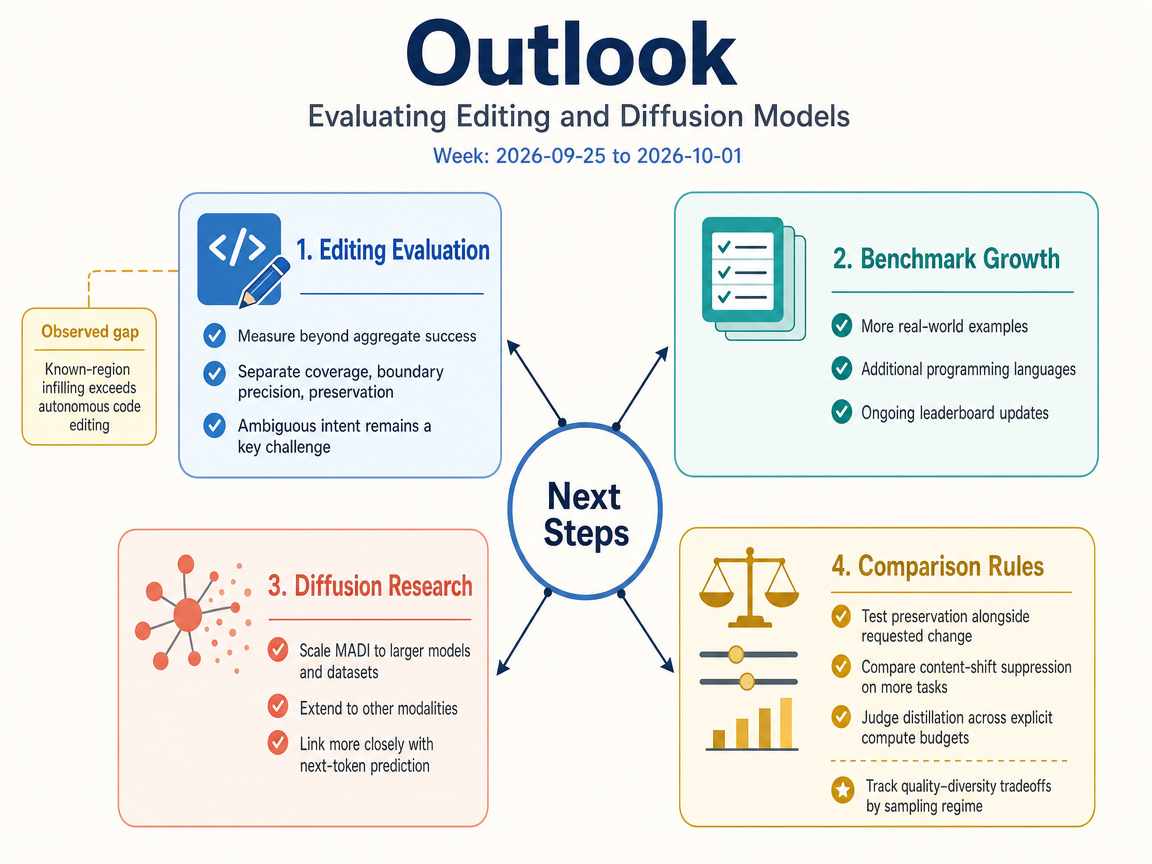
Evaluation is moving toward diagnosing real editing failures rather than reporting aggregate success alone. As EDIT-Bench expands across examples and languages, ambiguous user intent and reliable automatic test generation remain central challenges. Evaluations should distinguish edit coverage, boundary precision, and preservation of unchanged content. Diffusion research should test MADI at larger scales and across modalities, explore closer integration with next-token prediction, and broaden GATE’s content-drift controls. Visual editing should measure preservation alongside requested changes, while acceleration methods need quality–diversity comparisons at explicit computational budgets.
Infographic (English)
Three-Year Movement
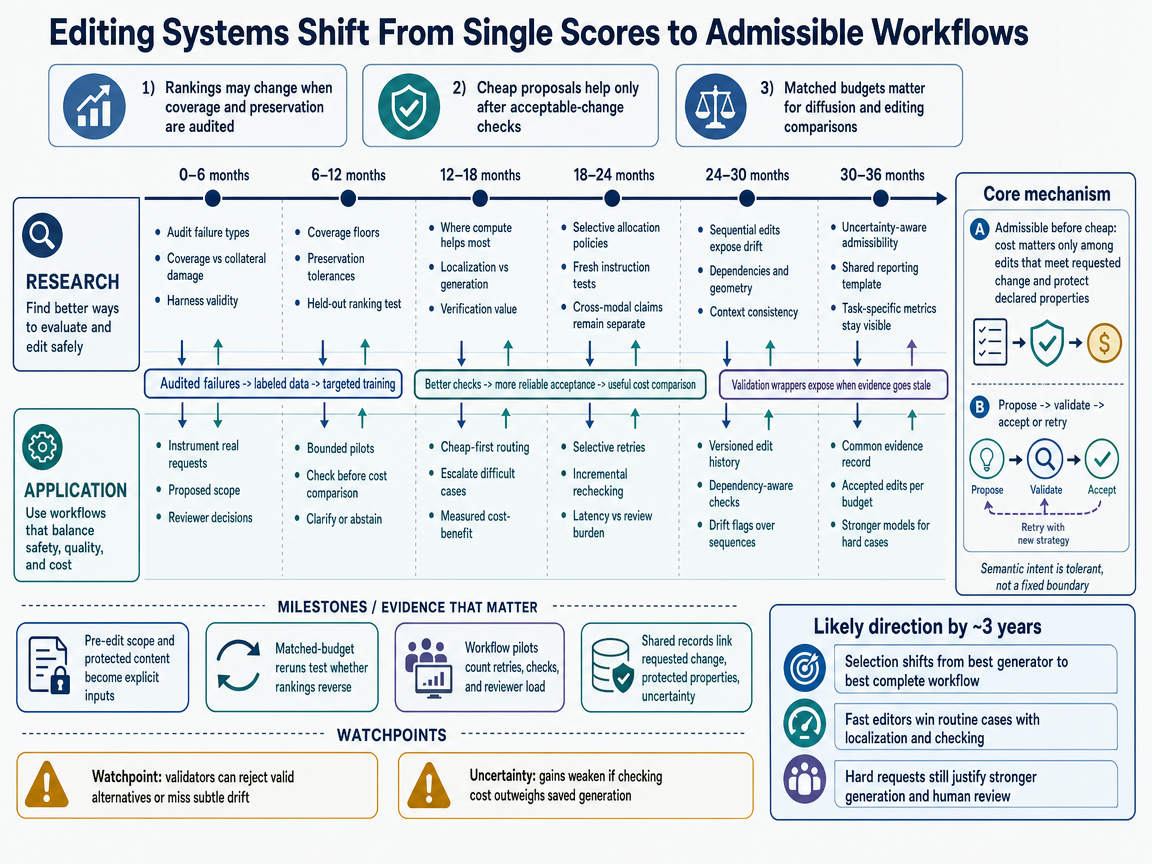
Over three years, the standard path moves from diagnosing isolated editing failures toward choosing workflows using evidence about accepted results and complete processing costs. The first-year starting point is the reported drop from 25. 4% success with supplied code-edit regions to 10. 6% with predicted regions, which makes localization a clear evaluation target. Researchers would separate missed changes from overly broad edits and damage to protected content, while checking whether generated tests wrongly reject valid alternatives. An early monitoring cue would be rankings on fresh requests that agree more closely with expert acceptance than the original aggregate score does.
The mechanism resembles electricity dispatch under operating constraints: using fewer resources helps only when the required work is completed without violating important limits. For editing, this means requiring adequate change coverage and preservation before comparing cost, while allowing related changes that the request genuinely requires. In year two, controlled studies could identify whether extra computation helps most with locating changes, generating them, or checking the results. That evidence could support inexpensive first attempts followed by selective escalation, while recurring failures become labeled examples that improve later training and evaluation.
By year three, researchers could test these policies across dependent editing sequences, where an initially acceptable change may create problems only after later revisions. Practical tools would retain histories and flag cumulative effects, while separate task-specific tests examine whether protected properties still hold after repeated changes. Around 36 months, a shared reporting template could connect each requested transformation to acceptance evidence and complete workflow cost, with uncertainty remaining visible. The likely outcome would be evidence-based workflow selection rather than one universally best generator, because difficult requests could still require stronger processing or human review. This path weakens if checking costs erase the gains or revised rankings fail to predict reviewer decisions; semantic intent cannot be treated as a fixed physical boundary.
The contender path makes acceptance an explicit step between generating an edit and applying it, rather than treating every returned output as ready to use. In year one, researchers would compare the same generator with and without validation, keeping code and visual tasks separate so that success in one does not imply transfer. The database-inspired mechanism retains the original artifact, checks a proposed change against protected properties, and accepts or rejects the result while preserving a recoverable local version. Its key monitoring cue is fewer harmful accepted changes at comparable instruction satisfaction and edit coverage, after counting all checking and retry costs.
In year two, the focus would shift to editing sequences and dependencies, meaning relationships outside the immediate change that the result still relies on. Tools could retain version histories and dependency records so that later edits trigger warnings when they make earlier validation evidence outdated or unreliable. Incremental validation would repeat only affected checks, allowing corrected or rejected edits to reveal missing dependencies and improve decisions about what needs checking next. This feedback loop matters only if reusing evidence lowers total processing cost while keeping cumulative damage under control, rather than merely moving effort into validation.
By year three, studies could test whether acceptance evidence remains useful after changing generators and whether application-specific checks can support longer sequences of dependent edits. Participating tools could trial common records linking requested changes to completed checks and unresolved uncertainty, allowing users to switch generators without losing the validation history. Fast generators could then provide inexpensive proposals, while rejected or uncertain changes receive stronger processing or human review instead of being silently accepted. Independent audits would still need to detect rules that reject valid alternatives or reward nearly unchanged outputs that fail to carry out the request. The path weakens if most edits invalidate earlier evidence or repeated sampling performs equally well at the same cost; the attainable result is better-supported acceptance, not a universal verifier.
The maybe path depends on a large buyer requiring editing tools to declare their intended scope before making changes, turning research diagnostics into a qualification requirement. In year one, researchers would distinguish missed regions from unnecessarily broad boundaries and incorrect edits, while visual studies separately measure requested changes and damage elsewhere. Editor prototypes would preview the proposed scope and record protected content, although user confirmation would not automatically make generated tests faithful to an ambiguous request. The mechanism resembles underground-utility protection: mark the work area before acting, use extra care near protected regions, and assess damage afterward rather than relying only on completion.
In year two, compatible records across at least two toolchains could connect declared regions with actual changes and turn reviewed failures into labeled training examples. Buyer requirements would therefore generate evidence that improves localization, while better evidence could make later qualification decisions more credible and easier to compare across tools. Researchers would still compare separate region-finding components with end-to-end systems, rather than assume that splitting the architecture necessarily produces better results or lower processing costs. A key monitoring cue would be whether passing scope checks predicts fewer real defects, including problems discovered well after an edit was initially accepted.
By year three, favorable audits could support limited unattended operation, such as batch code refactoring within approved modules or bounded image retouching with rollback and sampled review. Longer-running defect records would test whether the original preservation measures remain useful as tools perform more edits and hidden effects have more time to appear. Around 36 months, a shared change-control framework could emerge, but only where declared boundaries remain testable against user intent and checks detect meaningful collateral harm. Oversized declared regions would be a warning sign, because allowing an entire artifact to be changed could make scope compliance easy without making the edit safer. If buyers abandon scope requirements after unsuccessful pilots, or end-to-end systems solve localization without declarations, technical diagnostics could still improve but this requirement-driven feedback loop would weaken.
1-Year / 3-Year Research-Application Infographic
References
- Suppress Content Shift: Better Diffusion Features via Off-the-Shelf Generation Techniques - Authors: Benyuan Meng, Qianqian Xu, Zitai Wang, Zhiyong Yang, Xiaochun Cao, Qingming Huang / <See Details on Fugu-MT> / License: CC-BY-4.0
- MADI: Masking-Augmented Diffusion with Inference-Time Scaling for Visual Editing - Authors: Shreya Kadambi, Risheek Garrepalli, Shubhankar Borse, Munawar Hyatt, Fatih Porikli / <See Details on Fugu-MT> / License: CC-BY-4.0
- EDIT-Bench: Evaluating LLM Abilities to Perform Real-World Instructed Code Edits - Authors: Wayne Chi, Valerie Chen, Ryan Shar, Aditya Mittal, Jenny Liang, Wei-Lin Chiang, Anastasios Nikolas Angelopoulos, Ion Stoica, Graham Neubig, Ameet Talwalkar, Chris Donahue / <See Details on Fugu-MT> / License: CC-BY-4.0
- How Should Diffusion Language Models Edit Code? - Authors: Xijia Tao, Ziru Liu, Shansan Gong, Jiacheng Ye, Kecheng Chen, Zirui Wu, Lin Zheng, Xinyu Fu, Rui Liu, Lingpeng Kong / <See Details on Fugu-MT> / License: CC BY 4.0
- Distribution Matching Distillation for Continuous Diffusion Language Models - Authors: Paul Le Van Kiem, Dario Shariatian, Umut Simsekli, Alain Durmus / <See Details on Fugu-MT> / License: CC BY 4.0