Summary
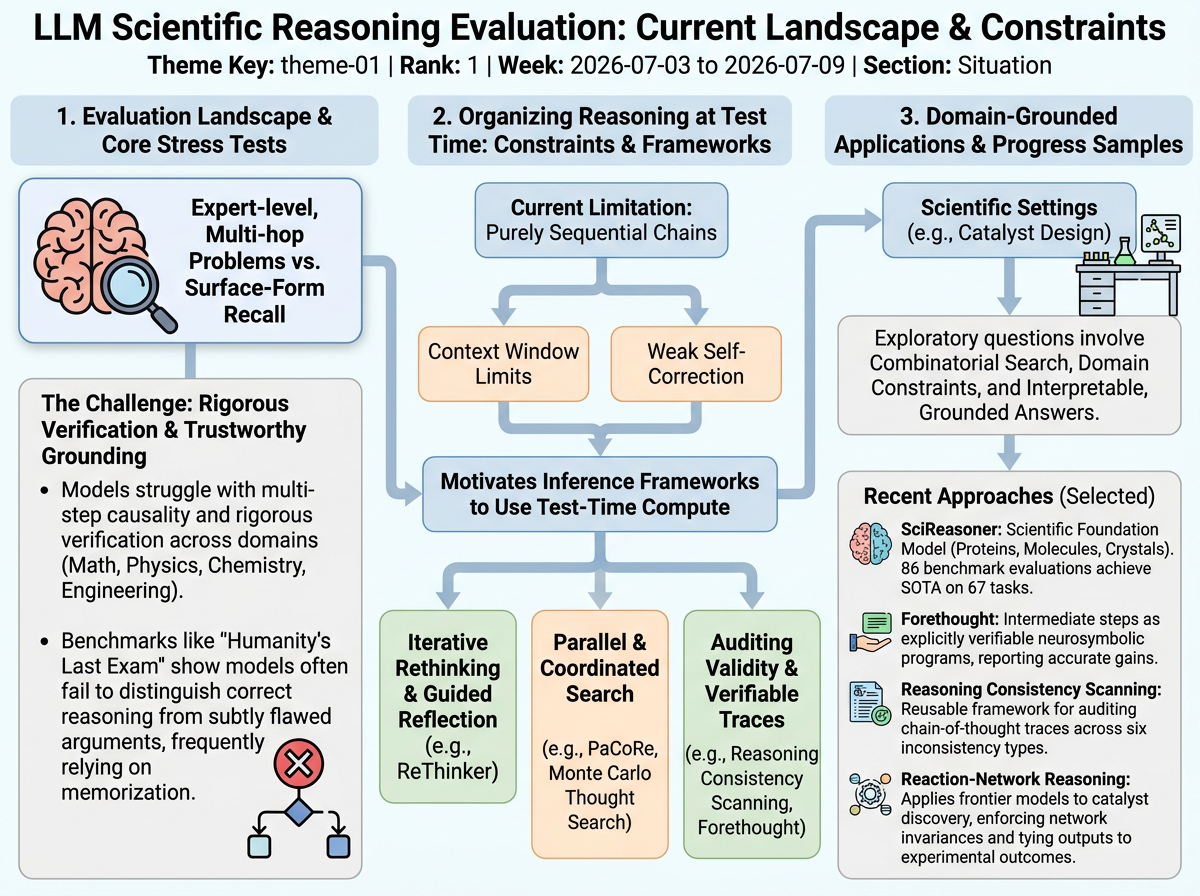
This theme centers on scientific reasoning as a demanding evaluation setting for LLMs, where models are tested on expert-level, multi-step problems rather than surface-form recall. The main concern is that current models still struggle with rigorous verification, long-horizon coordination, and trustworthy domain-specific reasoning, motivating inference frameworks that add reflection, parallel search, and structured test-time compute.
Situation
Representative introductions frame scientific reasoning as a core stress test for large language models because it requires quantitative rigor, multi-hop causal inference, and the integration of domain knowledge across fields such as mathematics, physics, chemistry, and engineering. Benchmarks like Humanity's Last Exam expose a recurring gap: models may appear strong at first glance yet often fail to distinguish correct reasoning from subtly flawed arguments, raising concerns that apparent performance reflects memorization rather than principled deduction.
A second recurring theme is that stronger evaluation increasingly depends on how reasoning is organized at test time. Single-pass or purely sequential chains are limited by context windows and weak self-correction, motivating iterative rethinking, guided reflection, confidence control, or coordinated parallel reasoning to better use additional compute. In application-oriented scientific settings such as catalyst design, the same motivation appears in another form: exploratory scientific questions involve combinatorial search, domain-specific constraints, and the need for answers that are specific, interpretable, and grounded in scientific concepts.
Infographic (English)
Progress
Accurate, Interdisciplinary and Transparent Structure-property Understanding with Deep Native Structural Reasoning <See Details on Fugu-MT>
Accurate, Interdisciplinary and Transparent Structure-property Understanding with Deep Native Structural Reasoning: SciReasonerは、タンパク質、小さな分子、無機結晶をまたいだ自然構造推論のための科学基盤モデルである。 SciReasonerは座標、トポロジ、周期接続性を統一された構造対応語彙に識別する。 86のベンチマークで、SciReasonerは67のタスクで最先端のパフォーマンスを達成する。 It connects to Model Evaluation / LLM through the paper's concrete task, method, evidence, or application setting.
Forethought: Verifiable Reasoning from Neurosymbolic Primitive Programming <See Details on Fugu-MT>
Forethought advances LLM reasoning by casting intermediate steps as explicit, verifiable neurosymbolic programs. Compared with prior reflection-style test-time methods, it shifts from heuristic self-correction to directly checkable reasoning traces, reporting roughly 30% accuracy gains over the base model.
Reasoning Consistency Scanning: A Framework for Auditing Chain-of-Thought Validity in AI Safety Evaluations <See Details on Fugu-MT>
Reasoning Consistency Scanning provides a reusable method for auditing whether chain-of-thought traces are internally consistent across tasks and models. Beyond aggregate benchmark scoring, it introduces a six-type inconsistency taxonomy and a validated benchmark showing that reasoning flaws are detectable and vary systematically across models and task types.
Reaction-network reasoning with frontier models for experimentally confirmed catalyst-selectivity hypotheses <See Details on Fugu-MT>
This work applies frontier language models to catalyst discovery by extracting experimentally testable selectivity hypotheses from reaction networks. It enforces network invariances within a human-AI co-reasoning framework and ties model outputs to experimentally confirmed chemistry outcomes, going beyond earlier generic discussions of domain-grounded reasoning.
Outlook
Outlook Summary
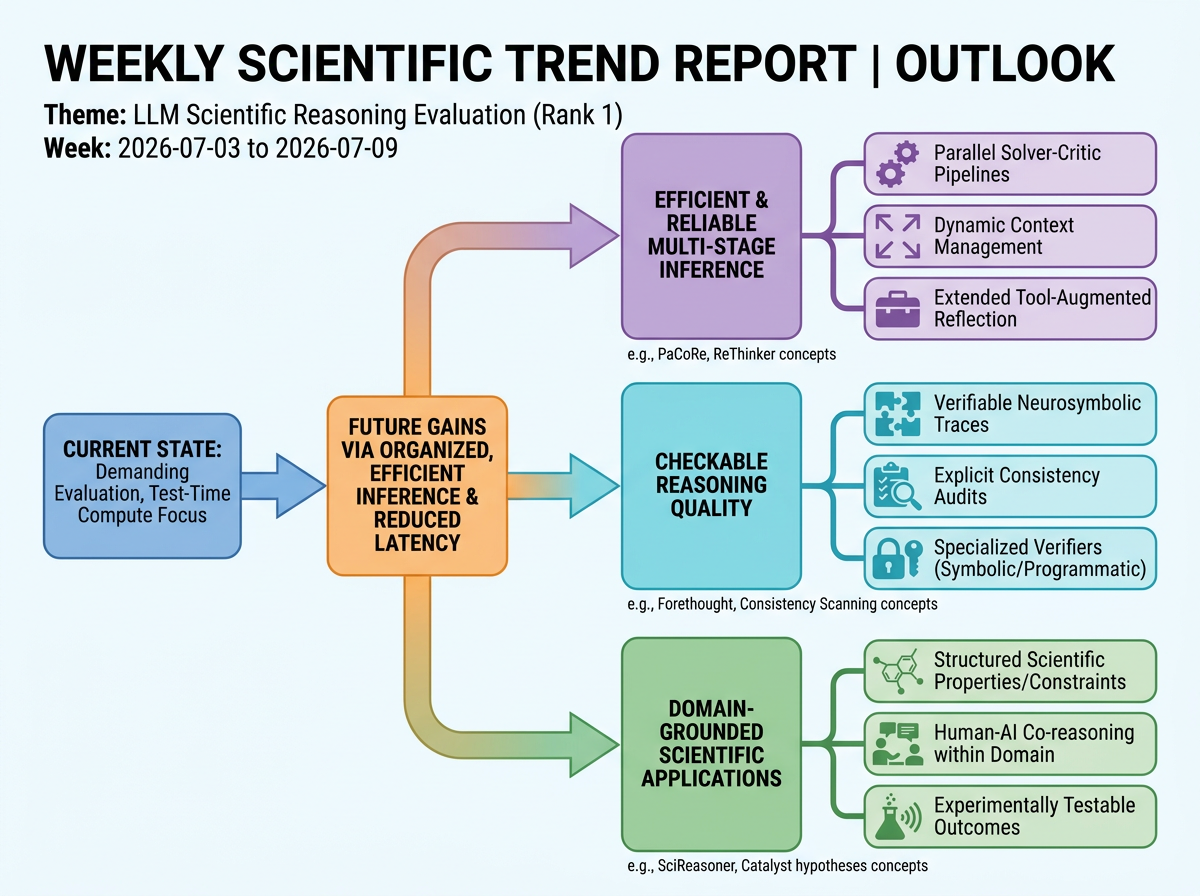
Near-term evaluation of scientific reasoning will focus on making multi-stage inference faster, more reliable, and easier to check. Systems will organize test-time computation through parallel solver–critic work, better context management, and specialized verifiers such as symbolic or programmatic checkers. Evaluation will increasingly inspect intermediate validity and consistency, linking model outputs to scientific constraints or testable outcomes rather than judging final answers alone.
Infographic (English)
Three-Year Movement
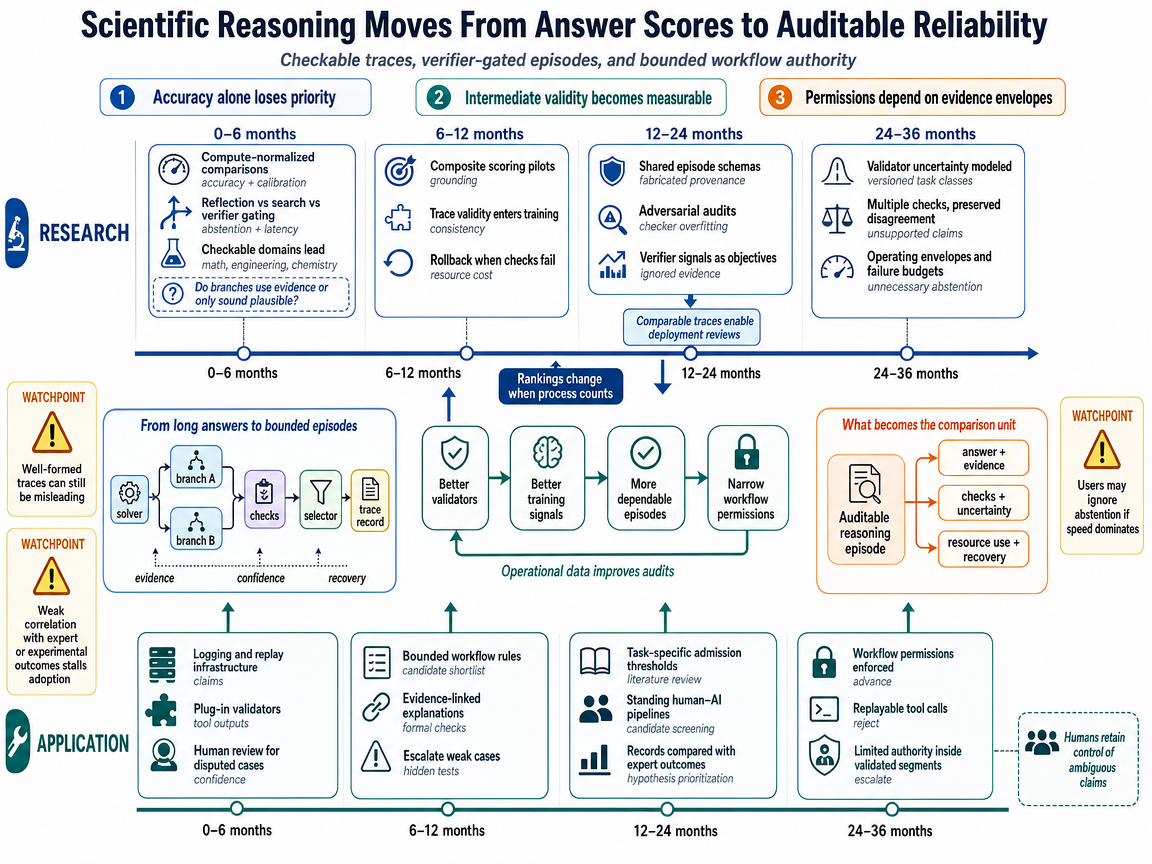
The standard path begins with scientific-reasoning systems organizing test-time work more carefully while making their reasoning easier to inspect. In the first year, composite evaluations will compare systems under similar computation limits and measure accuracy, checker pass rates, and latency. Research copilots will record claims, tool results, and correction steps so reviewers can see how an answer developed. Early use will remain narrow, with weakly supported or contradictory cases sent to scientists rather than handled automatically.
In the second year, the approach should expand if these measures agree with expert reviews or experimental results. Verifier outputs and calibrated abstention will become training signals instead of being used only after an answer is produced. Shared episode formats will support comparisons across systems, while adversarial testing will look for fabricated evidence and overfitting to checkers. Organizations will use accumulated records to define evidence envelopes, meaning the conditions within which a system has shown dependable behavior for a specific task.
By the third year, validators will themselves be treated as uncertain because databases can be incomplete and scientific predictors can be wrong. Systems will combine multiple checks, preserve disagreements, and revise conclusions when delayed evidence arrives. Benchmarks may then report versioned operating envelopes and acceptable failure limits rather than a single overall score. The mechanism resembles airworthiness testing: reaching a good result is insufficient unless critical procedures and failure responses also pass inspection. A key monitoring cue will be whether evaluation measures continue to predict expert judgments and real experimental outcomes. If they do, qualified systems may advance, reject, or escalate cases within narrow workflow segments, while people retain authority over ambiguous conclusions. The path would weaken if rankings remain unchanged, audit records are easily gamed, or users routinely ignore appropriate abstention. Even under success, these systems would validate bounded processes rather than certify general scientific truth, which is often disputed and slow to establish.
The contender path centers on standardized “trace containers,” which are bounded records of intermediate reasoning that other models or tools can read and check. This mechanism aims to reduce the cost and information loss created when work passes between reasoning stages. In the first year, researchers will test whether components can be exchanged across systems and whether compressed traces preserve decisive evidence. Evaluation will also examine whether a trace faithfully reflects the process or merely explains an answer after it was chosen.
Reusable checking infrastructure should develop alongside these tests. Common interfaces could connect code checkers, symbolic tools, and scientific predictors without requiring a custom integration for every system. Training may reward trace validity and constraint satisfaction as well as answer correctness. Narrow scientific pilots will provide an important monitoring cue: filtered proposals should produce confirmed improvements over otherwise similar unfiltered outputs.
In the second year, progress depends on major benchmarks scoring intermediate validity alongside final answers. If that happens, a small number of compatible formats may consolidate, much as standardized containers allow different transport systems to handle the same cargo. Wider format support would attract more verifiers, and stronger verifier coverage would make the formats more useful. By the third year, the likely result is a layered stack with interchangeable reasoning modules, specialized verifier registries, and replayable tool records. Research would extend these methods from strong early domains into materials science and engineering, while human review would remain necessary for claims that cannot be mechanically checked. Final-answer-only reporting may then be regarded as incomplete within serious scientific evaluations.
The main caveat is that reasoning traces are not passive cargo. Models can adapt to inspection rules and produce well-formed but misleading records, while compression can silently remove crucial evidence. The scenario would weaken if cross-system component swaps consistently underperform integrated designs, leading benchmarks reject trace scoring, or audit success fails to track scientific correctness.
The maybe path turns organized and checkable reasoning into a managed quality-assurance service. A research-computing group or specialist provider would operate the complete pipeline rather than offering only a standalone model. In the first year, researchers would compare full workflows under fixed limits on time, context, and computation. Early services would focus on bounded tasks such as quantitative derivations, reaction analysis, or engineering calculations, where at least part of the work can be checked.
Each service would define a task card that explains its supported scope, validation process, and conditions for human intervention. A reproducibility bundle would connect an output to sources, executed code, and checker results. This infrastructure should make system upgrades easier to audit and reduce unnecessary expert review. A useful monitoring cue would be whether the service prevents invalid proposals from reaching costly experiments or saves enough review time to offset its operating cost.
In the second year, successful institutions would compare services through shared task definitions and evidence formats. Sealed proficiency problems would test whether a workflow remains dependable after changes to a model, database, or verifier. The mechanism resembles laboratory accreditation because tools are tracked, valid operating ranges are defined, and exceptions are assigned to accountable experts. Each processed case would also provide failure data that could improve later routing and reduce review effort.
By the third year, qualified services could connect directly to laboratory systems, scientific databases, and secure computing environments. Routine outputs that satisfy a narrow task card might proceed automatically, while disagreements and unsupported questions would enter expert queues. Different assurance levels could separate exploratory work from outputs intended for consequential use, with portable records supporting independent review. Monitoring would ask whether proficiency results predict experimental outcomes and whether updated systems can be requalified without excessive delay. The scenario would weaken if users continue to prefer generic access, formally valid traces fail to improve decisions, or assurance costs do not reduce errors. Its central limitation is that process control cannot establish the truth of an original hypothesis when no prompt ground truth exists, so expert judgment and empirical testing remain essential.
1-Year / 3-Year Research-Application Infographic
References
- Monte Carlo Thought Search: Large Language Model Querying for Complex Scientific Reasoning in Catalyst Design - Authors: Henry W. Sprueill, Carl Edwards, Mariefel V. Olarte, Udishnu Sanyal, Heng Ji, Sutanay Choudhury / <See Details on Fugu-MT> / License: CC-BY-4.0
- PaCoRe: Learning to Scale Test-Time Compute with Parallel Coordinated Reasoning - Authors: Jingcheng Hu, Yinmin Zhang, Shijie Shang, Xiaobo Yang, Yue Peng, Zhewei Huang, Hebin Zhou, Xin Wu, Jie Cheng, Fanqi Wan, Xiangwen Kong, Chengyuan Yao, Kaiwen Yan, Ailin Huang, Hongyu Zhou, Qi Han, Zheng Ge, Daxin Jiang, Xiangyu Zhang, Heung-Yeung Shum, / <See Details on Fugu-MT> / License: CC-BY-4.0
- ReThinker: Scientific Reasoning by Rethinking with Guided Reflection and Confidence Control - Authors: Zhentao Tang, Yuqi Cui, Shixiong Kai, Wenqian Zhao, Ke Ye, Xing Li, Anxin Tian, Zehua Pei, Hui-Ling Zhen, Shoubo Hu, Xiaoguang Li, Yunhe Wang, Mingxuan Yuan, / <See Details on Fugu-MT> / License: CC-BY-4.0