Summary
This week's benchmarking work in affective AI addresses the need for evaluation resources that better reflect the complexity of human emotion. Representative papers argue that current assessments are often too shallow, too small, or too narrow in modality, and respond by introducing cognitively grounded benchmarks and larger multimodal datasets for emotion reasoning, remote physiological sensing, and micro-expression recognition.
Situation
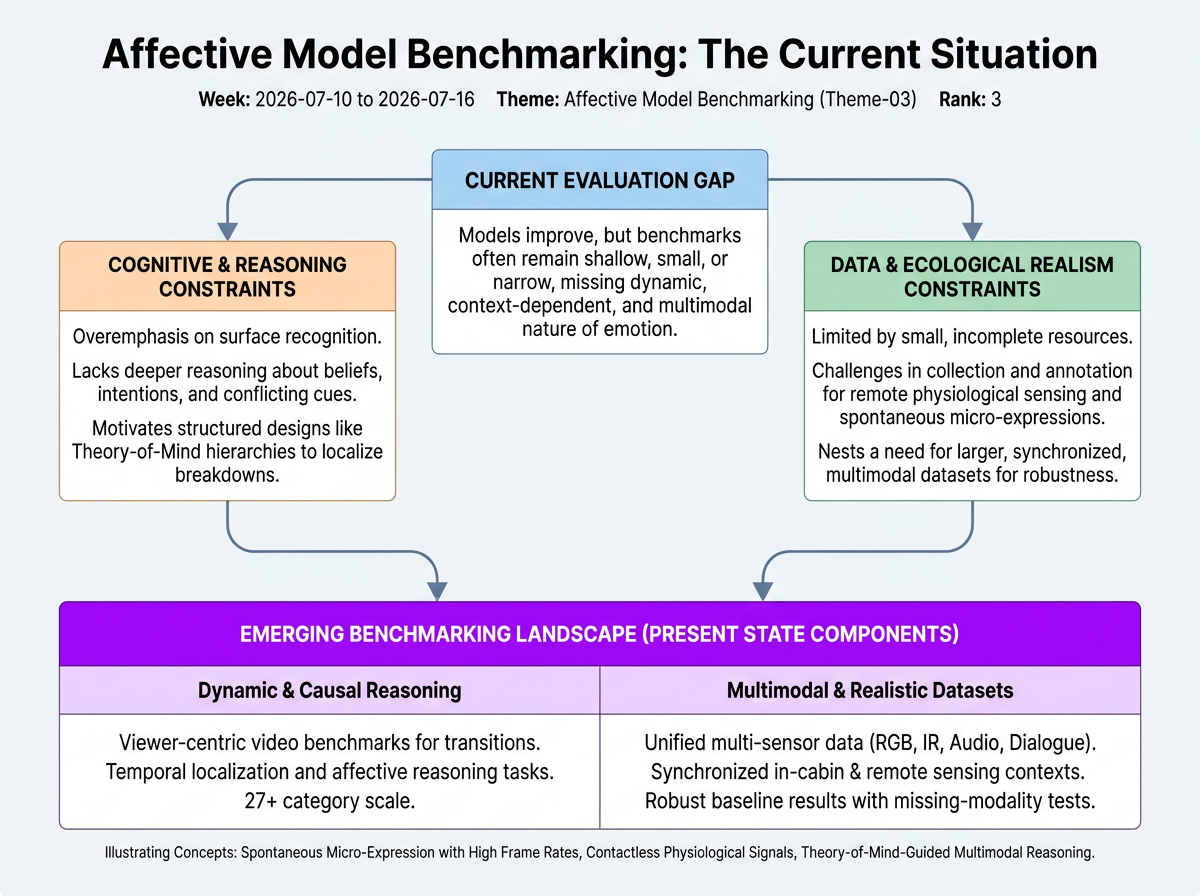
Representative introductions describe a common evaluation gap in affective computing: models have improved, but the benchmarks used to judge them often miss the dynamic, context-dependent, and multimodal nature of emotion. In multimodal large language models, existing emotion evaluations overemphasize surface-level recognition and provide only coarse scores, making it hard to diagnose failures in deeper reasoning about beliefs, intentions, and conflicting cues. This motivates more structured benchmark design, such as Theory-of-Mind-based hierarchies intended to localize where emotional reasoning breaks down.
A parallel pressure comes from data scarcity and ecological realism in benchmark construction. Dataset papers emphasize that emotion recognition remains limited by small or incomplete public resources, especially for remote physiological sensing and spontaneous micro-expressions, where collection and annotation are difficult. Current benchmarking is therefore expanding toward larger, synchronized, multimodal, and more realistic datasets that can support stronger baseline comparisons and more faithful evaluation of robustness in real-world affective settings.
Infographic (English)
Progress
Benchmarking Dynamic Affective Reasoning: A Viewer-Centric Video Emotion Dataset <See Details on Fugu-MT>
Introduces a large viewer-centric video benchmark for dynamic emotion transitions and causal reasoning across 27 categories. Unlike prior coarse static evaluations, it provides annotated emotion segments with tasks for both temporal localization and affective reasoning.
InCarEmo: A Multimodal Dataset for In-Cabin Emotion Recognition and Driver State Monitoring <See Details on Fugu-MT>
Presents a multimodal in-cabin dataset combining RGB, infrared video, audio, and dialogue text for emotion recognition and driver state monitoring. Compared with smaller or modality-limited benchmarks, it offers a unified evaluation with baseline results including missing-modality robustness tests.
Outlook
Outlook Summary
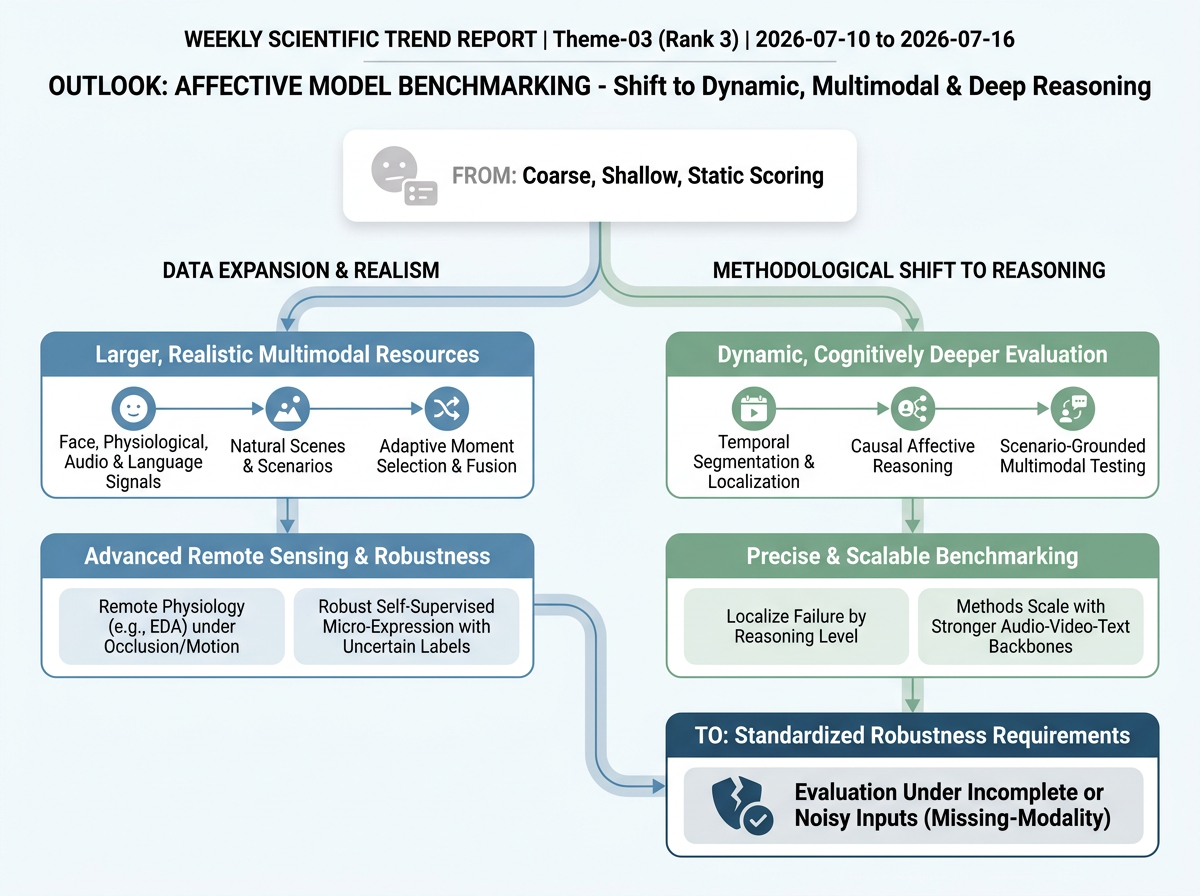
A likely next step is finer evaluation of dynamic, multimodal, and cognitively deeper affective reasoning. Benchmarks should test temporal changes, causal interpretation, and realistic scenarios rather than static recognition alone. Larger naturalistic datasets will combine behavioral and physiological signals, while methods improve signal fusion and remote sensing under motion or occlusion. Robustness to missing, noisy, and uncertain inputs is also likely to become a standard requirement.
Infographic (English)
Three-Year Movement
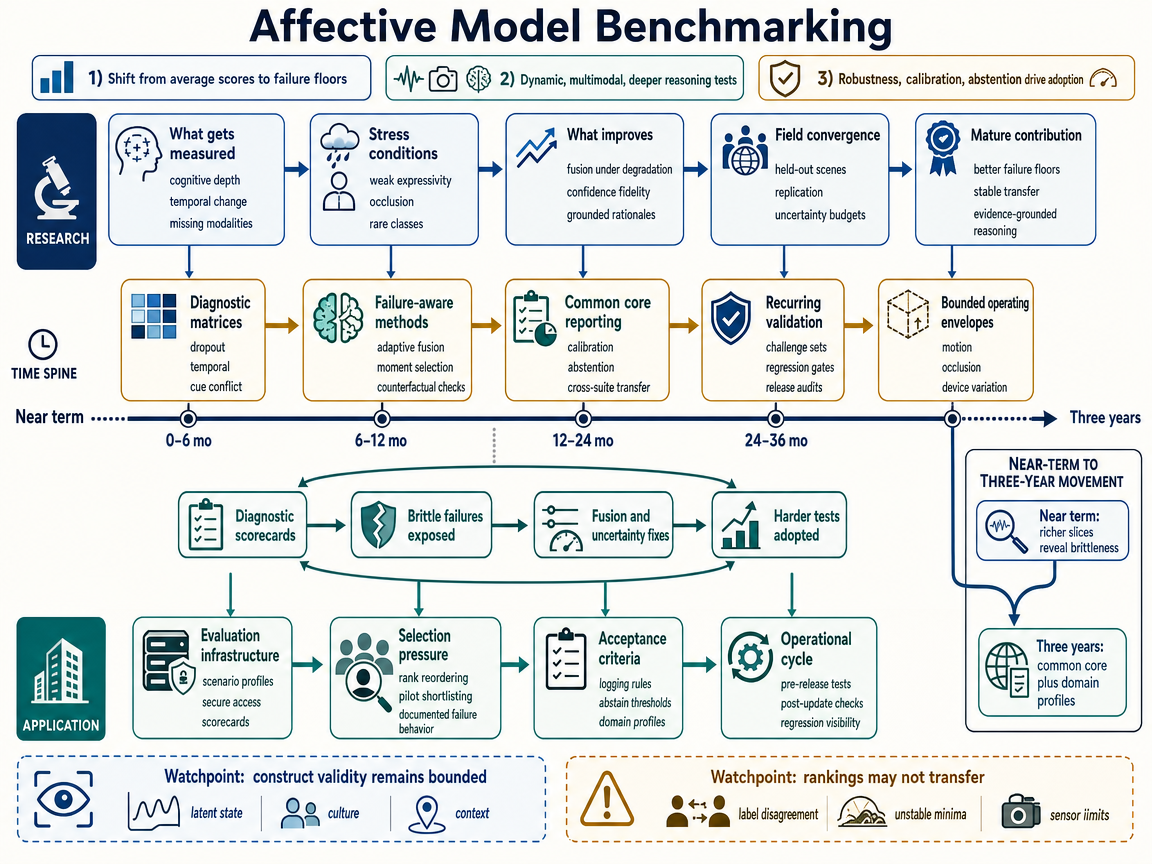
The field is moving from static emotion classification toward tests of dynamic behavior, multimodal evidence, and deeper social reasoning. In the first year, benchmark builders are likely to combine cognitive difficulty, temporal change, and degraded inputs into reusable test matrices. They will examine whether results transfer across datasets and remain statistically reliable for rare or difficult cases. Methods will then respond with adaptive fusion, which selects the most trustworthy available signals, and temporal selection, which focuses on informative moments. Calibration and abstention will also matter, because a system should express uncertainty or decline to answer when evidence is weak.
By the second year, successful diagnostic tests could converge into a compact common core. This core would measure reasoning depth, input corruption, and long-tail behavior, while held-out natural scenes would limit narrow tuning to public test sets. Remote physiological signals would be evaluated only under declared limits for motion, lighting, and device variation. Independent evaluators could use secure environments so that sensitive synchronized records do not need to be widely distributed.
By the third year, stress-profile evaluation could become a recurring part of model development and release validation. The central mechanism is that acceptance depends on performance in the weakest critical condition, not only on average accuracy. This gives developers a direct reason to repair failures exposed by missing inputs or difficult reasoning tasks. A key monitoring cue is whether diagnostic scores reorder leading models and are then used in real pilot selection. Separate tracks may emerge for sensing reliability and social reasoning, with application-specific profiles built on a shared reporting core. The main caveat is construct validity: facial behavior and physiological arousal can support an interpretation, but they do not reveal a person’s internal state directly. The path would weaken if rankings do not change, results fail to reproduce, or fluent explanations continue to receive credit without supporting evidence.
The near-term direction is toward finer tests of dynamic, multimodal, and cognitively deeper affective reasoning. In the first year, researchers would move beyond creating richer benchmarks and ask whether their measurements transfer across test suites. Shared tools could deliberately remove inputs, flag unreliable physiological estimates, and report confidence by condition. Small hard panels would include spontaneous episodes with ambiguous labels or conflicting cues. A strong monitoring cue would be repeated changes in model ranking when systems move from their original benchmark to these shared panels.
If those differences remain stable, the second year would bring recurring multi-site exercises. Several groups would evaluate the same reference cases independently and compare where their measurements disagree. Dataset releases would add clearer label documentation, temporal annotation rules, and signal-quality controls. Practical evaluation would focus on degraded inputs and uncertain natural behavior, while research tracks would retain harder causal and social-reasoning tasks. Application teams could then validate narrow alerts and fallback behavior instead of assuming that every affect prediction is equally dependable.
By the third year, audio-video-text models could receive multi-level reports that separate perception, understanding, and reasoning. Benchmark packages may include uncertainty budgets, cases that can be reviewed again, and transfer tests across different settings. The scenario mechanism is standardization before compounding: visible disagreement creates demand for reusable calibration tools, and widely used tools pressure other benchmark developers to improve comparability. Operational tests would guide sensor fusion, confidence thresholds, and withdrawal when evidence is incomplete. Compatible reports might support assurance workflows, but only for clearly defined use cases. The central caveat is that affect has no single external ground truth; self-report and observer interpretation can legitimately differ. This path would weaken if rankings remain stable without calibration, shared panels attract little participation, or users continue accepting coarse scores without incomplete-input testing.
The immediate opportunity is to turn new multimodal resources into repeatable tests for bounded in-cabin tasks, rather than claim general emotion understanding. During the first year, teams would separate direct perception, signal fusion, and higher-level reasoning into distinct tests. They would examine performance under obstructed cameras, missing audio, or conflicting behavioral cues. Physiological estimates and micro-expressions would remain supporting evidence rather than being treated as reliable in every setting. Protected test cases and explicit abstention measures would help determine whether model rankings survive changes in sensors, sites, or annotation practices.
Early application work would center on internal system-comparison tools. Teams could replay degraded sensor conditions and define a robustness envelope, meaning the conditions under which a system’s output remains usable. Changes to hardware or models would then trigger selected regression tests. The scenario mechanism resembles an interconnection code: a component must pass declared contingency tests before entering a safety-relevant system that depends on several sensors. Pilot failures could become protected benchmark cases, which would shape later remediation and acceptance tests.
By the second year, researchers and system integrators could align terminology, report formats, and definitions for common failure conditions. Independent laboratories or managed services might maintain protected challenge sets and produce traceable condition-level records. By the third year, continued alignment among major users could turn these practices into shared procurement clauses covering robustness, uncertainty, and retesting. Separate gates for sensing, fusion, and social reasoning would stop a persuasive explanation from concealing weak direct perception. A key monitoring cue is whether at least two major users adopt compatible scorecards and an independent provider runs reproducible tests. Under those conditions, the suite could become a de facto code for in-cabin affect-capable components, with limited transfer to other multimodal systems. The caveat is that affect labels lack physical invariants, so passing can show repeatable behavior only under declared conditions. The path should be downgraded if repeatable dropout tests are not operational by the end of year one, rankings remain unstable, or privacy constraints prevent controlled replay.
1-Year / 3-Year Research-Application Infographic
References
- More is Better: A Database for Spontaneous Micro-Expression with High Frame Rates - Authors: Sirui Zhao, Huaying Tang, Xinglong Mao, Shifeng Liu, Hanqing Tao, Hao Wang, Tong Xu and Enhong Chen / <See Details on Fugu-MT> / License: CC-BY-4.0
- CAST-Phys: Contactless Affective States Through Physiological signals Database - Authors: Joaquim Comas, Alexander Joel Vera, Xavier Vives, Eleonora De Filippi, Alexandre Pereda, Federico Sukno, / <See Details on Fugu-MT> / License: CC-BY-4.0
- Unveiling the Cognitive Compass: Theory-of-Mind-Guided Multimodal Emotion Reasoning - Authors: Meng Luo, Bobo Li, Shanqing Xu, Shize Zhang, Qiuchan Chen, Menglu Han, Wenhao Chen, Yanxiang Huang, Hao Fei, Mong-Li Lee, Wynne Hsu, / <See Details on Fugu-MT> / License: CC-BY-4.0