Summary
This theme centers on evaluating LLM-based coding agents on realistic software-engineering tasks, especially repository-level issue resolution. Representative work argues that benchmark progress now depends not only on whether a final patch passes tests, but also on how agents retrieve context, iterate through execution feedback, select among candidates, and handle errors or unnecessary edits accumulated during the solving process.
Situation
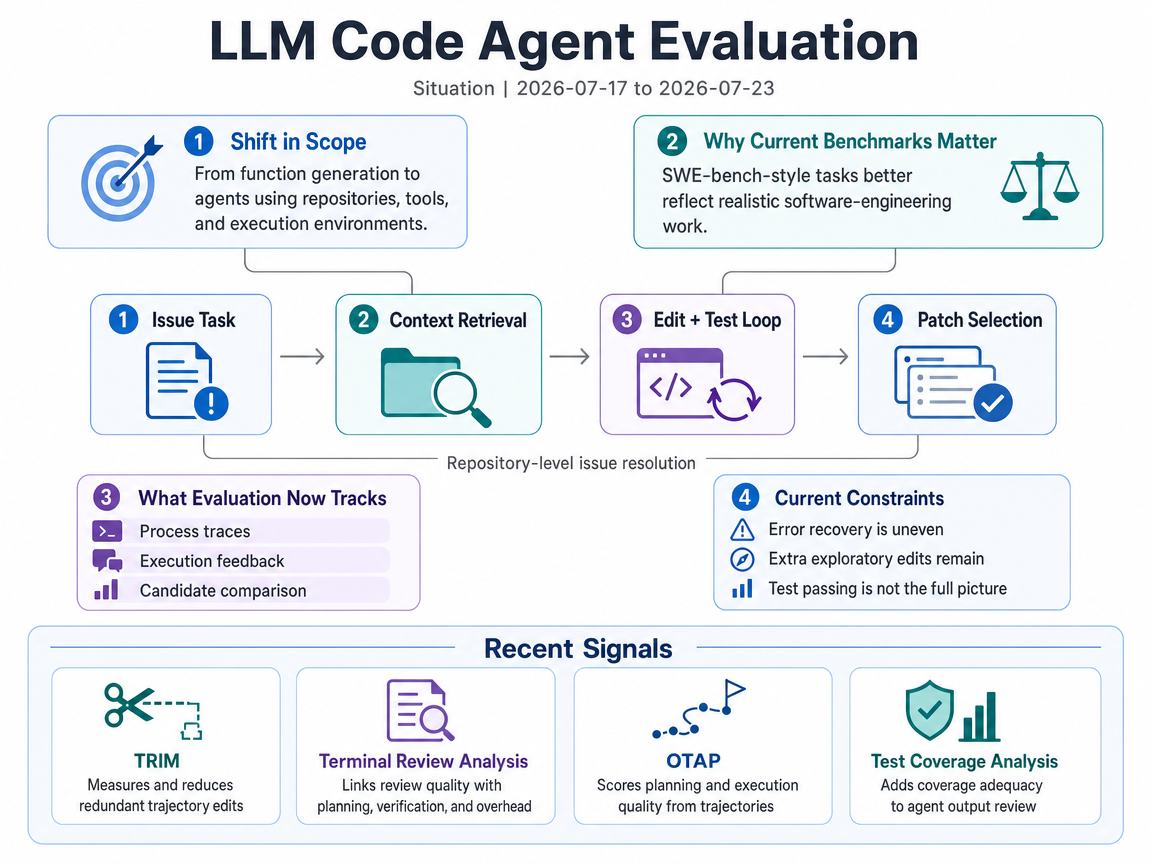
LLM-based software engineering has moved beyond simple function generation toward agentic systems that interact with repositories, tools, and execution environments to resolve real GitHub issues. Representative work frames SWE-bench-style tasks as a more realistic evaluation setting and highlights core stages such as codebase context retrieval, iterative edit-and-test generation, and final selection among candidate patches.
At the same time, the literature argues that evaluation based only on final outputs gives an incomplete picture of agent capability. Process-oriented evidence from solving trajectories and testing logs is gaining importance because agents often succeed or fail through repeated debugging, adaptation, and error recovery, and even test-passing patches may retain unnecessary exploratory edits that make them harder to review and maintain.
Infographic (English)
Progress
TRIM: Reducing AI-Generated CodeSlop via Agent Trajectory Minimization <See Details on Fugu-MT>
TRIM traces oversized agent-generated patches back to the search trajectory itself and applies hierarchical counterfactual minimization to remove redundant edits. Compared with evaluating only final patches, it makes trajectory-level code bloat a concrete and measurable quality target for coding agents.
Agentic Code Review in the Terminal: A Trajectory-Level Analysis of Behavior, Cost, and Human-Alignment <See Details on Fugu-MT>
This work evaluates terminal-based code review agents at the trajectory level, relating review quality to behavior, cost, and human alignment. Compared with performance-only assessments, it shows that successful reviews depend on stronger planning and downstream verification but incur investigation overhead.
Otap:Structure-Aware Optimal Transport for Evaluating Planning and Execution in Agent Trajectories <See Details on Fugu-MT>
OTAP introduces an optimal-transport-based trajectory metric that scores agent planning and execution by distance to valid solution graphs. Compared with binary success flags or exact-match evaluation, it captures process quality in a dependency-aware, reordering-invariant manner.
Test Coverage Analysis of Agentic Pull Requests <See Details on Fugu-MT>
This study analyzes test coverage of 4,882 agent-generated pull requests across five coding agents to assess whether generated code is adequately tested. Compared with patch-level success metrics, it adds test coverage adequacy as a practical quality dimension for reviewing agent outputs.
Outlook
Outlook Summary
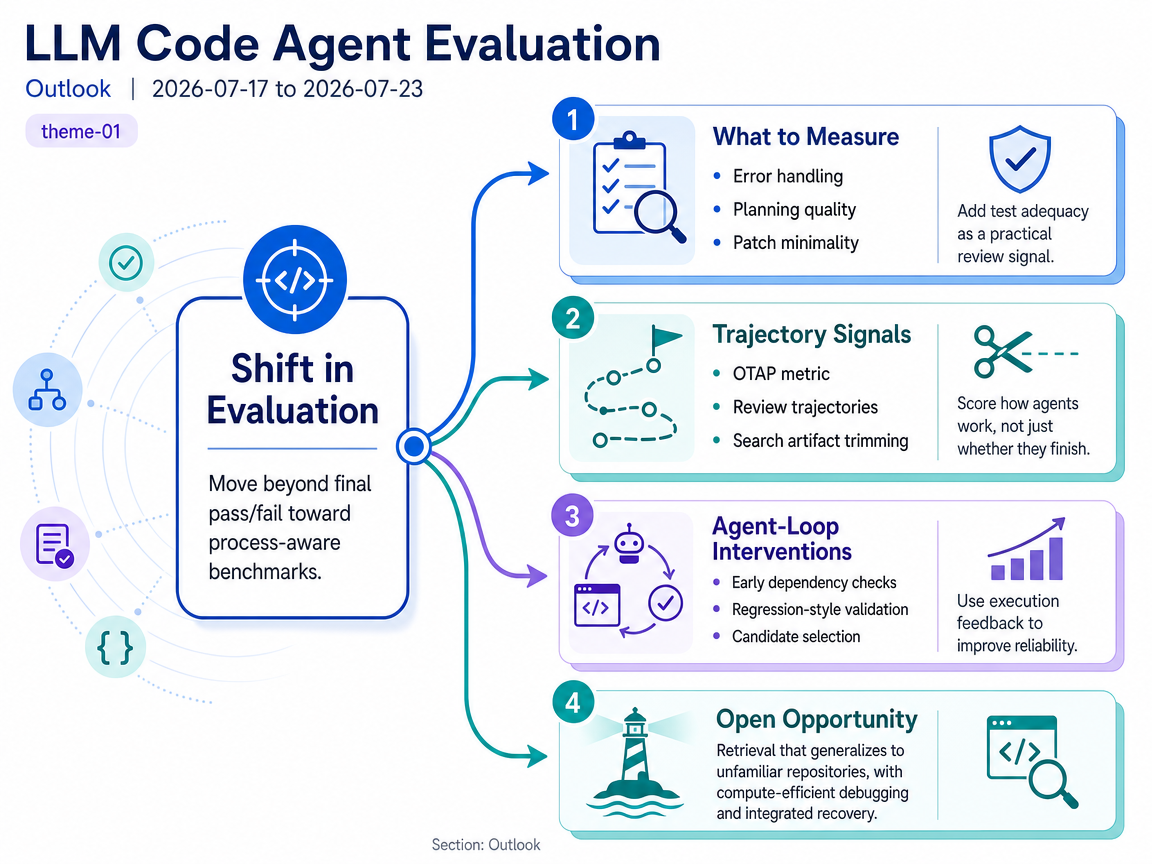
LLM code-agent evaluation will likely move beyond final pass or fail toward process-aware benchmarks. These will measure error handling, planning quality, and test adequacy while also detecting unnecessary patch changes. Recent work on trajectories, review behavior, and pull-request coverage supports this shift. Evaluation should also guide the agent while it works through earlier technical checks, stronger regression validation, and execution-based candidate selection. Progress will depend on retrieval that transfers to unfamiliar repositories and debugging methods that use limited computing resources effectively.
Infographic (English)
Three-Year Movement
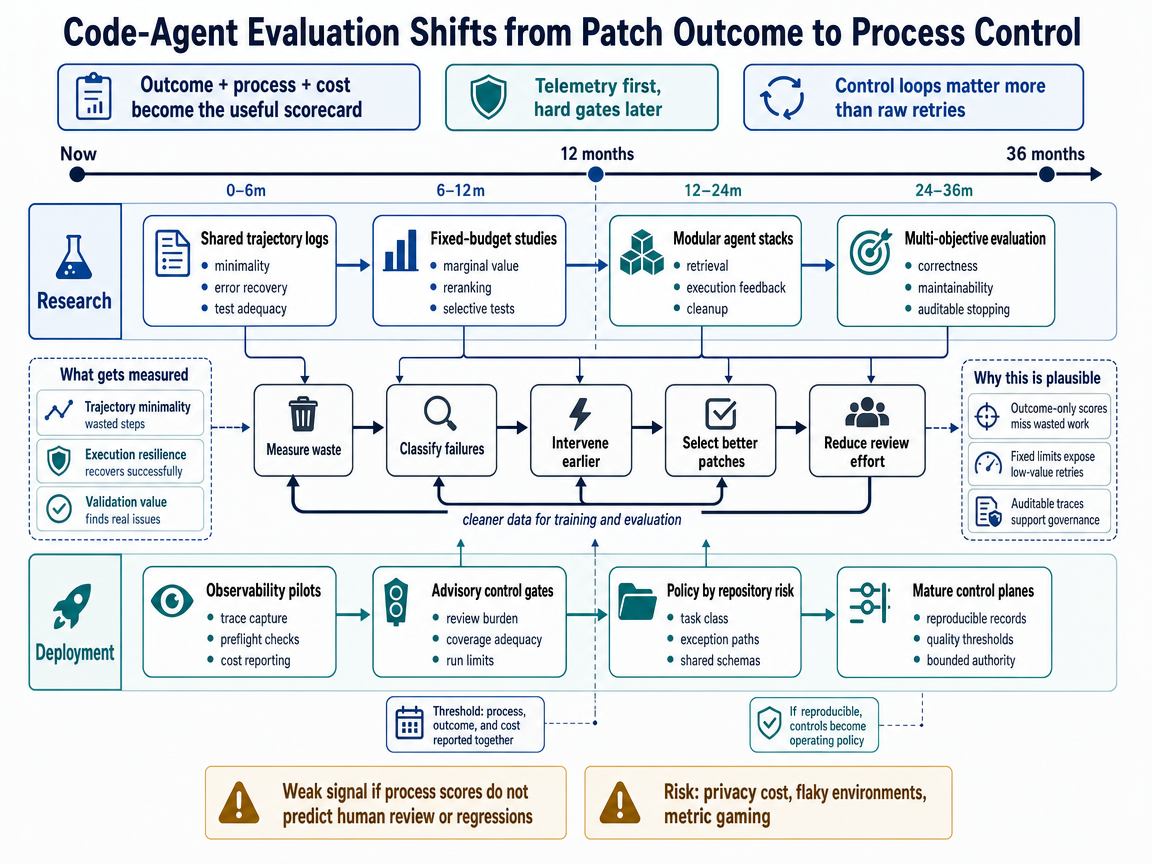
Over three years, code-agent evaluation could develop into a lean statistical process-control system. Instead of judging only the final patch, evaluators would measure planning, recovery from execution errors, and test adequacy. They would also identify wasted steps and unnecessary changes. The mechanism resembles a production line: the trajectory is the production path, execution failures are defects, and candidate selection is a quality gate.
In the first year, trajectory records should become more common and comparable. Studies would report process quality, final results, and resource use together. Dependency checks, static analysis, and targeted regression tests would be tested as early interventions. Stronger experiments would use several task suites and fixed limits rather than assume that more generated tests always improve quality. The main test is whether these measures predict later regressions and human review effort after task difficulty is considered.
In the second year, reproducible measures could support a modular agent loop. Retrieval, execution feedback, and selective test generation could become separate components connected by shared trajectory records. Organizations could then adjust quality gates to repository risk and run tests only when they provide useful evidence. By the third year, these components could form mature control planes that optimize software quality, operational efficiency, and human review burden. Internal rules could require reproducible traces, bounded runs, and checks that the execution environment is trustworthy. Better measurements would enable earlier intervention, while cleaner trajectories would improve later evaluation and system development.
A strong monitoring cue would be leading evaluations routinely publishing process quality, outcomes, and resource use in the same results. Falling redundant-edit rates and lower review effort would provide further support. The scenario weakens if trajectory scores do not predict real regressions, organizations cannot retain traces safely, or short high-quality solutions gain little from added controls.
Over three years, code-agent evaluation could become a resource-aware control discipline. Final patch success would remain important, but evaluators would also measure repository retrieval, error handling, and review burden. The scenario uses the mechanism of electricity-grid demand response. Agent runs are variable loads, repeated execution creates demand peaks, and evaluation systems act as operators that reduce low-value work when capacity is constrained.
During the first year, research would add resource telemetry to benchmark results. Common measures could include elapsed time, environment starts, and test invocations. Studies would ask whether each extra retry or candidate produces enough improvement to justify continued work. Repository maps, preflight checks, and cached retrieval would be evaluated as ways to prevent long unproductive runs. Early practical systems would emphasize visibility through dashboards and advisory limits rather than hard blocking. Runs might be paused when repeated failures or unchanged test results show little expected benefit.
In the second year, credible fixed-budget comparisons could lead to shared accounting rules. Researchers would need consistent treatment of cached context, failed setup, and shared infrastructure. Common trajectory formats would make it easier to compare complete agent systems rather than models alone. Workflow platforms could then connect traces to task type and repository risk, allowing controls to vary with the likely consequences of failure. By the third year, evaluation suites could test whether an agent should start, continue, or escalate under a defined resource limit. Routine tasks could enter low-resource lanes, while complex changes would receive larger limits or human handling. Common checks could support assurance of trace completeness, effective error handling, and minimal patches.
A key monitoring cue is whether major evaluations begin showing the value added by each extra test, retry, or candidate. That evidence would encourage wider use of targeted validation and stopping rules. The scenario weakens if comparable resource telemetry remains rare, process measures fail to predict maintainability, or reliable low-turn agents make load reduction unnecessary.
Over three years, code-agent process measures could become retained assurance records for governed software development. Evaluation would still check whether a patch works, but it would also preserve evidence about retrieval, error recovery, and validation. The mechanism resembles hazard analysis and critical control points, or HACCP, which monitors important stages of production rather than testing only the finished result. For an agent, critical points could include repository retrieval, error recovery, and patch validation, while the trajectory log becomes the audit record.
In the first year, research would build common measures and test whether they predict maintainability or human review effort beyond pass or fail. Practical pilots would record tool activity, validation evidence, and change provenance. Workflow systems might add advisory gates for unresolved errors or inadequate validation. The first major threshold would be an influential organizational template or independent assessment that connects eligibility to process evidence. General logging alone would not meet this threshold unless it clearly measured agent behavior and patch quality.
In the second year, a standards group or industry consortium could define shared trajectory formats and critical control points. Studies using unfamiliar repositories would test whether the evidence transfers beyond known public tasks. Tool providers could respond with deterministic replay, earlier checks, and clearer candidate-selection records. This would create a feedback loop in which evidence requirements improve instrumentation, and better instrumentation allows more precise requirements.
By the third year, the central problem would be resistance to gaming. Unlike a physical measurement, an adaptive agent may learn to produce a clean-looking trace without producing a better patch. Research would therefore add adversarial tests, randomized checks, and causal tests of whether generated validation provides real evidence. If those defenses work, process-assured agents could become common in governed software supply chains, while other agents remain available for experimental or lower-risk tasks. A useful monitoring cue is the appearance of an independent assessment that links process measures to deployment eligibility. The scenario weakens if those measures fail to predict quality, trajectory records cannot be retained safely, or standards fragment into incompatible checklists.
1-Year / 3-Year Research-Application Infographic
References
- CodeMonkeys: Scaling Test-Time Compute for Software Engineering - Authors: Ryan Ehrlich, Bradley Brown, Jordan Juravsky, Ronald Clark, Christopher Ré, Azalia Mirhoseini, / <See Details on Fugu-MT> / License: CC-BY-4.0
- Unveiling Pitfalls: Understanding Why AI-driven Code Agents Fail at GitHub Issue Resolution - Authors: Zhi Chen, Wei Ma, Lingxiao Jiang, / <See Details on Fugu-MT> / License: CC-BY-4.0
- Magellan: Autonomous Discovery of Novel Compiler Optimization Heuristics with AlphaEvolve - Authors: Hongzheng Chen, Alexander Novikov, Ngân Vũ, Hanna Alam, Zhiru Zhang, Aiden Grossman, Mircea Trofin, Amir Yazdanbakhsh, / <See Details on Fugu-MT> / License: CC-BY-4.0