Summary
This week's theme centers on evaluation shifting toward more realistic, high-constraint benchmarks rather than simplified test settings. Representative papers show that current systems can appear strong on narrow evaluations but degrade sharply when benchmarks reflect real dependencies, multilingual depth, multimodal robustness, or environment-preserving agent behavior.
Situation
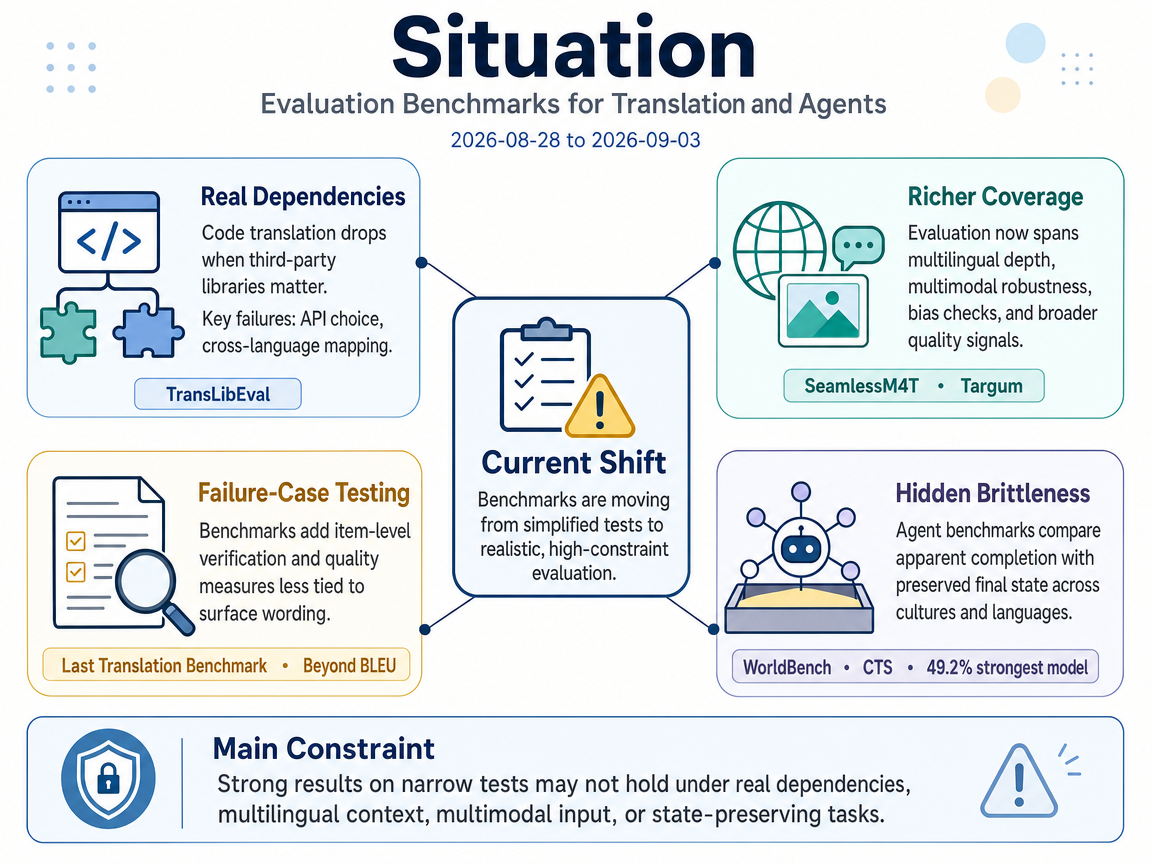
Representative evidence points to a shift from broad but simplified evaluation toward benchmarks that expose practical failure modes. TransLibEval (2509.12087v1) argues that most code-translation benchmarks underrepresent third-party libraries even though such dependencies dominate real software work, and demonstrates large LLM performance drops—over 60% in computational accuracy—especially around API selection and cross-language library mapping. SeamlessM4T (2308.11596v1) frames evaluation as necessarily multilingual and multimodal, incorporating robustness testing, bias measurement, and a language/modality-agnostic quality metric rather than relying on text-only translation scores alone.
Secondary evidence reinforces the same pressure toward richer testbeds and resources. Targum (2602.09724v1) prioritizes historically deep translation coverage for computational study of translation variation rather than generic training scale. This week's WorldBench (2609.01056v1) explicitly targets culturally grounded multilingual agent evaluation across seven languages and eight cultures, introducing Constrained Task Success (CTS) to distinguish apparent task completion from correct final-state preservation. Its reported gap between pass rate and CTS—with the strongest model reaching only 49.2% CTS—illustrates that realistic benchmarking increasingly focuses on measuring hidden brittleness rather than headline success.
Infographic (English)
Progress
Last Translation Benchmark <See Details on Fugu-MT>
This benchmark collects translation examples that break major machine translation models and attaches handcrafted verification rules to each case. Compared with broad aggregate scoring, it pushes translation evaluation toward explicit failure-case testing with item-level checks.
Beyond BLEU: A Case for Redefining Sign Language Translation Benchmarks <See Details on Fugu-MT>
This paper proposes moving sign language translation evaluation beyond BLEU, using an open-weight LLM QA protocol that aligns more closely with human rankings and is six to seven times more paraphrase-invariant. It extends the theme from realistic coverage to more faithful quality measurement by reducing sensitivity to surface-level wording differences.
WorldBench: Culturally Grounded Benchmark for Multilingual Agents <See Details on Fugu-MT>
WorldBench evaluates LLM agents in a sandbox with 1,600 culturally grounded tasks across seven languages, refined with human feedback from culture-specific annotators. It broadens benchmark realism by testing multilingual grounded behavior and state preservation rather than only apparent task completion.
Outlook
Outlook Summary
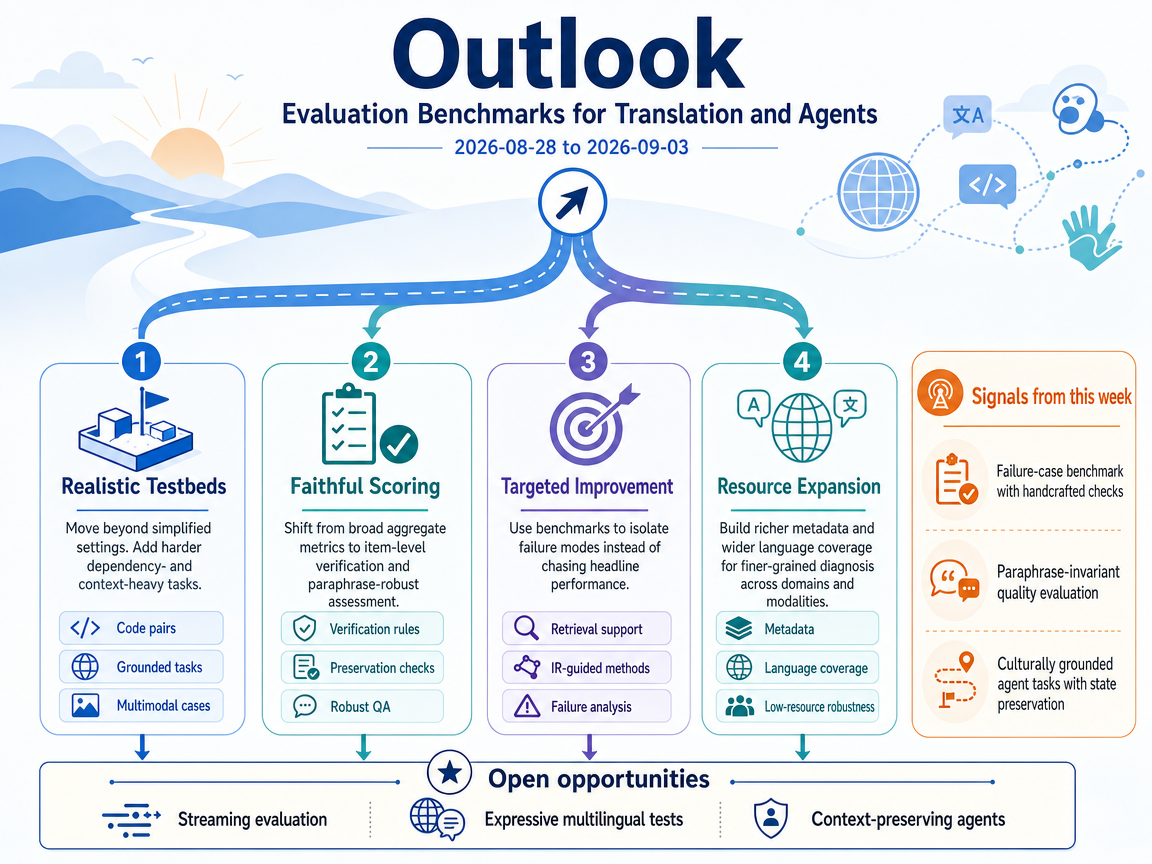
Evaluation research is likely to combine harder, more realistic testbeds with scoring that exposes hidden failures rather than relying on averages. Benchmarks would cover more programming-language pairs and culturally grounded agent tasks, while checking individual results, preserved meaning or state, and robustness to paraphrasing. Model improvements would target the weaknesses these tests reveal, including library translation through better retrieval and intermediate code representations. Multilingual and multimodal work would extend toward underserved languages, expressive quality, and streaming conditions. Richer resource metadata and broader language coverage would help explain failures across settings.
Infographic (English)
Three-Year Movement
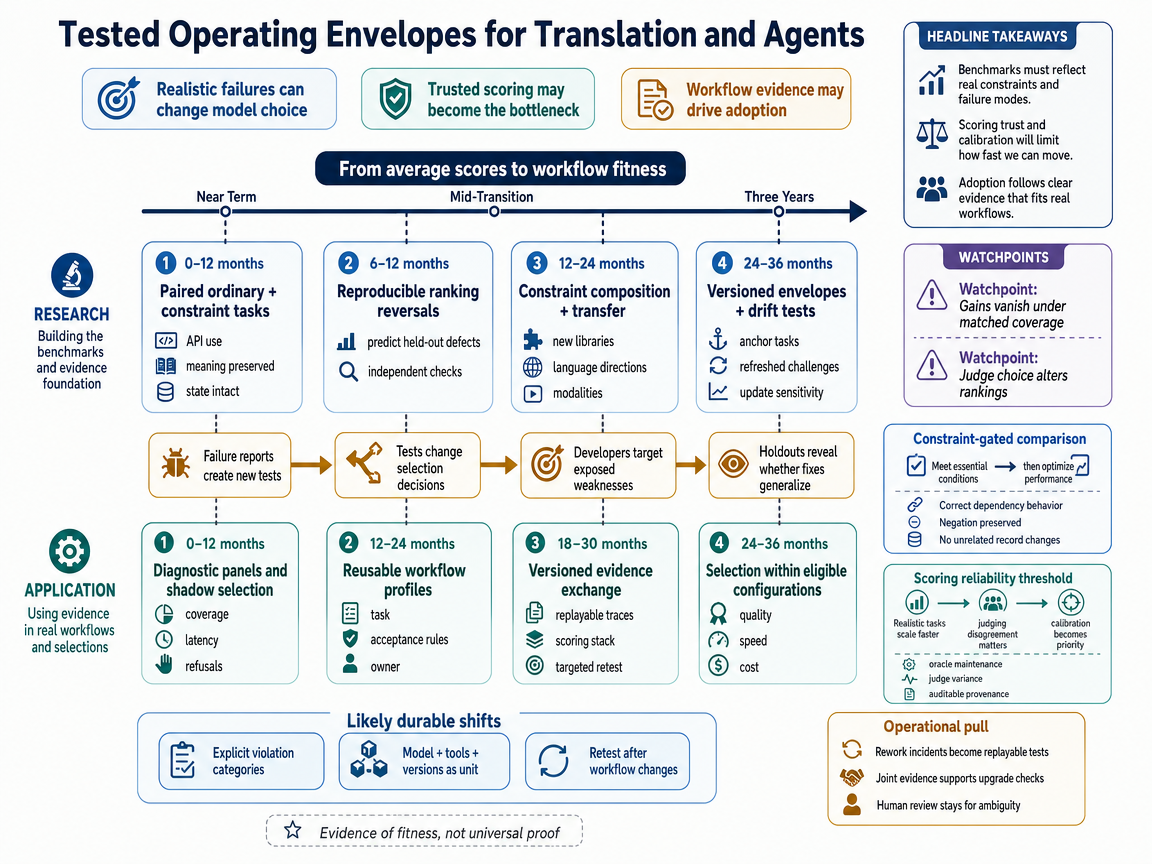
Over three years, realistic benchmarks could shift model selection from average scores toward evidence that a system meets the requirements of a particular workflow. TransLibEval's reported accuracy decline of over 60% under third-party-library constraints provides a concrete reason to test failures that ordinary code tasks can hide. In the first year, researchers would pair ordinary tasks with constrained versions that require correct library use, preserved meaning, or unchanged unrelated records. Teams would compare alternative model choices without changing live workflows, checking whether the constrained tests predict fewer defects on fresh tasks under comparable operating conditions.
If those checks prove useful, the second year would turn separate tests into reusable workflow profiles that define requirements and explain how results are judged. Researchers would then test whether passing individual checks still predicts success when constraints interact, and whether the results transfer to unfamiliar settings. The mechanism resembles electricity-grid safety checks: establish acceptable behavior under relevant disturbances before optimizing performance, rather than allowing a strong average score to offset a critical violation. Reported defects would generate new tests, developers would target the exposed weaknesses, and independent cases would show whether the fixes work beyond familiar examples.
By the third year, this process could produce versioned operating envelopes: documented conditions under which a specific model configuration has demonstrated acceptable behavior. Teams could exchange structured evidence and rerun affected checks after updates, while unchanged reference tasks would preserve comparisons as benchmarks evolve. Selection would depend on demonstrated fitness for the intended workflow rather than one universal ranking, with retesting required when operating conditions change. A useful monitoring cue would be independently reproduced ranking changes that lead teams to choose systems with fewer relevant defects despite lower average scores. The path would weaken if results depend heavily on the judge or apparent improvements come mainly from refusing difficult tasks rather than completing them reliably. Human review would remain important for ambiguous or culturally sensitive language because these tests offer revisable evidence, not proof of acceptable behavior in every situation.
Over three years, increasingly realistic tasks could make trustworthy scoring, rather than task creation, the main constraint on useful evaluation and dependable comparisons between systems. TransLibEval's reported accuracy decline of over 60% under library constraints supports closer testing, but the supplied evidence does not yet establish a widespread scoring shortage. During the first year, teams would expand difficult benchmarks and try to reproduce results using independently implemented checks across different evaluation environments. An oracle is a rule or executable check for deciding whether a requirement was met, and differences between implementations can change an item's score. The important monitoring cue would be disagreement between scorers that exceeds the improvement claimed for a model, prompting requests for replayable evidence and disclosed scoring versions.
If that problem becomes visible, the second year could introduce proficiency testing, where independent teams score the same fixed cases and compare their judgments. Borrowing from clinical laboratories, this mechanism would locate disagreement and calibrate scoring before small differences are used to guide model selection or release decisions. Case histories would record origins, revisions, and possible training exposure, helping researchers distinguish dependable measurement from results distorted by familiar or altered test material. Executable checks could advance fastest for library behavior and agent state, while language evaluation would still need human judgment about meaning and cultural fit.
By the third year, shared calibration could support routine quality control, with versioned checks connected to release pipelines and repeated after changes to dependencies or judges. Researchers could assess whether targeted improvements survive refreshed cases, while specialist testing providers could maintain reference examples and investigate disputed results across participating organizations. The outcome would be a limited layer of dependable measurement rather than a universal quality score, with credibility resting on agreement at the scale of reported gains. A major caveat is circular evaluation: related automated systems may generate and score similar cases, making apparent agreement less independent than it first appears. Stable rankings across independent implementations, with scoring differences consistently smaller than model gains, would weaken the expectation that unreliable judgment becomes the central constraint.
Over three years, diagnostic evaluation could develop into a maintained supplier-quality service, using documented incidents to decide whether specific language workflows are ready for upgrades. The mechanism resembles checking the contents of a delivery rather than its arrival: fluent output does not show that protected facts or records survived unchanged. In the first year, researchers would reconstruct recurring incidents such as changed dates, incorrect quantities, or unauthorized record changes, retaining enough evidence for independent review. Bilingual reviewers would distinguish hard failures from acceptable paraphrases, while pilot teams would test whether past incidents predict new defects without initially changing acceptance decisions. Progress would depend on catching confirmed defects across repeated updates while saving more rework and dispute-handling effort than testing and appeals require.
If that threshold is met, the second year could turn experimental suites into operational services, with supplier agreements defining retained evidence and ways to appeal disputed results. Researchers would investigate where failures originate, because detecting a damaged result does not by itself establish which component or participant was responsible for it. Incidents would become tests that guide supplier changes, while independently checked new cases would show whether those changes actually reduce repeat failures beyond the familiar suite. Customer-specific checks could share an evidence format without assuming that preserved meaning and correct agent state can be judged by the same method.
By the third year, exportable evidence packages could let customers assess replacement suppliers against their own failure histories and carry established tests between providers. A managed service might authorize upgrades for named language-workflow combinations, while research would examine whether these procedures transfer reliably to other customers and selected speech tasks. This would be limited release authority rather than general certification, and independent sampling would still need to demonstrate fewer new incidents after deployment. Useful monitoring cues would include reproducible incident records and voluntary supplier replay evidence, while unchanged fresh-defect rates or rising appeal costs would weaken the path. Ambiguous meaning and environments that cannot be reconstructed would remain subject to human review, and researchers would check whether incident-based testing overlooks broader cultural or expressive quality.
1-Year / 3-Year Research-Application Infographic
References
- A New Benchmark for Evaluating Code Translation with Third-Party Libraries - Authors: Pengyu Xue, Kunwu Zheng, Zhen Yang, Yifei Pei, Linhao Wu, Jiahui Dong, Xiapu Luo, Yan Xiao, Fei Liu, Yuxuan Zhang, Xiran Lyu, Xianhang Li, Xuanyu Zhu, Chengyi Wang, / <See Details on Fugu-MT> / License: CC0-1.0
- Targum -- A Multilingual New Testament Translation Corpus - Authors: Maciej Rapacz, Aleksander Smywiński-Pohl, / <See Details on Fugu-MT> / License: CC-BY-4.0
- WorldBench: Culturally Grounded Benchmark for Multilingual Agents - Authors: Leonardo Ranaldi, Sherrie Shen, Jushi Kai, Alexandra Birch / <See Details on Fugu-MT> / License: CC BY 4.0