Summary
This week's theme centers on how multimodal models should represent visual information when a single system is expected to understand, generate, and edit images. The representative papers frame the main bottlenecks as fragmented architectures, inefficient or semantically weak visual tokenization, and persistent gaps in fine-grained visual perception, while current work increasingly studies native-resolution encoding and tokenizer design inside unified autoregressive training rather than in isolation.
Situation
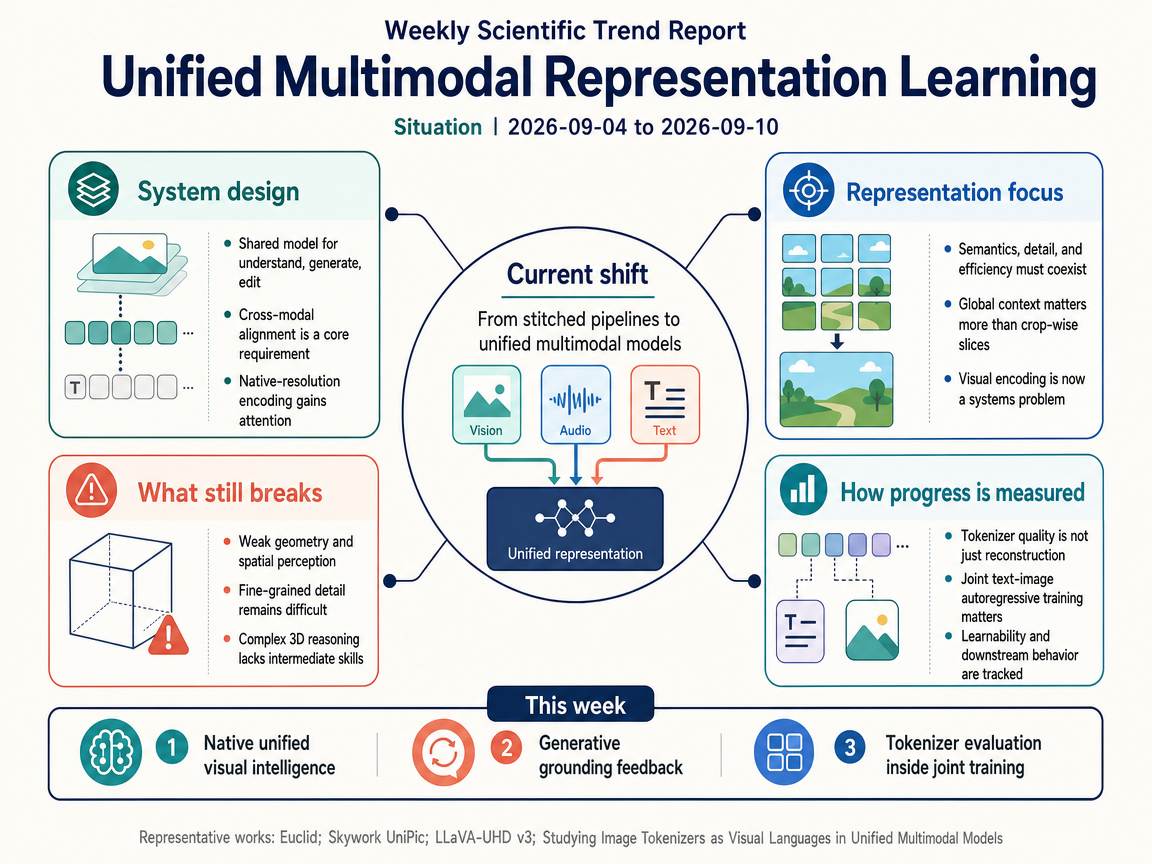
The representative papers describe a field moving away from stitched-together pipelines toward natively unified multimodal models. Skywork UniPic argues that separate stacks for understanding, generation, and editing limit cross-modal synergy and practical deployment, while LLaVA-UHD v3 motivates global native-resolution encoding over slice-based processing because crop-wise methods lose global context even when they reduce compute. Together, these introductions present representation learning as a central systems problem: models need visual encodings that preserve semantics, detail, and cross-modal alignment without prohibitive cost.
A second recurring concern is that current multimodal systems still struggle with what their representations actually capture. Euclid emphasizes low-level visual perception failures on geometry and spatial detail, arguing that better synthetic descriptions and curriculum-based training are needed for precise visual understanding. Current-week evidence from "Studying Image Tokenizers as Visual Languages in Unified Multimodal Models" (arXiv:2609.09143v1) sharpens this point by showing that reconstruction quality alone can diverge from multimodal learnability, and that image tokenizers should be evaluated within joint text–image autoregressive training because tokenizer choices affect cross-modal alignment and even text modeling.
Infographic (English)
Progress
SenseNova-U1.5: Towards Native Unified Visual Intelligence <See Details on Fugu-MT>
SenseNova-U1.5 demonstrates a unified 8B-MoT model that understands, reasons about, and generates visual content at up to 4K native resolution. Relative to earlier fragmented pipelines and crop-based encoding, it provides native high-resolution training and an openly released recipe covering supervised fine-tuning, reinforcement learning, and online distillation.
Dreaming in Flow: Generative Grounding Feedback for Self-Evolving Unified Multimodal Models <See Details on Fugu-MT>
Dreaming in Flow introduces a self-evolving post-training framework that couples visual understanding and generation through generative grounding feedback. Rather than optimizing the two capabilities as separate tasks, it uses the model's own visual outputs and text prompts to jointly improve a unified network.
Studying Image Tokenizers as Visual Languages in Unified Multimodal Models <See Details on Fugu-MT>
This paper evaluates image tokenizers inside unified autoregressive multimodal training, tracking task-specific validation losses as a measure of learnability. It shifts tokenizer assessment beyond standalone reconstruction metrics toward how visual token design affects joint text–image learning and downstream performance.
MV-STRIDE: Enabling MLLMs to Master Multi-View Spatial Reasoning via Hierarchical Capability Modeling <See Details on Fugu-MT>
MV-STRIDE provides a hierarchical multi-view spatial reasoning dataset that explicitly models dependencies from perception through scene understanding to contextual reasoning. Compared with flatter benchmarks, it exposes which intermediate spatial capabilities unified MLLMs still lack for complex 3D reasoning.
Outlook
Outlook Summary
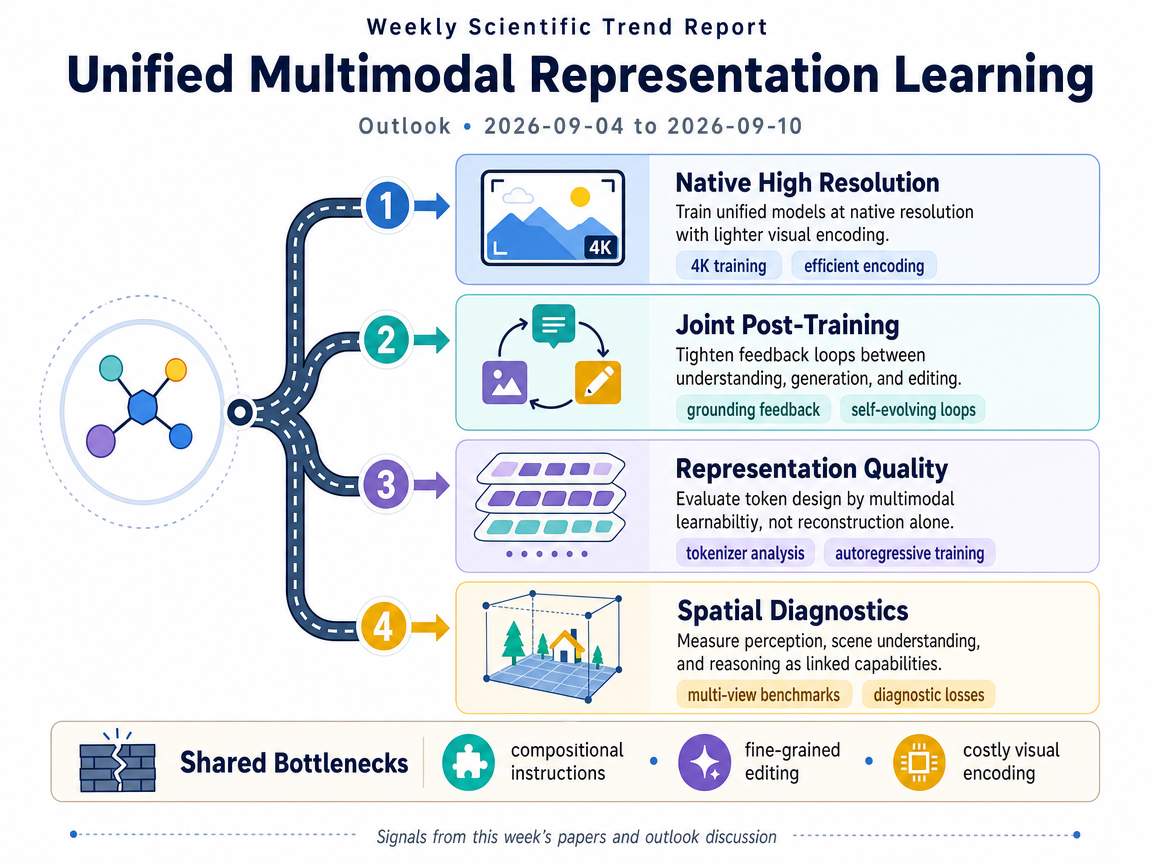
Near-term research will likely make unified multimodal models handle high-resolution images directly while reducing computation and improving joint understanding, generation, and editing. Key constraints remain complex instructions, precise edits, and basic spatial perception, alongside costly image encoding. This week’s work strengthens the case for closer feedback between understanding and generation during post-training. It also suggests judging image tokenizers by how well their representations support learning, not just image reconstruction. Better encoder adaptation and training curricula will need stronger spatial tests and diagnostic losses to show which changes actually improve the whole model.
Infographic (English)
Three-Year Movement
The outlook points toward models that understand, generate, and edit high-resolution images through a shared representation while using less computation. Earlier work supports more compact unified designs and cheaper image encoding. However, failures on basic geometry show why broad benchmark averages cannot establish whether a model preserves the details that a task requires.
This week’s reported high-resolution training methods and closer feedback between understanding and generation strengthen that direction. Tokenizer studies add a related mechanism: evaluate encoded image units by how well they support learning inside the complete model, rather than by image reconstruction alone. A useful monitoring cue is whether efficiency improvements accompany stronger basic spatial perception, rather than only higher overall scores. These remain promising research signals, not an established three-year development sequence, because several current-week claims are described editorially without full experimental evidence.
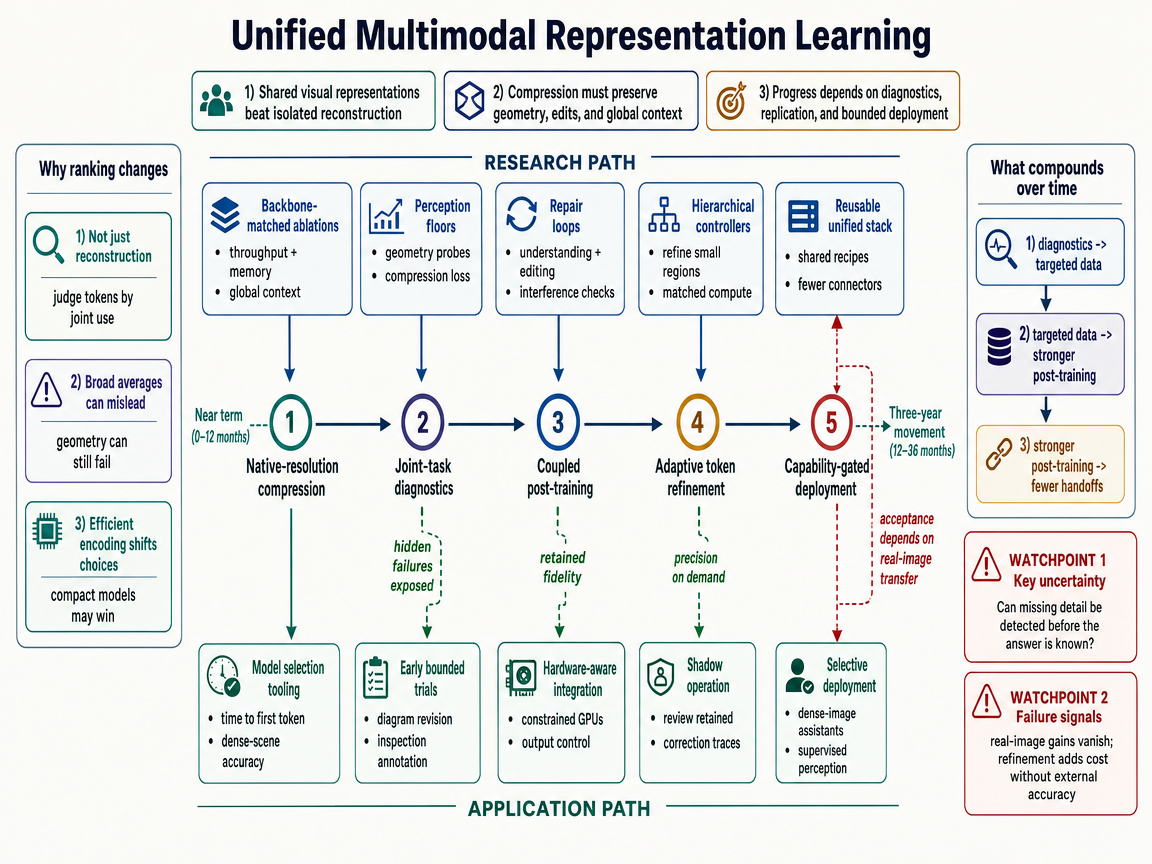
This scenario extends high-resolution unified models toward adaptive processing, where visual tokens—the model’s encoded image units—become finer only where a task needs more detail. The mechanism borrows from adaptive mesh refinement in numerical simulation, which concentrates computation where a coarse representation is inadequate rather than refining everything equally. Current reports motivate this approach, but do not yet demonstrate reliable controllers that decide when and where to request additional visual evidence.
In year one, researchers would test whether compression removes details needed for correct answers or edits, even when the compressed image still looks acceptable. Prototypes would preserve a global image representation while requesting finer tokens from selected regions, helping retain relationships that independent crops can lose. Task instructions would increasingly guide those requests rather than relying only on which regions appear visually prominent. The key monitoring cue is fewer externally measured errors at equal total computation across different model backbones, including the overhead of deciding where to refine.
In year two, successful prototypes would face unfamiliar layouts and multi-view scenes, testing whether they recognize missing visual evidence rather than merely lacking relevant knowledge. Promising applications could enter shadow operation, where people remain responsible while proposed changes are recorded and compared with actual outcomes. Human corrections would generate targeted training examples, helping controllers localize errors and avoid unnecessary refinement while leaving more computation for difficult cases.
By year three, repeated success could support reusable refinement interfaces that record requested precision, unresolved errors, and exhausted computation budgets, with review and rollback procedures. Selected document and inspection workflows could request a measured tolerance instead of a fixed resolution, potentially favoring compact models that reliably request more detail. This path weakens if small features remain undetected or fixed-resolution systems match results after all overhead is counted; independent checks and human escalation remain essential.
This scenario changes how unified multimodal progress is judged, shifting attention from final benchmark scores toward measurements of the stages that produce reliable perception. Tokenizers, which turn images into model-readable units, would be assessed for how well their outputs support learning rather than simply preserving visual appearance. Spatial tests would separately examine basic perception and more complex reasoning, helping reveal weaknesses that strong overall results can conceal.
In year one, researchers would compare compression methods and training stages to identify where important spatial capabilities emerge or disappear. A stronger shift would require a visible pilot failure traced to poor perception, alongside an accepted result showing a compact model outperforming a higher-ranked system on spatial tests. Shared evaluations could then require a minimum perception score before counting generation or editing results, but only where that threshold predicts performance on the intended task.
In year two, successful diagnostics would become automated training checks that identify the stage responsible for a failure, allowing teams to repair it and rerun tests. This measurement-repair-retest loop could make targeted improvements more practical than repeatedly optimizing one overall score, while helping developers compare systems under real operating constraints. However, synthetic training might improve familiar geometry answers without improving real scenes, so rotating tests and independent, undisclosed tasks would remain necessary.
By year three, shared protocols and independently maintained tests could support diagnostic services and more consistent release reports, making stage evidence useful beyond individual research papers. Participating inspection and technical-document workflows could routinely require verified perception thresholds, while general creative tools could still be judged mainly by output quality. Existing multi-component systems could remain useful if checking their interfaces is effective; unification would not automatically justify replacement. A monitoring cue is whether real pilots require diagnostic evidence and accept resulting changes in model rankings. If stage checks offer no additional predictive value, diagnostics may remain research tools rather than displacing headline benchmarks.
1-Year / 3-Year Research-Application Infographic
References
- Euclid: Supercharging Multimodal LLMs with Synthetic High-Fidelity Visual Descriptions - Authors: Jiarui Zhang, Ollie Liu, Tianyu Yu, Jinyi Hu, Willie Neiswanger, / <See Details on Fugu-MT> / License: CC-BY-4.0
- Skywork UniPic: Unified Autoregressive Modeling for Visual Understanding and Generation - Authors: Peiyu Wang, Yi Peng, Yimeng Gan, Liang Hu, Tianyidan Xie, Xiaokun Wang, Yichen Wei, Chuanxin Tang, Bo Zhu, Changshi Li, Hongyang Wei, Eric Li, Xuchen Song, Yang Liu, Yahui Zhou, / <See Details on Fugu-MT> / License: CC-BY-4.0
- LLaVA-UHD v3: Progressive Visual Compression for Efficient Native-Resolution Encoding in MLLMs - Authors: Shichu Sun, Yichen Zhang, Haolin Song, Zonghao Guo, Chi Chen, Yidan Zhang, Yuan Yao, Zhiyuan Liu, Maosong Sun, / <See Details on Fugu-MT> / License: CC-BY-4.0
- Studying Image Tokenizers as Visual Languages in Unified Multimodal Models - Authors: Siting Li, Zhengyang Wang, Simon Shaolei Du, Xi Chen, Yang Liu / <See Details on Fugu-MT> / License: CC BY 4.0