Summary
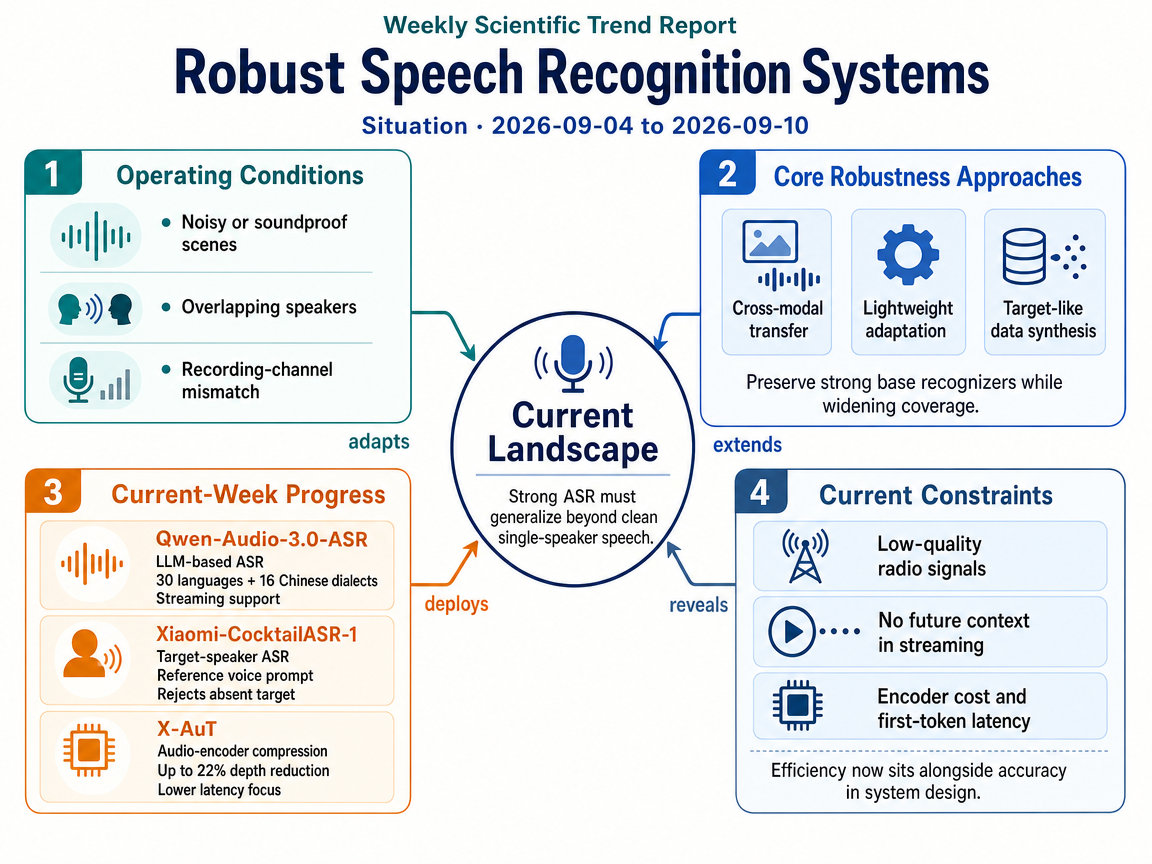
This theme covers speech recognition systems designed to operate beyond clean single-speaker conditions, addressing noisy or soundproof environments, overlapping speakers, and channel mismatch. Representative work emphasizes modular adaptation of strong pretrained or streaming architectures through separation, cross-modal transfer, and domain-adaptive synthesis. This week's progress highlights LLM-based ASR scaling to dozens of languages with streaming support, end-to-end target-speaker transcription, and encoder compression for low-latency deployment.
Situation
The representative papers frame a common problem: strong ASR performance in standard settings does not transfer cleanly to real-world conditions. Radio2Text argues that speech recognition should extend to low-latency, large-vocabulary transcription from mmWave reflections in noisy or soundproof scenarios, but must cope with low-quality radio signals and the absence of future context in streaming decoding. A Sidecar Separator treats overlap as a model-adaptation problem, showing that a fixed single-speaker ASR can be augmented with a lightweight separator instead of being fully redesigned. CADA-GAN targets robustness gaps caused by recording-channel mismatch, using domain-adaptive synthesis to reduce ASR brittleness across microphones.
Taken together, the baseline evidence points toward modular and scalable robustness: transferring knowledge across modalities, inserting lightweight adaptation components, and synthesizing target-like data to preserve strong base recognizers while broadening operating conditions. As current-week evidence, X-AuT (2609.11412v1) adds a deployment angle, arguing that speech LLMs now face first-token latency and encoder-cost constraints in streaming, mobile, and in-vehicle settings, making compression and recovery of pretrained audio encoders part of the ASR systems agenda alongside accuracy.
Infographic (English)
Progress
Qwen-Audio-3.0-ASR Technical Report <See Details on Fugu-MT>
Qwen-Audio-3.0-ASR presents a Mixture-of-Experts LLM-based ASR system supporting 30 languages and 16 Chinese dialects, with a dedicated streaming variant for low-latency applications. Compared with earlier modular robustness strategies, it unifies multilingual coverage, contextual entity recognition, and single-pass disfluency polishing inside one instruction-controlled framework with a streaming mode.
Xiaomi-CocktailASR-1 Technical Report <See Details on Fugu-MT>
Xiaomi-CocktailASR-1 introduces an end-to-end target-speaker ASR system that uses a reference voice prompt to transcribe the desired speaker directly, without explicit speech separation. Compared with earlier separator-based adaptation, it adds the ability to reject cases where the target speaker is absent and supports chain-of-thought reasoning for interpretability.
X-AuT: Progressive Audio-Encoder Compression for Speech LLMs with Cross-Scale Distillation <See Details on Fugu-MT>
X-AuT compresses pretrained speech-LLM audio encoders via progressive layer pruning and cross-scale distillation, reducing encoder depth by up to 22% while retaining competitive accuracy. Compared with prior work on acoustic-condition adaptation, it makes encoder efficiency and first-token latency a concrete part of robust ASR system design for streaming and on-device deployment.
Outlook
Outlook Summary
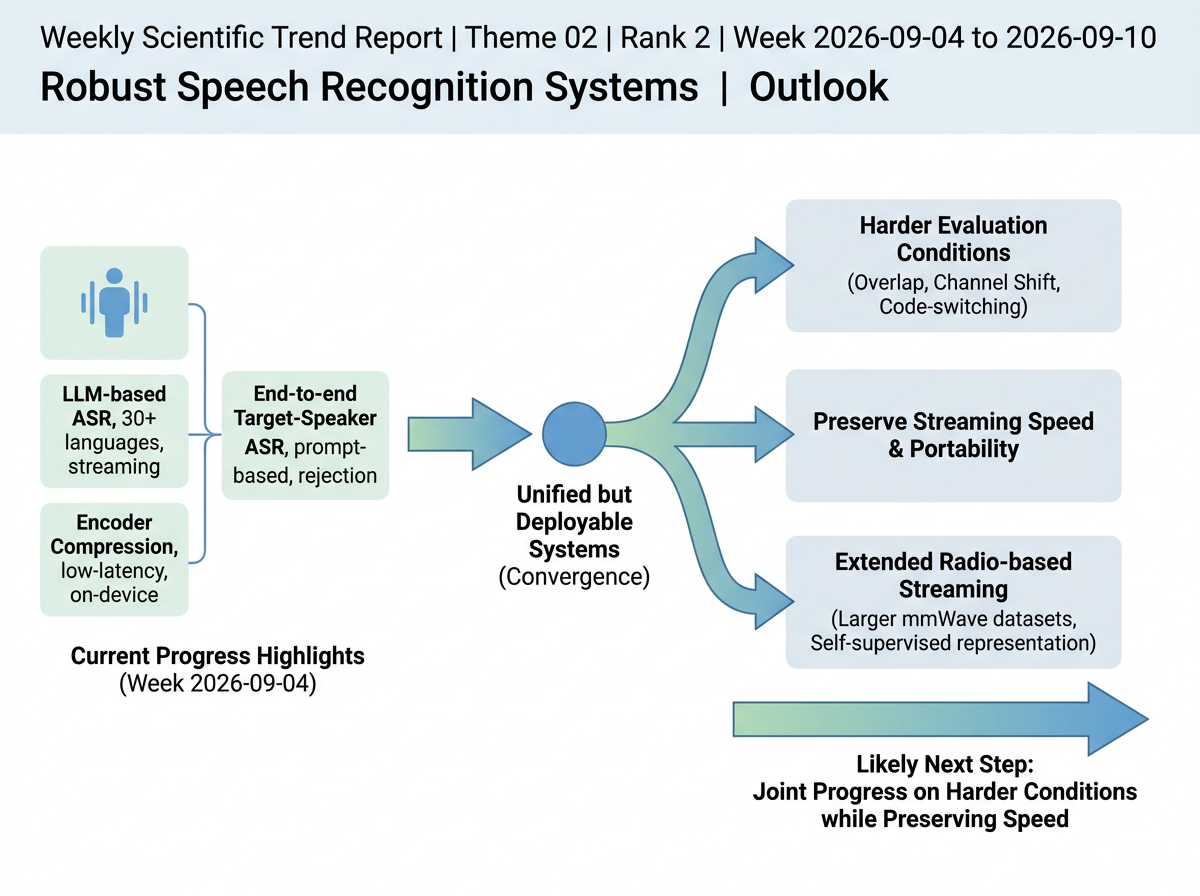
Near-term progress is likely to improve speech-recognition robustness by extending proven recognizers rather than rebuilding them. Priorities include larger mmWave speech datasets with learning from unlabeled recordings, broader testing of channel-adaptive speech synthesis, and lightweight add-ons for existing models. These directions appear to be converging toward deployable systems that recognize selected speakers and support multilingual streaming. Encoder compression makes low response delay a central constraint. The next step is to test combined difficulties, including overlapping speakers and changing microphone conditions, while preserving streaming speed and portability.
Infographic (English)
Three-Year Movement
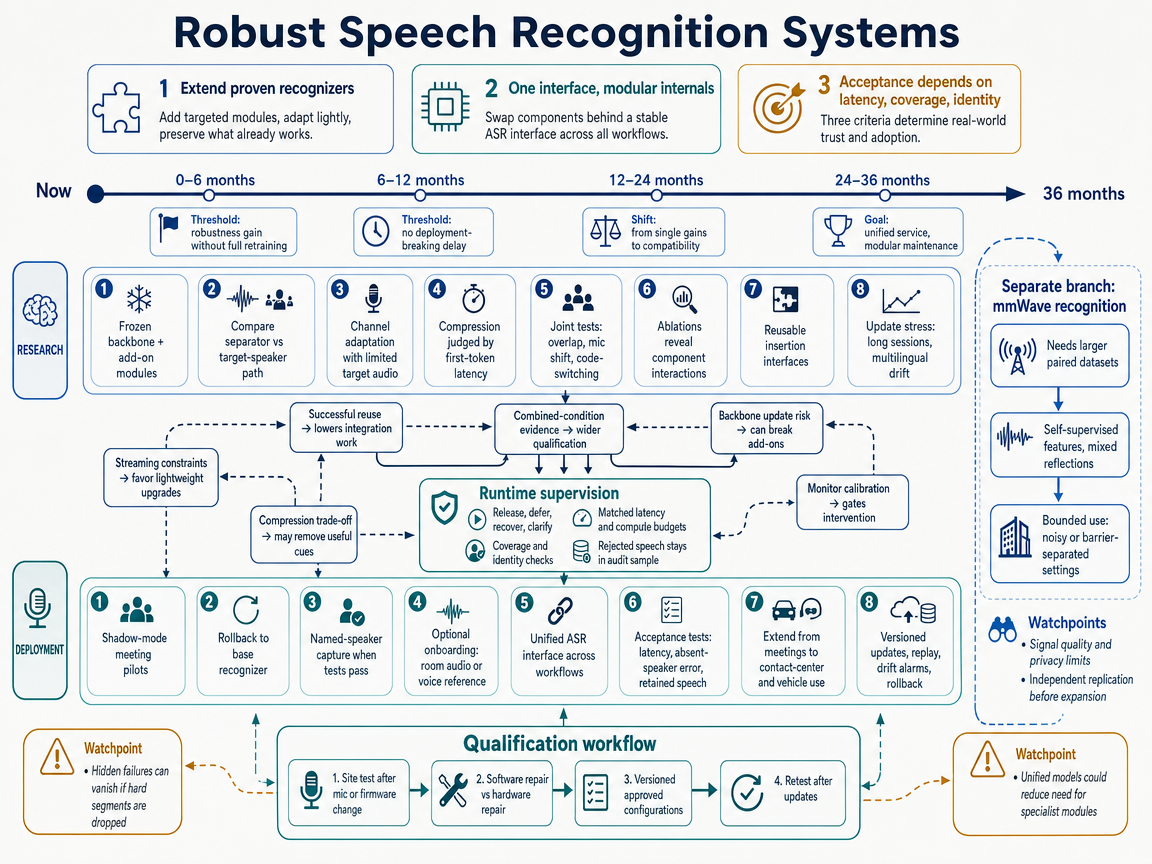
Over three years, this scenario would extend proven speech recognizers through reusable add-ons rather than rebuild the whole system whenever operating conditions become more difficult. Its orchard-grafting mechanism keeps a strong base and attaches specialized capabilities, but current results do not yet show that these combinations work reliably together. In the first year, researchers would compare ways to isolate a requested speaker in real meetings, including cases where that speaker is absent. They would also test microphone-matched training speech on stronger recognizers and assess compression through recognition errors and first-token latency, meaning the delay before text first appears.
If these tests succeed, the second year would shift from proving individual improvements to checking whether several components remain useful when combined under streaming constraints. Researchers would remove components one at a time to identify their contributions, while application teams could offer one interface that selects different internal processing paths. Collecting a small microphone sample or optionally enrolling a reference voice could become documented setup procedures, helping successful configurations transfer between workflows with less integration work. Common component interfaces and explicit test requirements would strengthen this feedback loop by making both reuse and comparison easier across successive deployments.
By the third year, the central task would be maintaining these combinations across base-model updates and longer sessions that mix languages with changing acoustic conditions. Proven meeting configurations could extend into selected vehicle workflows, with response time and speaker-selection errors treated as acceptance criteria alongside transcription accuracy. A useful monitoring cue would be repeated improvement on combined-condition tests without full retraining or slower responses after updates. This path would weaken if compression removes information that add-ons need, or if an equally capable unified model eliminates their practical advantage. mmWave recognition would remain a separate research branch, with larger datasets supporting further experiments but deployment still dependent on sensing performance and privacy safeguards.
Over three years, this scenario would place a supervisor above a streaming recognizer to decide when its output can be accepted and when recovery is needed. Borrowing from robotics-style runtime assurance, the supervisor would monitor assessed operating limits and choose whether to release text, try another processing path, or request repetition. The first-year question would be whether it can identify likely mistakes before text is committed, especially when overlapping speakers and unfamiliar microphones occur together. Consented meeting pilots would initially record proposed interventions without changing transcripts, then permit limited action only after tests on previously unused recordings show an advantage.
Those tests would compare alternative systems at equal speech retention and computing effort, while checking p95 latency, the response time within which 95 percent of cases finish. In the second year, successful prototypes would develop reusable interfaces that distinguish provisional from committed text and preserve speaker identity during recovery. Application teams would introduce staged releases and rollback procedures, while researchers test whether the supervisor remains reliable after the underlying recognizer changes. Consented intervention records could improve targeted evaluations, creating a feedback loop in which recurring failures guide repairs and better-calibrated monitoring reduces unnecessary interruptions. Rejected speech would need to remain in audit samples so apparent gains do not come simply from discarding the hardest material.
By the third year, cross-site trials would test long sessions with combined difficulties and assess whether established operating limits remain useful after base-model replacement. Successful systems could spread to more meeting locations and selected vehicle workflows, keeping transcript acceptance rules separately evaluated even when recognition components change. A key monitoring cue would be fewer speaker-attributed errors without reduced speech retention or worse tail latency, meaning delays among the slowest responses. The approach would weaken if monitors lose reliability or users disable clarification, and it would remain empirical because the supervisor and recognizer can share the same blind spots.
Over three years, this scenario would turn some meeting-room maintenance visits into opportunities to test and repair transcription quality without automatically replacing otherwise functioning equipment. Its mechanism is a repeatable qualification process: a particular hardware and software combination passes checks for stated conditions, and later changes trigger renewed testing. In the first year, consented field pilots would compare software adaptation with unchanged recognizers and hardware repair, initially keeping proposed fixes separate from the live service. Evaluation would connect recognition quality to human correction effort and streaming delay, while independent recordings test whether improvements extend beyond the samples used for adaptation. A paid extension would require lower combined support and correction costs within customer quality limits, with success repeated at another site after an unfamiliar equipment change.
In the second year, successful repairs could become documented procedures supported by versioned configurations and customer-controlled test recordings, making earlier results easier to check after updates. Researchers would identify short commissioning tests that predict later problems, while reusable channel profiles describe microphone and room characteristics but still require validation at new sites. The utility analogy explains the feedback loop: changing inputs trigger checks, and evidence from completed repairs improves how later failures are diagnosed and addressed. Contractors could then offer limited quality and recovery commitments, although customer permission would determine whether recordings or findings could be shared across installations.
By the third year, progress would center on reducing the effort needed to maintain demonstrated quality across many rooms rather than claiming universally reliable recognition. Automated change detection could flag configurations for review, while research establishes which equipment or model updates need full evaluation and which permit narrower retesting. A useful monitoring cue would be falling qualification time per site alongside update-triggered acceptance tests, indicating that the procedure is becoming repeatable. This path would weaken if ordinary microphone replacement resolves problems more cheaply or gains disappear in unfamiliar rooms, so commitments would remain limited to tested conditions and defined recovery responses.
1-Year / 3-Year Research-Application Infographic
References
- A Sidecar Separator Can Convert a Single-Speaker Speech Recognition System to a Multi-Speaker One - Authors: Lingwei Meng, Jiawen Kang, Mingyu Cui, Yuejiao Wang, Xixin Wu, Helen Meng / <See Details on Fugu-MT> / License: CC-BY-4.0
- Radio2Text: Streaming Speech Recognition Using mmWave Radio Signals - Authors: Running Zhao, Jiangtao Yu, Hang Zhao and Edith C.H. Ngai / <See Details on Fugu-MT> / License: CC-BY-4.0
- Channel-Aware Domain-Adaptive Generative Adversarial Network for Robust Speech Recognition - Authors: Chien-Chun Wang, Li-Wei Chen, Cheng-Kang Chou, Hung-Shin Lee, Berlin Chen, Hsin-Min Wang, / <See Details on Fugu-MT> / License: CC-BY-4.0
- Qwen-Audio-3.0-ASR Technical Report - Authors: Chuanmeng Bian, Daren Chen, Peixin Chen, Zhigao Chen, Zhiyun Fan, Zhifu Gao, Bo Gong, Qing Gu, Jiajun He, Yawei Hu, Yunjie Ji, Jingbei Li, Xiangang Li, Xu Li, Zengxi Li, Zheng Li, Chengdong Liang, Baiji Liu, Ying Liu, Bin Ma, Yiping Peng, Yuezhang Peng, Zhendong Peng, Yu Pu, Yang Shi, Xin Shu, Jian Tang, Biao Tian, Peiyao Wang, Tianzi Wang, Wen Wang, Wupeng Wang, Cheng Wen, Yuzhong Wu, Zijian Xia, Yunchong Xiao, Nan Yang, Jianwei Yu, Jixing Yu, Binbin Zhang, Lei Zhang, Sitong Zhao, Guangdong Zhou, Yuan Zhou, Jianheng Zhuo / <See Details on Fugu-MT> / License: CC BY 4.0
- Xiaomi-CocktailASR-1 Technical Report - Authors: Yiru Zhang, Hang Su, Lichun Fan, Ying Zeng, Chang Liu, Yifeng Wang, Yuquan Liang, Tao Li, Lian Li, Wenhao Yang, Jian Luan, Cong Zou, Heng Qu / <See Details on Fugu-MT> / License: CC BY 4.0
- X-AuT: Progressive Audio-Encoder Compression for Speech LLMs with Cross-Scale Distillation - Authors: Haojun Zhang, Yi Zou, Min Chen, Qize Yu, Lianrui Fan, Xini Ding, Hao Li, Shuchang Zhou, Xianming Liu, Shiyu Huang / <See Details on Fugu-MT> / License: CC BY 4.0