Summary
This theme centers on how learning systems can improve themselves or revise their own reasoning without silently accumulating harmful changes. The key challenge is evaluation under noisy feedback: stronger search, refinement, or recursive modification is useful only when paired with mechanisms that verify gains, reject regressions, and manage open-ended improvement loops.
Situation
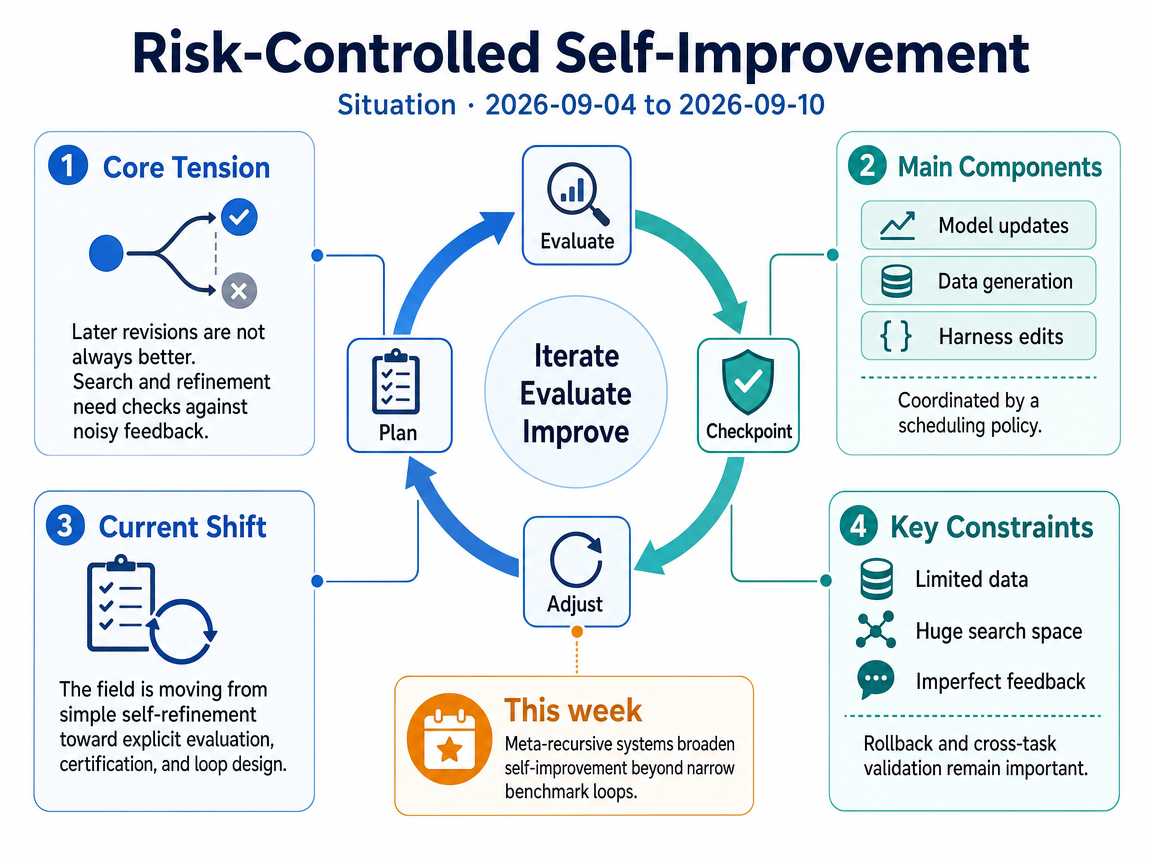
The representative introductions describe a common tension in self-improving ML and LLM systems: iterative refinement, search, and recursive self-modification can unlock better reasoning and adaptation, but later revisions are not guaranteed to be better than earlier ones. SGM (2510.10232v1) frames this as a risk-control problem for recursive edits, arguing that heuristic acceptance rules in AutoML and reinforcement learning can adopt spurious improvements. SCREWS (2309.13075v1) similarly shows that refinement steps may need a selection mechanism that can roll back to an earlier answer. In parallel, the AlphaLLM framework (2404.12253v1) argues that search-based self-improvement depends on overcoming limited data, huge language search spaces, and imperfect feedback.
Current-week evidence from MetaRSI / RSI2 (2609.06396v1) pushes this discussion toward broader recursive self-improvement systems. Its introduction argues that most existing RSI loops are still tied to machine-checkable benchmarks, and proposes a unified framework spanning data generation, execution-harness edits, and model updates under a higher-level scheduling policy. Together, these papers suggest the field is moving from simple self-refinement toward more explicit evaluation, certification, and loop-design principles for sustained self-improvement.
Infographic (English)
Progress
MetaRSI / RSI2: A Meta-Recursive Self-Improving System for Recursive Self-Improving Systems Themselves <See Details on Fugu-MT>
MetaRSI unifies recursive self-improvement as a scheduled composition of typed operators over model, data, and harness changes. Compared with earlier RSI work centered on coding or formal benchmarks, it broadens the loop to scientific and engineering settings under a meta-level scheduling policy.
RISE: Recursive Improvement via Self-Extrapolating Policy Distillation <See Details on Fugu-MT>
RISE improves models recursively by distilling synthetic teachers from the model's own RL training trajectories. Compared with RL-only training or on-policy self-distillation, it provides a self-improvement mechanism that scales across reasoning, code, and agent tasks.
UniRRM: Unified Reasoning Reward Models Across Languages and Evaluation Paradigms <See Details on Fugu-MT>
UniRRM introduces a unified reasoning reward model supporting multiple languages and evaluation paradigms for open-ended RL tasks. It extends prior reward modeling beyond static, fragmented benchmarks into a more consistent cross-lingual evaluation layer.
From Interaction Traces to Persistent Skills: Online Evolution for Computer-Use Agents <See Details on Fugu-MT>
This framework converts interaction traces and evaluator feedback into a versioned library of persistent skills for computer-use agents. It demonstrates that repeatedly accepted edits can still fail to recover the original task, underscoring the need for rollback and cross-task validation in online improvement.
Outlook
Outlook Summary
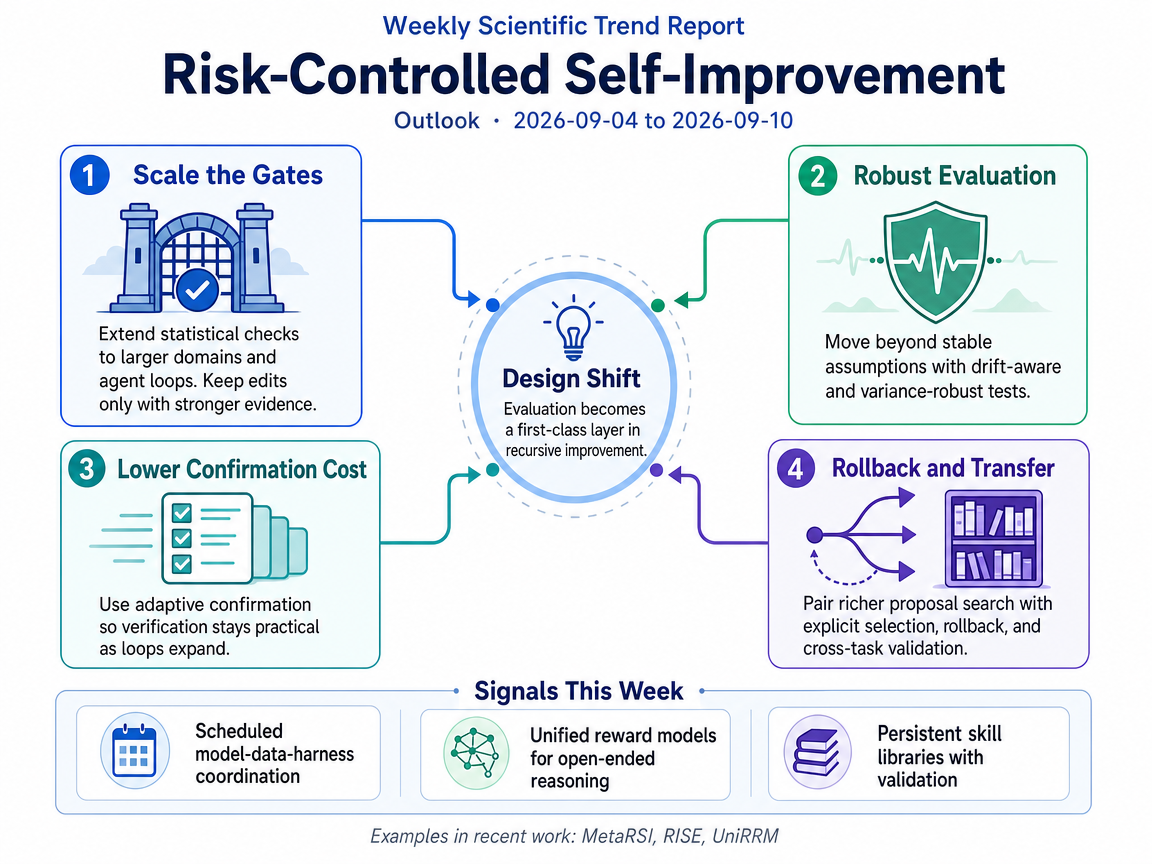
Self-improving systems are likely to expand from small benchmark loops into larger agentic and scientific workflows, with stronger evidence required before changes are kept. Priorities include scaling statistical acceptance checks, handling correlated results and changing test conditions, and lowering evaluation costs through adaptive confirmation. Stronger revision methods and synthetic data generation will need selection and rollback to preserve earlier capabilities. Evaluation is becoming part of the architecture, coordinating model and data updates while checking reusable skills across tasks. The direction is toward modular improvement loops with broader transfer, but progress depends on affordable verification and protection against unnoticed regressions.
Infographic (English)
Three-Year Movement
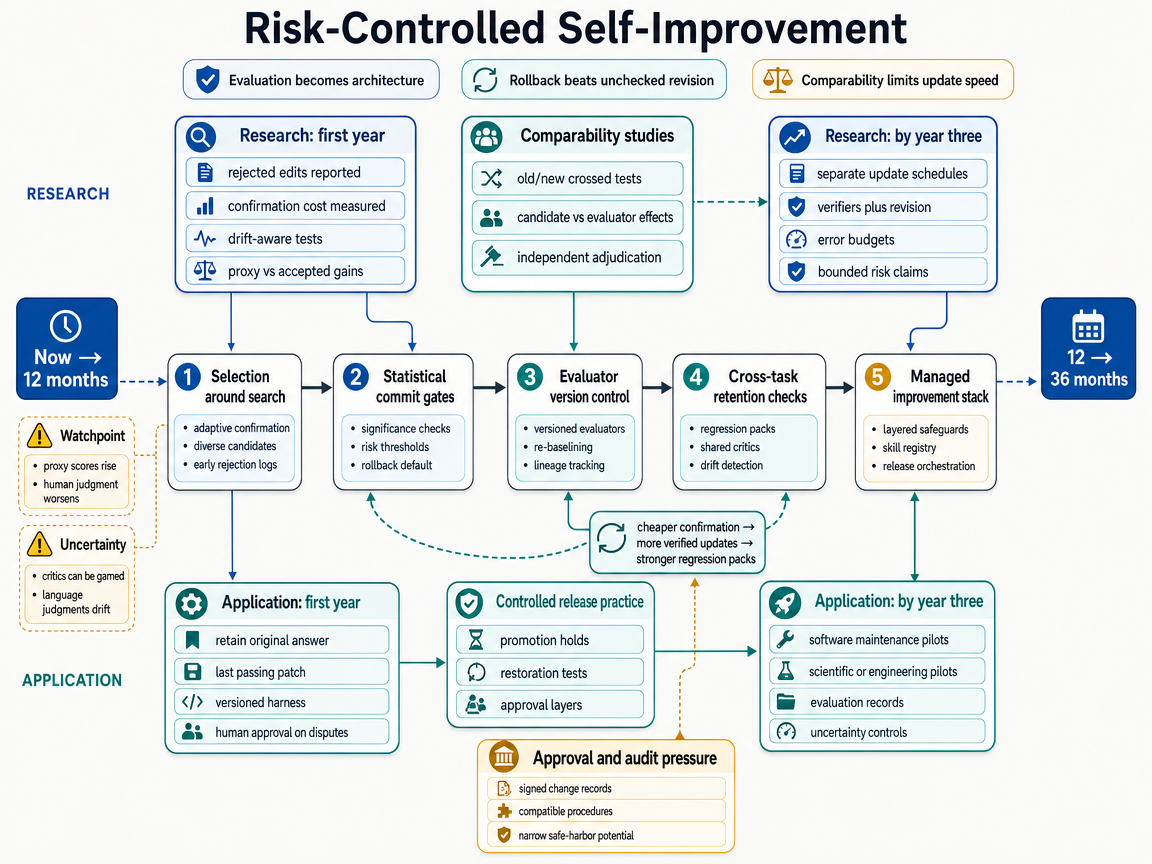
Over three years, self-improvement is likely to become a controlled update process, where proposed changes must demonstrate gains rather than merely produce higher scores. The mechanism resembles pharmaceutical change control: compare each proposed configuration against a validated reference and keep the previous version available for restoration. In the first year, researchers would add statistical acceptance checks to existing reasoning and code-repair loops before extending them to larger systems. Adaptive confirmation would spend more trials on uncertain decisions and fewer on clear ones, making stronger checks more affordable without abandoning the testing rules. Early applications would retain the last passing version and preserve human approval where automated evaluation misses important quality problems.
In the second year, attention would shift toward coordinating updates, because changing a model and its evaluator together can make an apparent improvement difficult to interpret. Separate update schedules and fresh reference measurements would help distinguish better performance from changes in the software that runs and scores tests. Versioned skill libraries would preserve working capabilities, while checks on earlier tasks would test whether new revisions cause forgetting and whether restoration actually works. If these controls prove useful and affordable, cheaper evaluation could support more confirmed updates, which would expose additional weaknesses and strengthen regression testing.
By the third year, selected software-maintenance and scientific workflows could combine stronger candidate generation with acceptance checks and tests of retained capability. Evaluation would become a permanent architectural layer, with records explaining the conditions under which each change was accepted and how it can be reversed. A useful monitoring cue would be published evidence of rejected edits and successful recovery, accompanied by lower confirmation costs rather than final scores alone. This path weakens if automated scores rise while human assessments worsen, or if changing test conditions prevent valid comparisons, leaving human approval necessary.
This scenario makes reliable measurement the central problem as self-improving systems begin changing their evaluators alongside the capabilities those evaluators are meant to assess. Its mechanism comes from scientific metrology: treat evaluators as measuring instruments and use protected reference tasks to check whether comparisons remain valid. In the first year, researchers would test old and new candidates with both evaluator versions, revealing whether a scoring change alters which candidate appears better. Independent review would examine disputed outcomes, while calibration bridges—studies connecting evaluator versions—would establish when results remain comparable rather than merely looking similar. Early code-repair pilots would pause acceptance when gains disappear under unchanged evaluation, with restoration or a fresh reference available when the disagreement cannot be resolved.
In the second year, research would examine how uncertainty builds across successive evaluator changes and when direct comparison with an older reference becomes necessary. Other laboratories would repeat selected comparisons in different environments to establish how far the evidence applies, rather than assuming that local results transfer automatically. Application teams could reuse validated calibration procedures, reducing setup effort while using recorded disagreements to identify where expensive confirmation is most needed. This would support expansion only if the process retains more independently verified improvements at acceptable cost, without treating selectively chosen tests as unbiased evidence.
By the third year, successful calibration could let system components change on separate schedules without invalidating the evidence supporting earlier acceptance decisions. Workflow owners could pause only affected changes, while fresh tasks and independent reviewers check whether earlier capabilities survive long runs of repeated updates. A useful monitoring cue would be evaluator histories that support independently confirmed gains after several transitions, with uncertainty smaller than the improvements worth accepting. The path weakens if fixed-evaluator testing works equally well at the same cost; changing human preferences also mean some transitions require a new evidence baseline.
This scenario adds an institutional driver: a scientific or engineering organization requires a certified change plan before allowing an AI system to update itself. The mechanism adapts process-based food-safety controls, using acceptance gates and corrective action throughout operation rather than relying only on inspection of final outputs. In the first year, researchers would add statistical gates to bounded improvement loops, while an adopting institution defines acceptable changes and the evidence needed for approval. Tests that gather additional evidence only when needed could reduce confirmation costs, but limits on false acceptance would remain conditional rather than guarantees of overall safety. The first important threshold would be an audited pilot and a second institution accepting compatible records, showing that the plan can extend beyond one organization.
In the second year, research would address correlated feedback and changing data, since repeated updates can undermine the assumptions that made earlier acceptance tests reliable. Evaluator changes would need separate controls, including checks that expressed confidence matches observed reliability, so a revised scoring system cannot quietly conceal deteriorating performance. If pilots retain earlier capabilities under independent review, oversight bodies could consider allowing specified changes under an approved plan without requiring another full review. That permission would remain a policy decision supported by operating evidence, not an automatic consequence of passing statistical tests or completing the required paperwork.
By the third year, successful pilots could support reusable control systems that coordinate updates and acceptance checks while maintaining recoverable versions with traceable change records. Long-running scientific agents would test revisions against earlier tasks, and suppliers could reuse compatible evidence across programs instead of rebuilding each approval process. The reinforcing mechanism is lower-cost valid confirmation: wider use supports better shared tools, which makes stronger verification more practical for additional scientific and engineering workflows. A useful monitoring cue would be multiple operating pilots accepting common evidence, rather than institutions merely publishing similar requirements or record formats. The path weakens if systems exploit fixed tests or suffer unnoticed capability loss despite following the plan, especially because the proposed institutional transition is unusually compressed.
1-Year / 3-Year Research-Application Infographic
References
- SCREWS: A Modular Framework for Reasoning with Revisions - Authors: Kumar Shridhar, Harsh Jhamtani, Hao Fang, Benjamin Van Durme, Jason Eisner, Patrick Xia / <See Details on Fugu-MT> / License: CC-BY-4.0
- Toward Self-Improvement of LLMs via Imagination, Searching, and Criticizing - Authors: Ye Tian, Baolin Peng, Linfeng Song, Lifeng Jin, Dian Yu, Haitao Mi, Dong Yu, / <See Details on Fugu-MT> / License: CC-BY-4.0
- SGM: A Statistical Godel Machine for Risk-Controlled Recursive Self-Modification - Authors: Xuening Wu, Shenqin Yin, Yanlan Kang, Xinhang Zhang, Qianya Xu, Zeping Chen, Wenqiang Zhang, / <See Details on Fugu-MT> / License: CC-BY-4.0
- MetaRSI / RSI2: A Meta-Recursive Self-Improving System for Recursive Self-Improving Systems Themselves - Authors: Zihan Tan, Leixin Sun, Zitong Shi, Yitao Liu, Jiajun Wu, Nathaniel Brooks, Jiaru Qian, Xiaoran Shang, Suyuan Huang, Yi Ding, Yangxu Liao, Mukai Li, Qiushi Sun, Shudong Liu, Xuankun Rong, Xiaohang Yu, Zhuo Chen, Hejia Geng, Chenxin Li, Aozhou Wang, Zengji Tu, Robert Tang, Yuxin Zhan, Eric Jiang, Yuxin Wu, Jianqing Zhang, Xiao Liang, Fang Wu, Haochi Zhang, Alexander Marlow, Guancheng Wan / <See Details on Fugu-MT> / License: CC BY 4.0