Summary
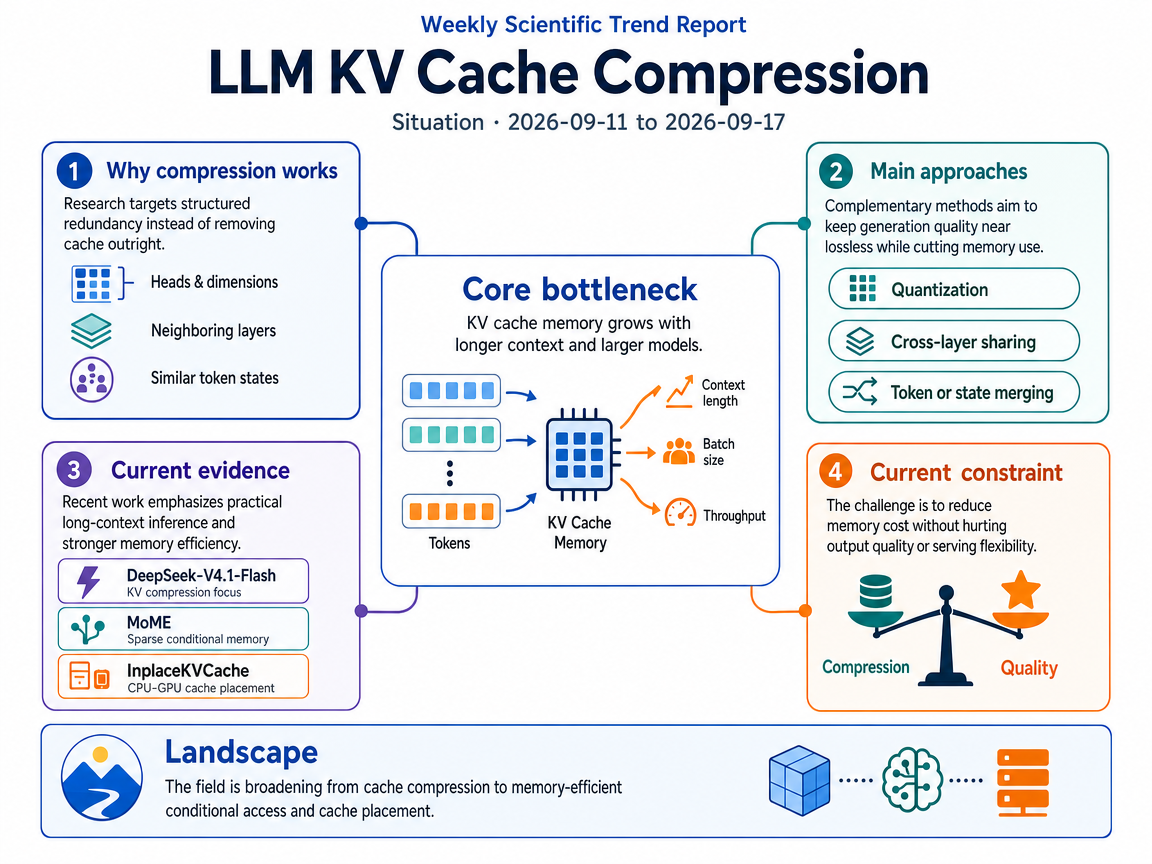
This theme centers on making long-context LLM inference practical by reducing the rapidly growing KV cache memory footprint. Representative papers frame the field around complementary compression strategies—quantization, cross-layer sharing, and token/state merging—with the common goal of preserving generation quality while enabling longer contexts, larger batches, and lower serving cost.
Situation
Representative introductions depict KV cache as a core deployment bottleneck for decoder-only LLMs: as context windows and model sizes grow, cached key-value states consume large amounts of GPU memory and constrain token length, batch size, and throughput. The main research direction is not simply to discard cache, but to exploit structured redundancy in it. The cited papers argue that this redundancy appears across several axes—within attention heads and dimensions, across neighboring layers, and among similar token states in long contexts—motivating methods such as joint compression architectures, cross-layer merging, and similarity-based KV merging that aim to keep performance near lossless while sharply reducing memory use.
Within that landscape, the current week adds adjacent evidence that efficient LLM scaling is expanding beyond cache management alone. MoME: Mixture-of-Memory Embeddings for Context-Aware Sparse Lookup (arXiv:2609.15126v1) argues that transformers lack a native retrieval primitive and proposes context-aware conditional memory as a lightweight sparse lookup mechanism, separating retrieval of static patterns from dense computation. While not a KV-cache paper, it reinforces the broader trend that LLM systems research is increasingly organized around memory efficiency and conditional access, complementing the push toward more scalable long-context inference.
Infographic (English)
Progress
DeepSeek-V4.1-Flash: Pushing the Limits of KV Cache Compression <See Details on Fugu-MT>
DeepSeek-V4.1-Flash: Pushing the Limits of KV Cache Compression: DeepSeek-V4.1-Flashは,552Bのバックボーンパラメータを持つマルチモーダルMixture-of-Experts(MoE)モデルで,最大100万トークンのコンテキストをサポートする。 Causal-Decoder (CED) アーキテクチャでは、デコード時にトークン毎に16Bパラメータを起動するが、プリフィル時に8Bパラメータしか有効にせず、エージェントワークロードのコスト効率を大幅に向上する。 It connects to Model Evaluation / LLM through the paper's concrete task, method, evidence, or application setting.
MoME: Mixture-of-Memory Embeddings for Context-Aware Sparse Lookup <See Details on Fugu-MT>
MoME introduces a context-aware sparse memory lookup that replaces fixed per-token memory vectors with a mixture of slots selected by hidden-state gating, improving pretrained LLM backbones across multiple architectures. Unlike KV-cache compression methods that reduce stored states, MoME broadens the theme toward memory-efficient conditional access as a complementary route for scaling LLM capacity.
Physically Partitioned KVCache Format for CPU--GPU Load Balancing in MoE Inference <See Details on Fugu-MT>
InplaceKVCache introduces a formal abstraction that fixes byte-level physical residency for KV cache entries at write time, enabling principled CPU–GPU load balancing during long-context MoE inference. Rather than reducing cache size through compression, this work extends the theme to systems-level KV cache placement and spill management for single-GPU serving.
Outlook
Outlook Summary
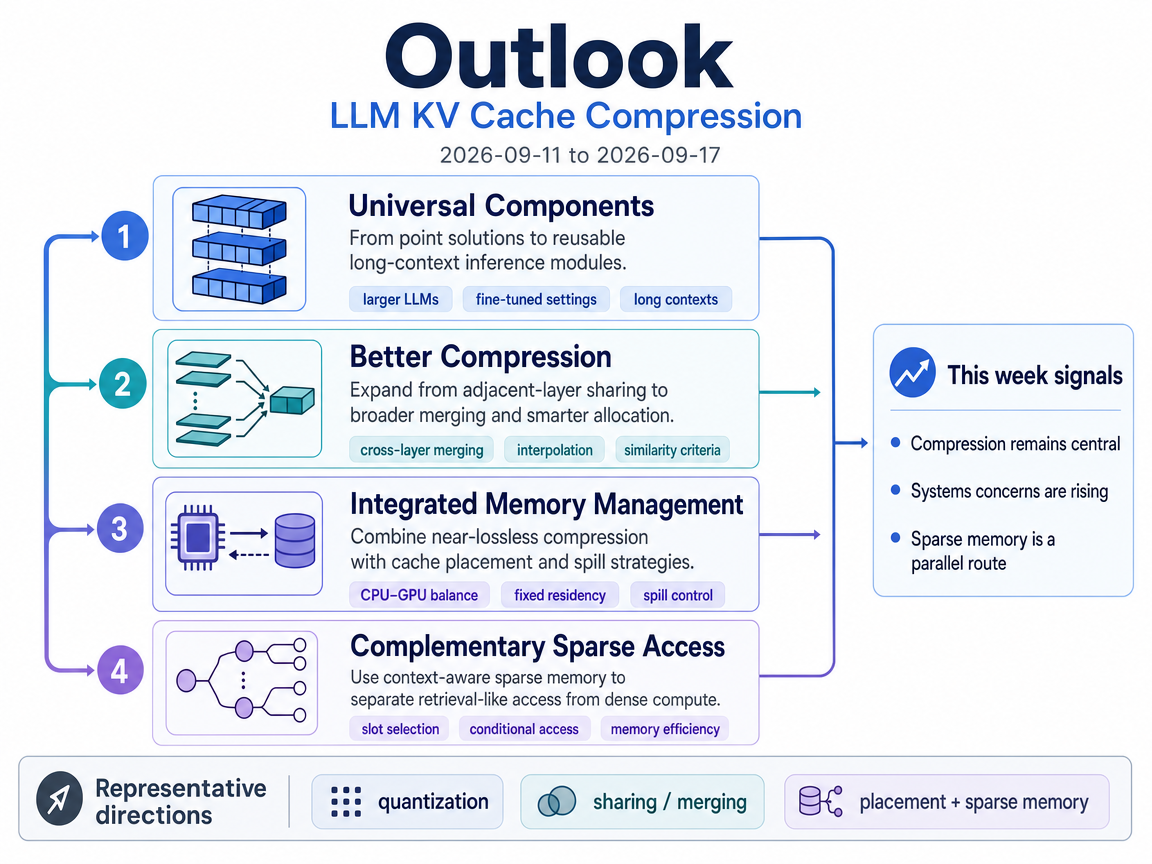
KV-cache compression is moving from isolated techniques toward reusable components for long-context inference. Progress depends on testing larger and fine-tuned models, distributing compression more efficiently, and improving similarity-based merging across multiple layers. The next step is integrated memory management that combines near-lossless compression with CPU–GPU cache placement and spill strategies for moving data out of GPU memory. Context-aware sparse memory offers a complementary way to separate selective information retrieval from dense computation.
Infographic (English)
Three-Year Movement
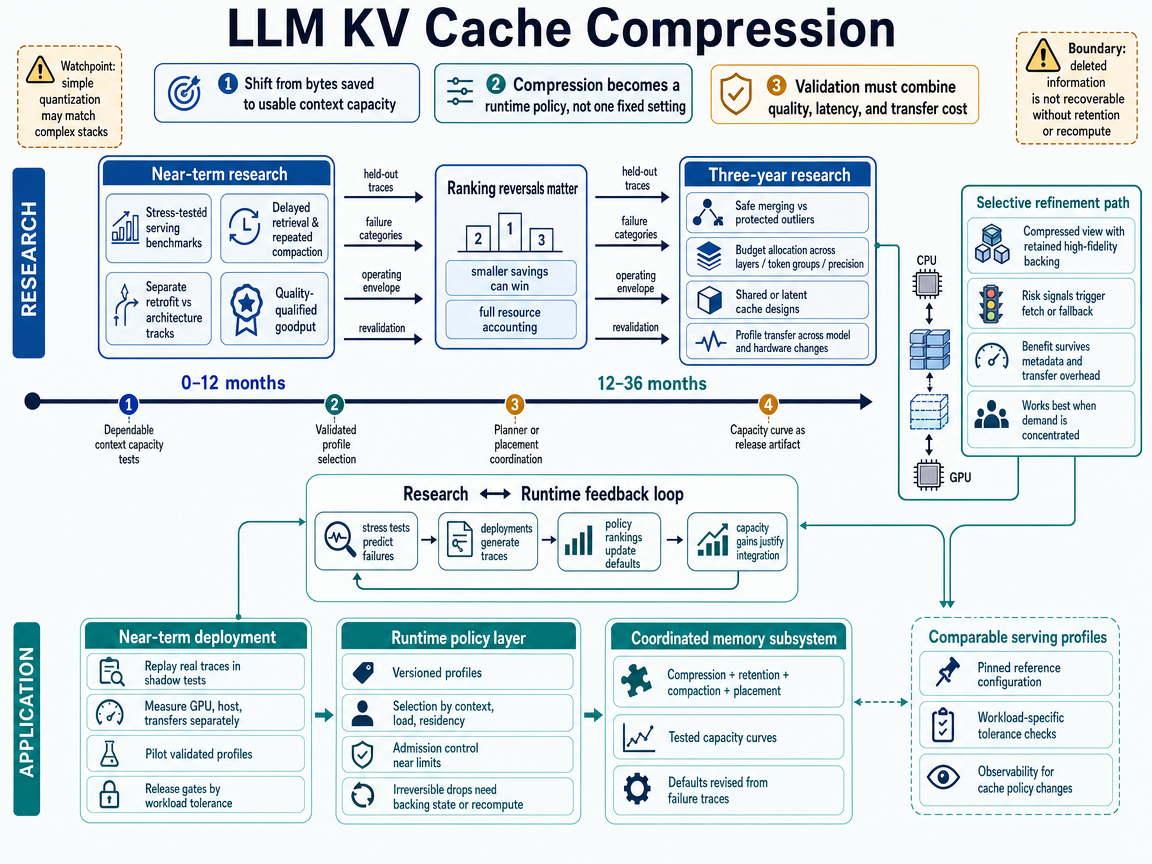
Over three years, KV-cache compression could become a coordinated memory subsystem, judged by dependable service capacity rather than memory savings alone. Like testing electricity supply under stress, this approach would measure whether compressed caches support answers within defined quality and response-time limits. In the first year, researchers would test whether models preserve easily overlooked facts through repeated cache consolidation and concurrent requests with different context lengths. The main measure would be quality-qualified goodput: completed work that meets both answer-quality and response-time requirements, with memory use and transfer overhead reported separately. A useful early signal would be a reproduced ranking reversal, where a method with smaller headline savings supports more usable capacity across different models and hardware.
In the second year, failures from these tests would guide decisions about which cached states can safely merge and which rare information needs protection. Runtime teams would package successful settings into validated profiles, each tied to a particular model and execution environment rather than presented as a universal solution. Software could select among those profiles using context length and current load, while delaying additional requests when tested operating limits would otherwise be exceeded. This remains bounded selection among tested choices, because memory counters alone cannot tell the runtime whether an answer will preserve the information a user needs.
By the third year, developers could compare models designed with compact caches against compression added to existing models under the same quality and latency constraints. Participating runtimes could coordinate compression with retention and data placement, producing tested curves that show how supported concurrency changes as contexts grow. Operational failures would become new test cases, whose results would revise profile rankings and eventually change the runtime's default settings. The pathway weakens if these tests fail to predict application problems, or if simple quantization delivers comparable results with much less complexity. Even successful validation would establish only a tested operating range, since deleted information may be unrecoverable and unfamiliar prompts can expose new failures.
Over three years, compression could become an adjustable execution plan rather than one fixed cache setting, with higher-fidelity data accessed only when it helps. The mechanism resembles approximate database queries: a compact cache provides a cheap initial view, while retained source states offer a possible refinement path. In the first year, researchers would link compressed blocks to their retained originals and test whether inexpensive signals identify when refinement improves answers. Serving pilots would compare this approach with a well-tuned fixed policy, counting backing storage and transfer overhead rather than measuring GPU memory savings alone. An early monitoring cue would be refinement demand concentrated in a small share of cases, alongside reliable quality-risk predictions on previously unseen requests.
If those comparisons succeed, the second year would turn manually tuned rules into model-specific profiles describing the runtime cost and observed quality risk of supported operations. Engineers would coordinate advance data fetching with generation batches, because simultaneous requests for backing data could overwhelm the connection between CPU and GPU memory. Sampled comparisons against higher-fidelity execution would expose costly mistakes, helping the planner reduce unnecessary refinement while checking whether its signals survive unfamiliar prompts and model updates. Tested fallback settings and limits on incoming work would constrain failures when demand or prediction errors exceed the conditions covered by those profiles.
By the third year, successful results could influence cache layouts and attention kernels, making movement between compressed views and retained states less expensive. Records of how each compressed block was formed would help the runtime identify what information is available for refinement and what has already been lost. Suitable services could then use adjustable compression plans within demonstrated quality and latency limits, while continuing to measure host-memory pressure and transfer costs. The scenario weakens if reliable error detection requires higher-fidelity processing almost everywhere, or if a fixed compression-and-placement policy performs just as well. Refinement also cannot generally undo earlier internal model changes or generated tokens, so fetching better data is not a complete recovery mechanism.
Over three years, changing cache policies could lead to shared disclosure and qualification practices, because identical model weights do not ensure identical long-context behavior. The mechanism is focused comparison with a named reference configuration, establishing acceptable differences for specified workloads rather than claiming identical answers on every prompt. In the first year, researchers would compare cache settings at fixed memory budgets, testing delayed information use and reporting uncertainty in measured quality differences. Runtime teams would add profile identifiers and configuration logs, making it easier to trace a reported regression to a change in memory policy. A documented failure caused by an undisclosed cache change could prompt a customer or consortium to require disclosure and an abbreviated reference comparison.
A small shared evaluation suite would connect research to deployment by helping developers find lower-memory configurations that still meet a defined quality requirement. This pathway would accelerate only if a reusable test report costs less to produce than repeatedly answering separate customer requests for evidence. In the second year, an actual requirement could support a registry of passing configurations, recording their model versions and execution conditions alongside the tested memory policies. Different workloads would need different tolerances, and changes to the runtime or request distribution would require renewed evidence rather than relying indefinitely on an earlier result.
By the third year, automated testing and reusable reports could make qualification routine within participating organizations, without implying that a universal certification system has emerged. Models designed around compact caches would shift evaluation toward whole memory subsystems, since their compressed representation would already be part of the reference model. Operators could select qualified profiles for particular workloads and return to a reference mode when monitoring shows that the earlier evidence no longer applies. The strongest monitoring cue would be customers actually requiring these reports and runtimes making qualified configurations easy to select and record. If no such requirements appear, results cannot be reproduced, or testing remains too costly, the likely outcome is better engineering practice rather than shared qualification infrastructure.
1-Year / 3-Year Research-Application Infographic
References
- MiniCache: KV Cache Compression in Depth Dimension for Large Language Models - Authors: Akide Liu, Jing Liu, Zizheng Pan, Yefei He, Gholamreza Haffari, Bohan Zhuang, / <See Details on Fugu-MT> / License: CC-BY-4.0
- Model Tells You Where to Merge: Adaptive KV Cache Merging for LLMs on Long-Context Tasks - Authors: Zheng Wang, Boxiao Jin, Zhongzhi Yu, Minjia Zhang, / <See Details on Fugu-MT> / License: CC-BY-4.0
- Lossless KV Cache Compression to 2% - Authors: Zhen Yang, J. N. Han, Kan Wu, Ruobing Xie, An Wang, Xingwu Sun, Zhanhui Kang, / <See Details on Fugu-MT> / License: CC-BY-4.0
- MoME: Mixture-of-Memory Embeddings for Context-Aware Sparse Lookup - Authors: Muchen Li, Leonid Sigal, Renjie Liao / <See Details on Fugu-MT> / License: CC BY 4.0