Summary
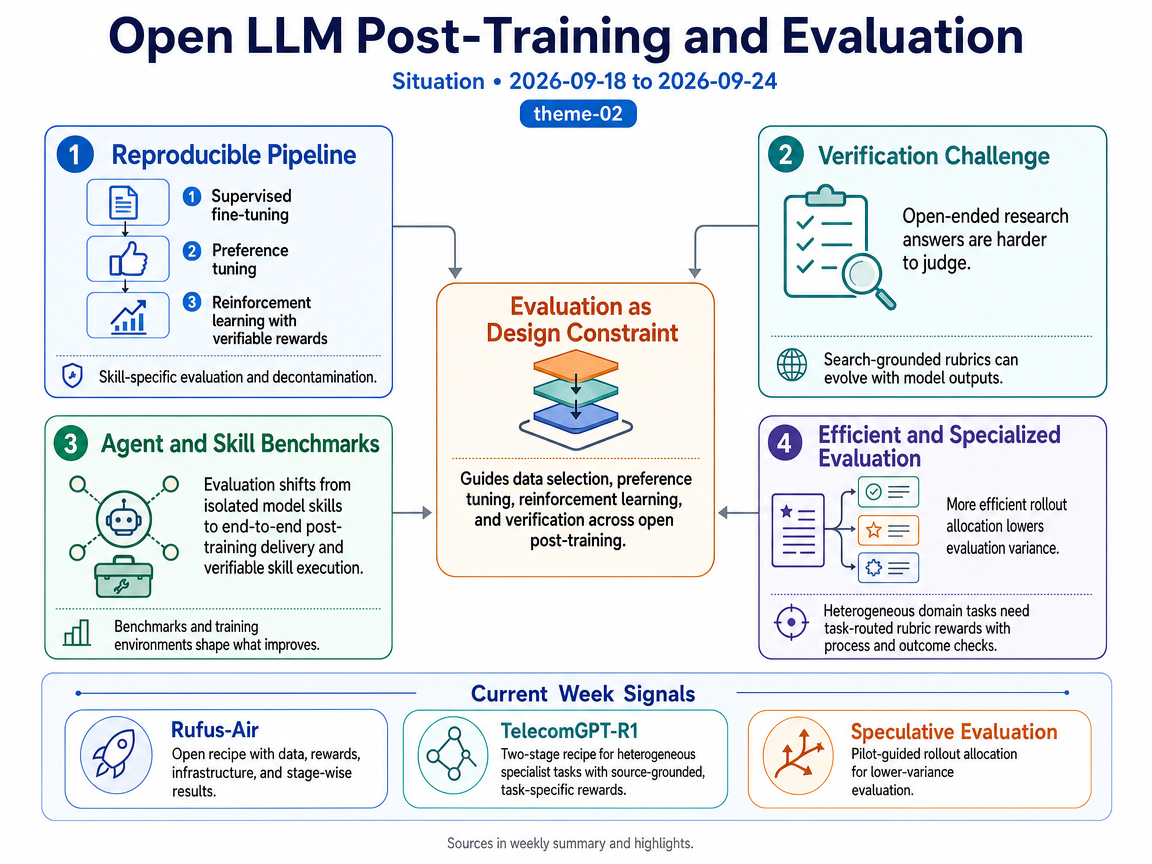
The theme centers on open, multi-stage LLM post-training in which evaluation and verification guide data selection, preference tuning, and reinforcement learning. This week's work adds reproducible recipes, agent-oriented benchmarks, and more efficient evaluation. Telecom work extends the pattern to heterogeneous domain tasks, emphasizing source-grounded training and task-specific rewards rather than treating general reasoning ability as sufficient.
Situation
TÜLU 3 frames post-training as a reproducible pipeline of supervised fine-tuning, preference tuning, and reinforcement learning with verifiable rewards, guided by skill-specific evaluation and decontamination. The post-training survey places these choices alongside test-time scaling while highlighting factual reliability, alignment, and the difficulty of evaluating reasoning. DR Tulu shows why verification becomes harder for open-ended research answers: fixed rubrics may miss important qualities, motivating search-grounded rubrics that evolve with model outputs.
As current-week evidence, “TelecomGPT-R1: Unified Post-Training for Reasoning Across Heterogeneous Telecom Tasks” applies a two-stage supervised fine-tuning and reinforcement-learning recipe to standards, logs, configurations, formulas, and code. Its introduction argues that these tasks differ in reasoning structure, verifier design, and reward density, and it uses task-routed rubric rewards that combine process feedback with outcome correctness. Together, these papers treat evaluation not merely as a final score but as a design constraint throughout open post-training, especially when answers must be grounded in external or specialized sources.
Infographic (English)
Progress
Rufus-Air: An Open LLM Post-Training Recipe <See Details on Fugu-MT>
Rufus-Air documents an open post-training recipe on GLM-4.5-Air-Base. It makes data, reward design, infrastructure, stage order, and stage-wise results available for reproduction.
Trains but Doesn't Learn: A Post-Training Delivery Benchmark for LLM Agents as Forward-Deployed Engineers <See Details on Fugu-MT>
This benchmark evaluates LLM agents that fine-tune, evaluate, and deploy models under a budget. It shifts evaluation from model skills to end-to-end post-training delivery on open bases from 8B to 70B across several GPU types.
SkillGym: Internalizing Human Skills into LLMs for Real-World Problem Solving <See Details on Fugu-MT>
SkillGym turns human skills into executable, verifiable training environments for LLM agents. It ties agent training to verifiable skill execution, with its 35B agent reported at 51.47% on skill-assisted SkillsBench.
GVPO++: Group Variance Policy Optimization for LLM Post-Training and On-Policy Distillation <See Details on Fugu-MT>
GVPO++ builds gradient weighting from the analytic solution of KL-constrained reward maximization. It extends the same post-training method to on-policy distillation.
TelecomGPT-R1: Unified Post-Training for Reasoning Across Heterogeneous Telecom Tasks <See Details on Fugu-MT>
TelecomGPT-R1 releases an open telecom reasoning model and a reproducible training recipe. It applies verification-aware post-training to heterogeneous specialist tasks rather than relying on general reasoning alone.
Speculative Evaluation of Stochastic LLMs <See Details on Fugu-MT>
Speculative evaluation allocates stochastic LLM rollouts using pilot results and speculative continuations. It reduces evaluation variance by 12.8–33.6% on average versus uniform allocation at 8–64 rollouts per task.
Critical-State RL: Diagnosing Trainable States for Multi-Turn Tool Use <See Details on Fugu-MT>
Critical-State RL diagnoses which multi-turn tool-use states are worth training on. It checks whether rewards capture an action's effect on task success and whether a reference policy can be improved, tested on BFCL v4.
ACLArena: Agent Continue Learning in Multi-stage Post-training <See Details on Fugu-MT>
ACLArena studies how agent capabilities carry over across multi-stage post-training. It adds a continual-learning recipe combining offline trajectory replay with RL-routed LoRA experts.
Outlook
Outlook Summary
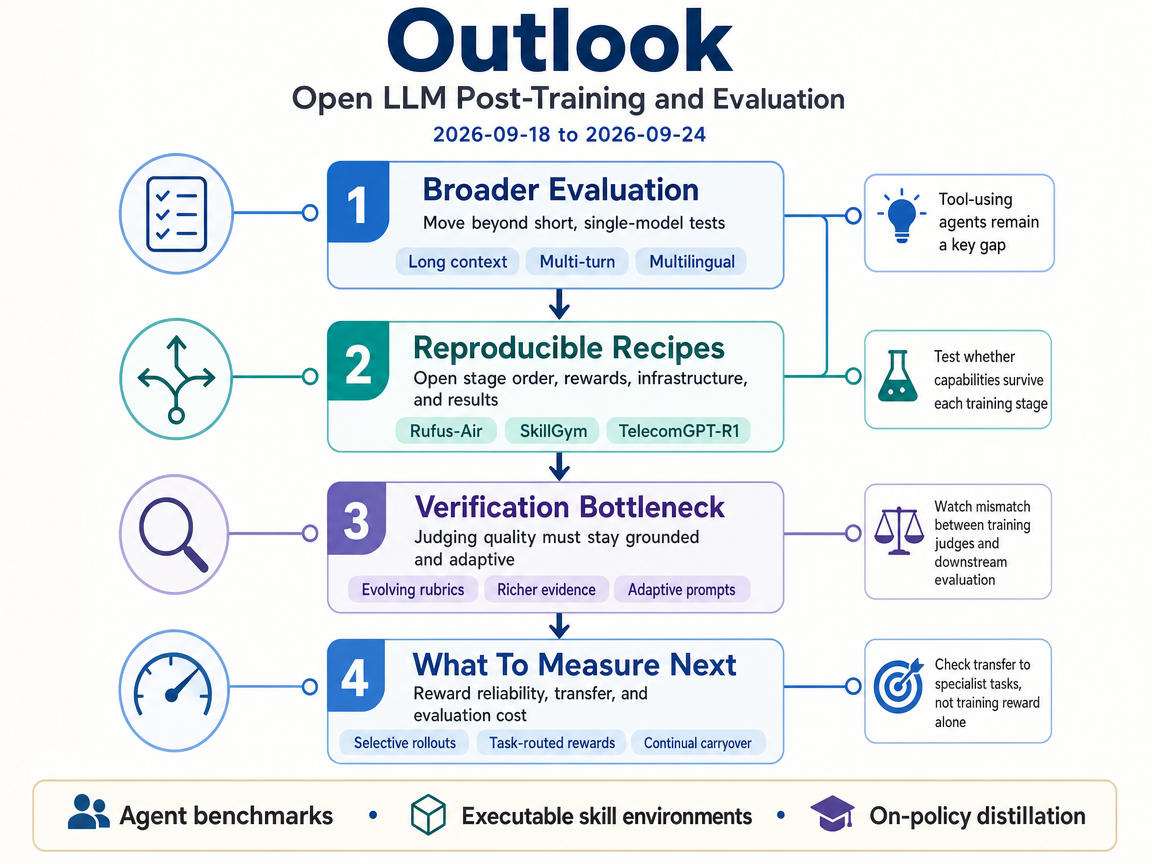
Open post-training recipes are likely to expand toward longer interactions, multilingual tasks, and tool-using agents, addressing gaps identified by TÜLU 3. Reproducible workflows and executable benchmarks can test whether skills survive successive training stages and transfer to specialist tasks. Verification remains a bottleneck: DR Tulu suggests evolving, search-grounded rubrics but exposes disagreement between training judges and downstream tests. Task-specific rewards and selective evaluation therefore need scrutiny for reward hacking, judging reliability, and total evaluation cost, rather than acceptance based on training rewards alone.
Infographic (English)
Three-Year Movement
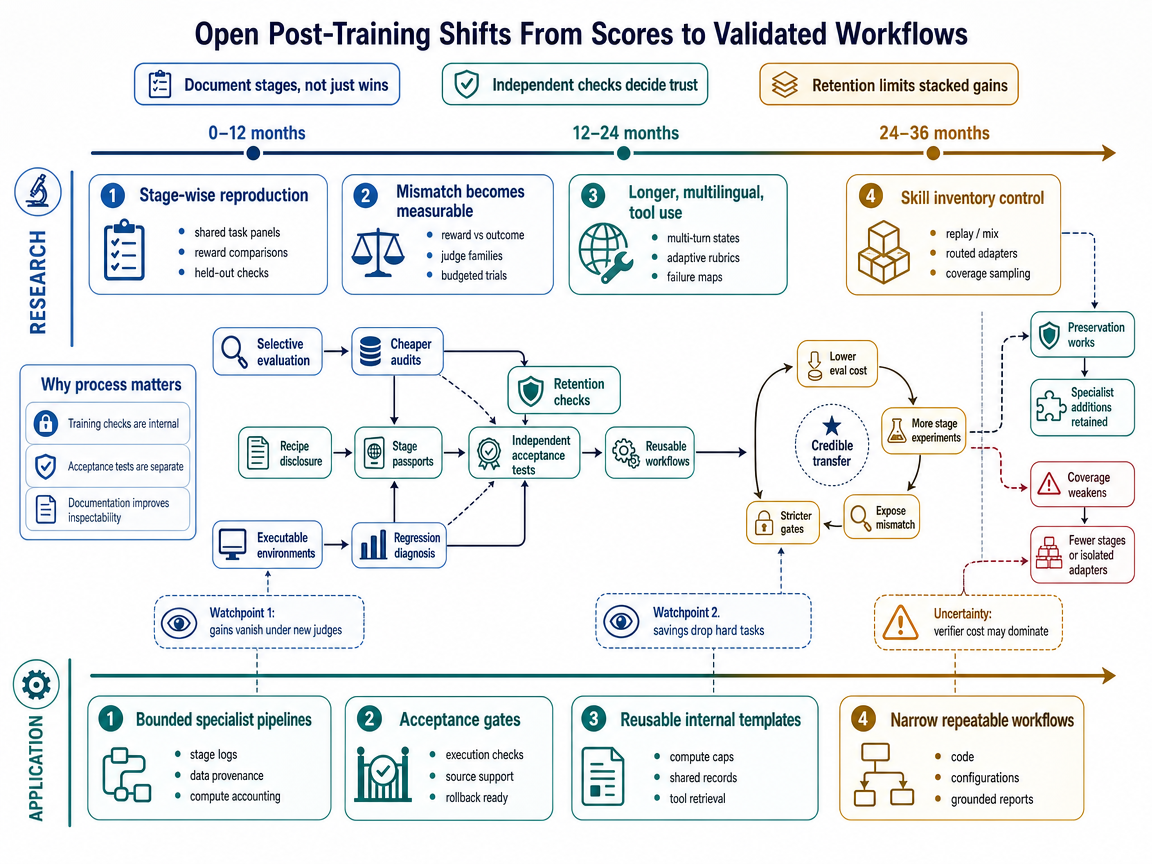
Over the next three years, open post-training research could produce a small set of repeatable specialist workflows rather than broadly autonomous agents. TÜLU 3's documented training sequence and DR Tulu's reward experiments provide a starting point, but stronger training scores still require separate tests of practical performance. In the first year, teams would reproduce individual training stages and compare reward designs while recording how each model was produced. A meaningful early signal would be at least two independent groups reproducing stage-level gains under separate downstream evaluations, rather than merely publishing additional recipes.
If that evidence accumulates, the second year would extend the recipes into longer conversations and tool use, with other languages testing the limits of transfer. Teams would also check whether changing scoring rubrics continue to distinguish good answers from poor ones as models adapt to those rubrics. Practical work could settle around a few tested templates for specialist tasks, reducing the need to rebuild each training and evaluation pipeline. The mechanism resembles process validation: documented training stages make development inspectable, while a separate acceptance test checks whether the resulting model serves its intended purpose. More selective testing could lower evaluation costs and support additional experiments, provided it does not achieve savings by avoiding difficult tasks.
By year three, teams could add specialist skills individually, test whether earlier abilities remain intact, and retain the previous version when regressions are unacceptable. Reusing earlier training examples or attaching small specialist modules could help preserve capabilities, although neither method is established here as a guaranteed solution. Researchers would then test whether these controlled additions remain useful after accounting for the full cost of training and verification, including answer generation. The supplied weekly reports remain starting points for replication, not independently verified evidence that this transition has already occurred. Gains that disappear under a different evaluator would weaken the scenario, because documentation alone cannot establish reliability with unfamiliar users or tools.
This scenario assumes that rewards improve enough to support repeated training stages, while checking everything those stages might damage remains costly. The resulting three-year shift would make preservation of earlier capabilities a central constraint on dependable model development, rather than replacing reward quality as a concern. During the first year, researchers would measure skills after each stage and compare methods that reuse earlier examples or separate specialist functions. Engineering teams would keep a stage record showing what changed, what improved, and what regressed before accepting a new model version.
Independent reproduction of both gains and retained skills within comparable budgets would be a strong early monitoring signal that these preservation methods work. In the second year, longer interactions and unfamiliar tools would expand the abilities needing protection, while multilingual testing would reveal further gaps in coverage. The mechanism resembles a biological ratchet: each stage can improve its immediate objective while introducing a loss elsewhere that subsequent work fails to reverse. Reusing earlier examples or routing tasks to specialist components could interrupt that accumulation, but researchers would need to measure the associated repair costs. The danger emerges when new stages create hidden losses faster than available checks can detect them, and successive repairs add still more complexity.
By year three, the main evaluation question would be how to keep the full set of required skills observable within a fixed testing budget. Selective testing would need to preserve coverage of uncommon capabilities, not simply reduce repeated trials on familiar tasks while leaving whole skill categories unchecked. If preservation controls succeed, teams could maintain multi-skill models through reversible specialist additions, supported by coverage records and a reliable return to earlier versions. If they fail, a stable general model paired with separate specialist modules could become more practical than an increasingly complicated sequence of training stages. The analogy remains limited because checkpoints can be restored; cheap detection of forgotten skills or consistent recovery without special preservation methods would weaken this scenario.
Over three years, shared measurement tools could become a trusted basis for deciding which post-training results deserve reuse, rather than remaining optional reporting aids. The starting concern is that better training rewards do not consistently predict better downstream performance, even when teams openly document their training recipes. In the first year, researchers would independently reproduce stage-level gains and test whether conclusions survive changes in evaluators and computing budgets. A shared evaluation harness, meaning software that runs comparable checks and records results, could make these comparisons easier to repeat across different teams.
The key early signal would combine recurring reproduction failures with a maintained shared harness that at least one team uses to accept or reject delivery. If that threshold is crossed, second-year testing would expand into longer conversations and unfamiliar tools, while other languages would expose limits in recipe transfer. Engineering teams would introduce release checks that block a new training stage when it erases earlier abilities required for the intended task. The reinforcing mechanism is straightforward: comparable tests expose weak recipes, teams favor stronger external evidence, and shared checks gain influence over subsequent research. Like common reporting definitions in public health, these instruments could make scattered observations comparable without implying that any single test establishes reliability everywhere.
By year three, continued reuse could favor a small number of compatible evaluation systems that let teams adapt established workflows without reconstructing every check. Their maintainers would increasingly help define acceptable evaluation uncertainty and capability loss, while making the resources needed to demonstrate performance more visible. Researchers would still need to test whether these instruments measure the intended abilities, including source support in research reports and successful completion of unfamiliar tool interactions. A major caveat is that familiar checks can become optimization targets, allowing models to satisfy scoring rules without genuinely improving the underlying task. Independent evaluators and refreshed tasks could help, but unmaintained repositories or continued preference for inexpensive custom checks would weaken the proposed shift toward shared verification.
1-Year / 3-Year Research-Application Infographic
References
- TÜLU 3: Pushing Frontiers in Open Language Model Post-Training - Authors: Nathan Lambert, Jacob Morrison, Valentina Pyatkin, Shengyi Huang, Hamish Ivison, Faeze Brahman, Lester James V. Miranda, Alisa Liu, Nouha Dziri, Shane Lyu, Yuling Gu, Saumya Malik, Victoria Graf, Jena D. Hwang, Jiangjiang Yang, Ronan Le Bras, Oyvind Tafjord, Chris Wilhelm, Luca Soldaini, Noah A. Smith, Yizhong Wang, Pradeep Dasigi, Hannaneh Hajishirzi, / <See Details on Fugu-MT> / License: CC-BY-4.0
- LLM Post-Training: A Deep Dive into Reasoning Large Language Models - Authors: Komal Kumar, Tajamul Ashraf, Omkar Thawakar, Rao Muhammad Anwer, Hisham Cholakkal, Mubarak Shah, Ming-Hsuan Yang, Phillip H. S. Torr, Salman Khan, Fahad Shahbaz Khan, / <See Details on Fugu-MT> / License: CC-BY-4.0
- DR Tulu: Reinforcement Learning with Evolving Rubrics for Deep Research - Authors: Rulin Shao, Akari Asai, Shannon Zejiang Shen, Hamish Ivison, Varsha Kishore, Jingming Zhuo, Xinran Zhao, Molly Park, Samuel G. Finlayson, David Sontag, Tyler Murray, Sewon Min, Pradeep Dasigi, Luca Soldaini, Faeze Brahman, Wen-tau Yih, Tongshuang Wu, Luke Zettlemoyer, Yoon Kim, Hannaneh Hajishirzi, Pang Wei Koh, / <See Details on Fugu-MT> / License: CC-BY-4.0
- TelecomGPT-R1: Unified Post-Training for Reasoning Across Heterogeneous Telecom Tasks - Authors: Bohao Wang, Chenwei Wu, Hang Zou, Yu Tian, Lina Bariah, Li Wei, Chongwen Huang, Yongliang Shen, Zhaoyang Zhang, Merouane Debbah / <See Details on Fugu-MT> / License: CC BY 4.0