Summary
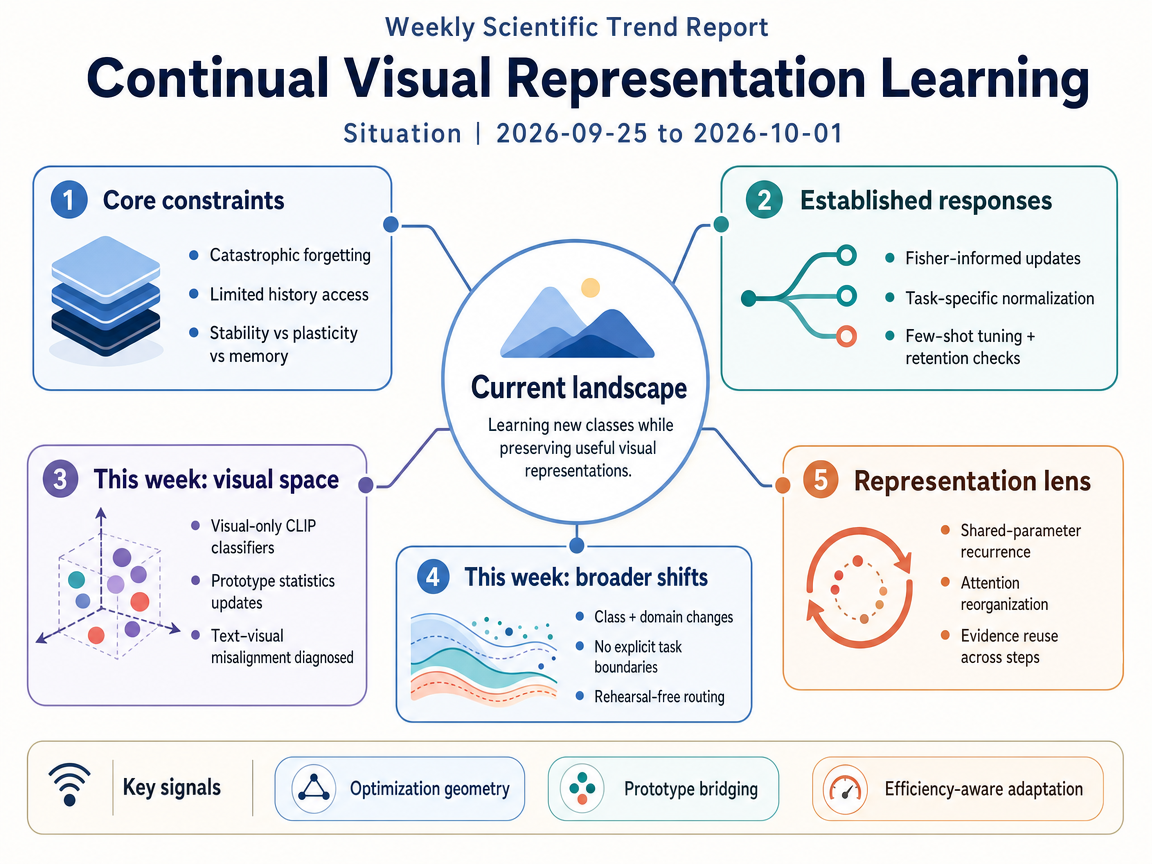
The theme centers on preserving useful visual representations while learning new classes. Representative work addresses optimization geometry, lightweight task-specific adaptation, and few-shot stability–adaptability trade-offs. This week's evidence adds visual-only CLIP classifiers, text–visual prototype bridging, and boundary-free class and domain shifts. A recurrent vision–language study extends the discussion to how representations evolve under shared-parameter processing.
Situation
Class-incremental learning remains constrained by catastrophic forgetting, limited access to historical data, and the competing demands of stability, plasticity, and memory efficiency. The representative Introductions outline complementary responses. "Closing the Oracle Gap" reports low-loss linear connectivity in full-history-data oracles of advanced incremental methods and motivates Fisher-informed update transformations that do not rely on replay. Task-specific batch normalization preserves the shared feature extractor while adding small normalization and classification modules, using out-of-distribution detection to infer task identity. For few-shot settings, "A Bag of Tricks for Few-Shot Class-Incremental Learning" combines stronger embedding separation with selective encoder tuning, and it evaluates retention and novel-class adaptation rather than accuracy alone.
Current-week supplemental evidence adds two distinct perspectives. "Visual Branch is What You Need for CLIP-based Class-Incremental Learning" diagnoses misalignment between textual classifier weights and visual class distributions. This motivates visual prototypes and incremental classifiers built from additive sufficient statistics. Separately, "LoopVL: Recurrent Visual Intelligence" (2609.38426v1) studies shared-parameter recurrence over joint vision–language states and reports that later steps reorganize and reuse visual evidence. Although it is not a continual-learning method, it extends the representation discussion to spatial attention dynamics and to deeper multimodal computation without additional parameters.
Infographic (English)
Progress
Visual Branch is What You Need for CLIP-based Class-Incremental Learning <See Details on Fugu-MT>
VIS advances CLIP-based class-incremental learning by removing the textual branch at deployment and classifying entirely in visual space. Visual prototypes and closed-form updates from additive sufficient statistics address the diagnosed text–visual classifier misalignment.
Hyperbolic Prototype Routing for Rehearsal-Free Class-Incremental Learning <See Details on Fugu-MT>
HyPro introduces a rehearsal-free class-incremental learning framework. It brings hyperbolic prototype routing to the setting where past exemplars are not stored.
Dual-Mode Low-Rank Learner with Bridge-Prototype Ensemble for Vision-Language Class-Incremental Learning <See Details on Fugu-MT>
DuLBE combines dual-mode low-rank learning with a bridge-prototype ensemble for vision-language class-incremental learning. Unlike visual-only classification, it links visual prototypes and text embeddings through geodesic bridges while retaining low-rank parameter efficiency.
Online Versatile Incremental Learning: Towards Class and Domain-Agnostic Adaptation at Any Time <See Details on Fugu-MT>
Online VIL extends incremental learning to classes and visual domains that evolve simultaneously without explicit task boundaries. TopFlow combines domain-agnostic flow matching with global topology preservation to retain knowledge without explicit memory of past inputs.
LoopVL: Recurrent Visual Intelligence <See Details on Fugu-MT>
LoopVL examines how visual representations evolve under recurrent updates of shared vision–language states. Its observed attention shifts across loops point to evidence reuse during computation as a lens on representation behavior.
Decoupled and Distilled: Task-Adaptive LoRA-Teachers with Ensemble Knowledge Transfer for Few-Shot Class-Incremental Learning <See Details on Fugu-MT>
TALON introduces task-adaptive LoRA teachers with ensemble knowledge transfer for few-shot class-incremental learning. It adds inference efficiency as an explicit design goal alongside retention and adaptation.
Outlook
Outlook Summary
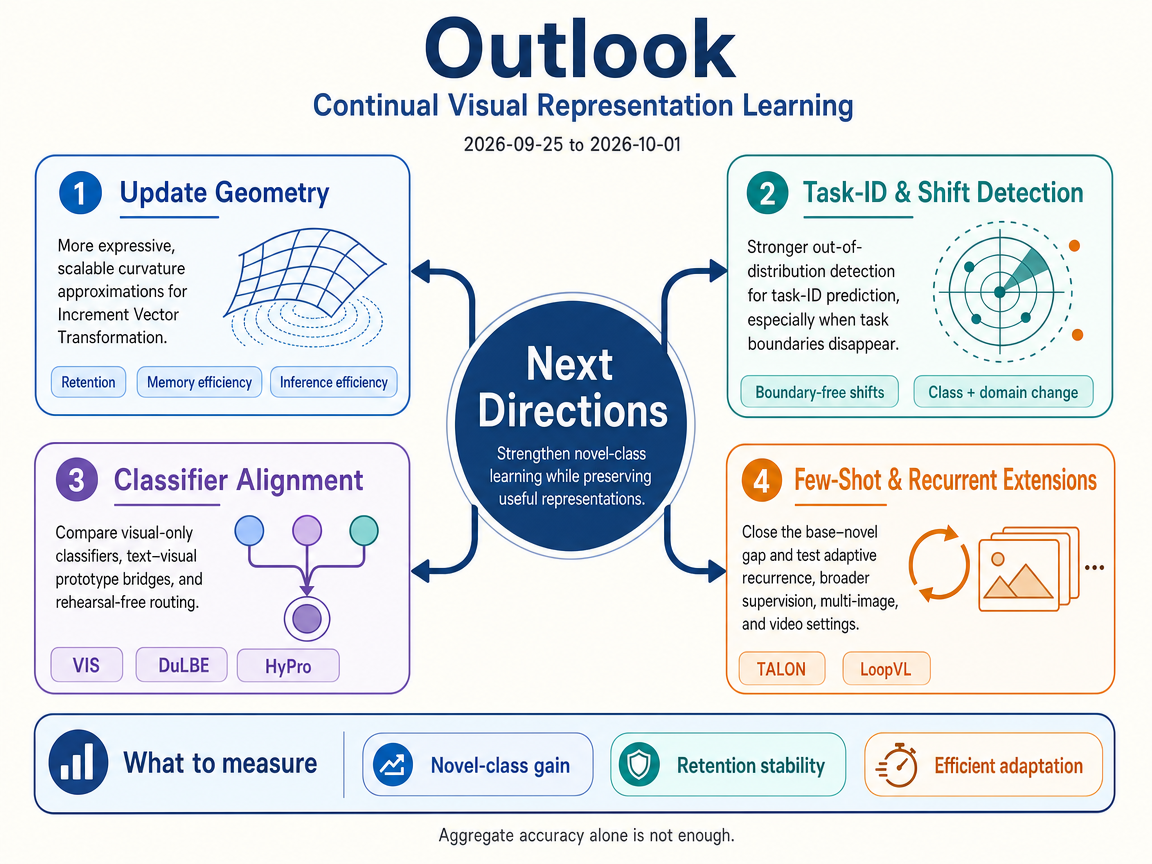
Next steps include richer but scalable curvature approximations for Increment Vector Transformation, stronger out-of-distribution detection for task routing, and a smaller learning gap between base and new classes. Comparisons should test whether improved updates, routing, or classifier alignment help new classes without weakening retention or exceeding memory and inference limits; aggregate accuracy is insufficient. Simultaneous class and domain shifts without explicit boundaries make routing and feature preservation harder to assess. Separately, LoopVL proposes matched recurrent controls, adaptive recurrence, and compute-matched tests. Broader post-training supervision would target repetitive reasoning, while multi-image and video extensions would test evidence integration beyond fixed image features. These multimodal directions remain proposed work, not demonstrated remedies for continual-learning forgetting.
Infographic (English)
Three-Year Movement
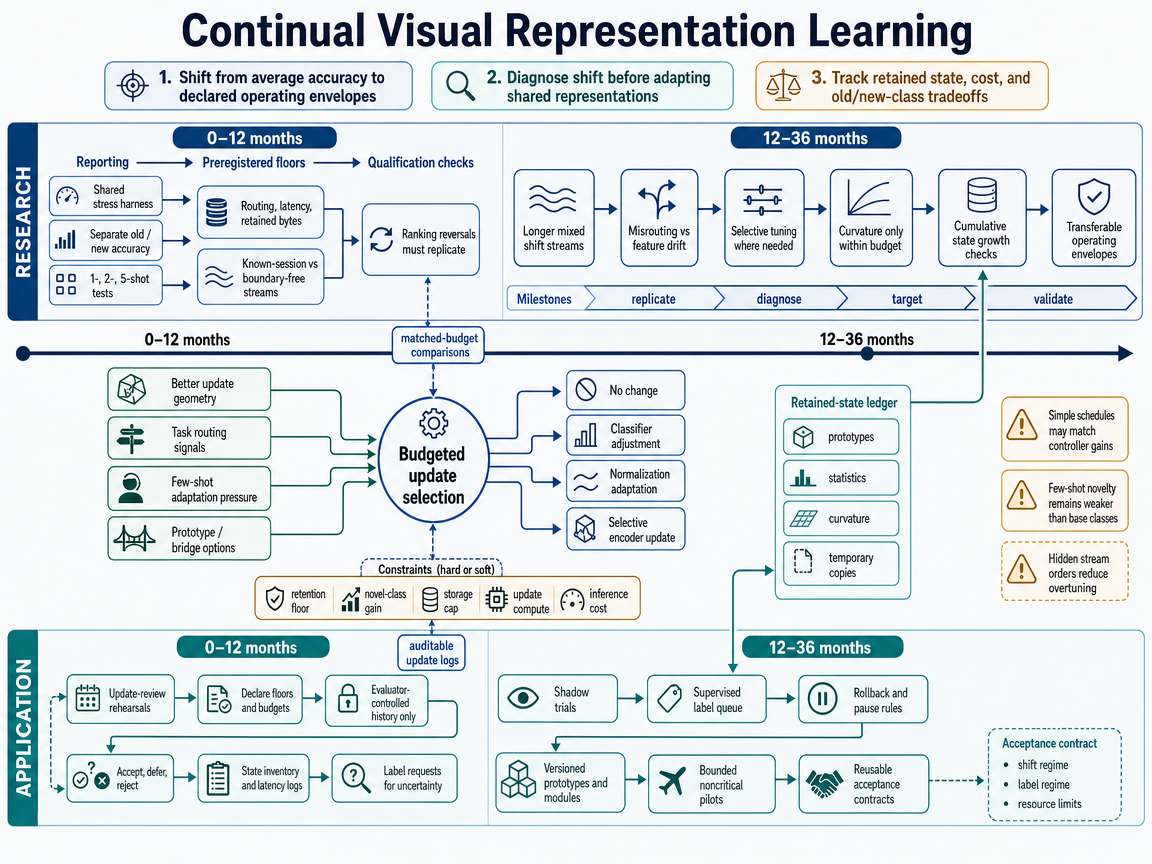
Over three years, this scenario moves from comparing individual learning methods toward repeatable tests of whether updates meet declared performance and resource requirements. In year one, a shared evaluation framework would separate old-class retention from new-class learning, rather than hide their differences inside one average accuracy score. It would also measure routing mistakes and resource use, with separate tests for known task sessions and streams whose task boundaries are unavailable. The mechanism resembles electricity-grid adequacy testing: a method qualifies only if it maintains required service under demanding conditions, not merely on average.
The proposed trigger is two independent groups reproducing consequential changes in method rankings across at least two stream settings after applying requirements chosen before seeing results. In year two, longer streams and overlapping class and domain changes would help researchers identify why methods fail, rather than combine techniques without diagnosis. Routing failures could motivate stronger detection of unfamiliar inputs, while weak new-class learning could justify selective tuning; richer curvature estimates would need to earn their extra computation. Practical teams could use these findings in shadow trials, where proposed updates are assessed without controlling the active workflow, with rollback available when checks fail.
By year three, the central question would be whether these improvements survive repeated updates, as small retained components can accumulate into substantial storage and processing demands. Hidden stream orders and independently generated shifts would test whether success extends beyond familiar benchmarks, while resource tiers would clarify which methods fit different limits. Successful trials could produce reusable acceptance agreements for bounded, non-critical applications, stating the conditions under which continued updating remains acceptable rather than promising universal reliability. A useful monitoring cue would be published results that separate old- and new-class accuracy and count all retained state, especially when these measurements change method selection. If matched tests preserve existing rankings, the case for qualification gates weakens, and neither these benchmarks nor medical-image rehearsals would establish clinical effectiveness.
Over three years, this scenario shifts attention from applying one adaptation method repeatedly toward a controller that diagnoses change before recommending an update. In year one, controlled image streams would test whether limited labels can distinguish a genuinely new class from changed image conditions, since confidence alone may confuse them. The mechanism is dual control: requesting a carefully chosen label can both help immediate learning and reveal which explanation of the change is more plausible. Fair comparisons would require better new-class learning at matched retention and resource limits, with random label requests and simple confidence rules receiving equally careful evaluation.
In year two, successful controllers would face delayed labels and overlapping changes, while tests with different encoders would examine whether their decisions transfer beyond the original setup. Diagnostic labels would expose mistaken explanations, and independent evaluation would show which interventions improved new classes without unnecessarily damaging recognition of earlier ones. If those lessons transfer, fewer unnecessary encoder changes could preserve scarce labels and computation for difficult cases, while operators manage requests and deferred decisions through a supervised queue. Because encoder updates alter the feature space used by stored prototypes, state versioning would track which components belong together and compatibility checks would prevent mismatched combinations.
By year three, the goal would be lightweight controllers supporting bounded nonclinical pilots, with operators approving changes rather than delegating unrestricted adaptation to the system. Researchers would test whether a smaller controller and fewer update options preserve the advantage after charging for diagnosis and assessment of candidate changes. Successful pilots could support a reusable interface that records the evidence behind each intervention and makes its uncertainty and resource cost visible across different visual-learning systems. The key monitoring cue would be gains that survive changed class orders and shift timing, while outperforming ordinary label selection followed by a simple update schedule. If diagnosis consumes too much of the label allowance or these gains fail to transfer, the credible outcome would be narrower diagnostic tools, not an autonomous update-control workflow.
Over three years, this scenario makes retained-state accounting a stronger influence on continual-learning design, alongside the existing need to balance retention with new-class learning. In year one, researchers would build ledgers describing what remains after old images are removed, recording the origin, size, and growth of retained objects. These records would distinguish resources needed for future updates from those needed only to classify images, revealing dependencies that a small deployed model can conceal. Early privacy tests would examine whether retained information exposes training-set membership or sensitive image content, although an unsuccessful attack would not establish safety.
The mechanism is a disclosure feedback loop: visible state growth prompts reviewer questions, repeated questions encourage bounded designs, and useful designs give buyers clearer update requirements. A benchmark adopting ledger columns beside accuracy, or a pilot buyer requesting the same disclosures, would provide an early monitoring cue that this mechanism is taking hold. In year two, researchers would test ways to shrink retained components and measure the resulting effects on retention, routing accuracy, and new-class learning. Reusable audit tools could help participating pilots define a retained-state envelope, meaning explicit storage limits and acceptance tests that each proposed update must satisfy.
By year three, the stronger version of this scenario would replace isolated disclosures with controlled update pipelines that check cumulative state growth alongside separate old- and new-class performance. Logs would explain why changes were accepted, while streams without clear task boundaries would require periodic snapshots and procedures to pause or reverse unacceptable updates. Around month 36, ledger appendices could become routine in participating research venues and a small number of procurement templates, encouraging research under fixed retained-state budgets. The persistent few-shot performance gap would remain unresolved, and equal storage sizes would not imply equal privacy risks because different retained objects preserve different information. Shared reporting rules followed by buyer-linked update criteria would strengthen this path; without buyer uptake, useful measurement improvements could persist without the proposed change in design priorities.
1-Year / 3-Year Research-Application Infographic
References
- A Bag of Tricks for Few-Shot Class-Incremental Learning - Authors: Shuvendu Roy, Chunjong Park, Aldi Fahrezi, Ali Etemad / <See Details on Fugu-MT> / License: CC-BY-SA-4.0
- Class Incremental Learning with Task-Specific Batch Normalization and Out-of-Distribution Detection - Authors: Xuchen Xie, Yiqiao Qiu, Run Lin, Weishi Zheng, Ruixuan Wang / <See Details on Fugu-MT> / License: CC-BY-SA-4.0
- Closing the Oracle Gap: Increment Vector Transformation for Class Incremental Learning - Authors: Zihuan Qiu, Yi Xu, Fanman Meng, Runtong Zhang, Linfeng Xu, Qingbo Wu, Hongliang Li / <See Details on Fugu-MT> / License: CC-BY-4.0
- Online Versatile Incremental Learning: Towards Class and Domain-Agnostic Adaptation at Any Time - Authors: Jae-Ho Lee, Min-Yeong Park, Jun-Yeong Moon, Jung Uk Kim, Gyeong-Moon Park / <See Details on Fugu-MT> / License: CC BY 4.0
- Visual Branch is What You Need for CLIP-based Class-Incremental Learning - Authors: Tao Hu, Zhen-Hao Xie, Jingcai Guo, De-Chuan Zhan, Da-Wei zhou / <See Details on Fugu-MT> / License: CC BY 4.0
- LoopVL: Recurrent Visual Intelligence - Authors: Zhe Qian, Ziyang Gong, Zhongxing Xu, Hehan Li, Zhonghua Wang, Fei Luo, Mingxuan Wang, Xue Yang, Shiwei liu, Yanbiao Ma, Junchi Yan, Jungong Han / <See Details on Fugu-MT> / License: CC BY 4.0