Summary
The representative research broadens LLM evaluation beyond single-turn correctness to multi-task interaction, learning across repeated attempts, and reward quality under increased inference compute. This week's additional evidence extends that reliability focus to multimodal deployment, reporting that token-pruning acceleration can increase jailbreak vulnerability even before task utility declines.
Situation
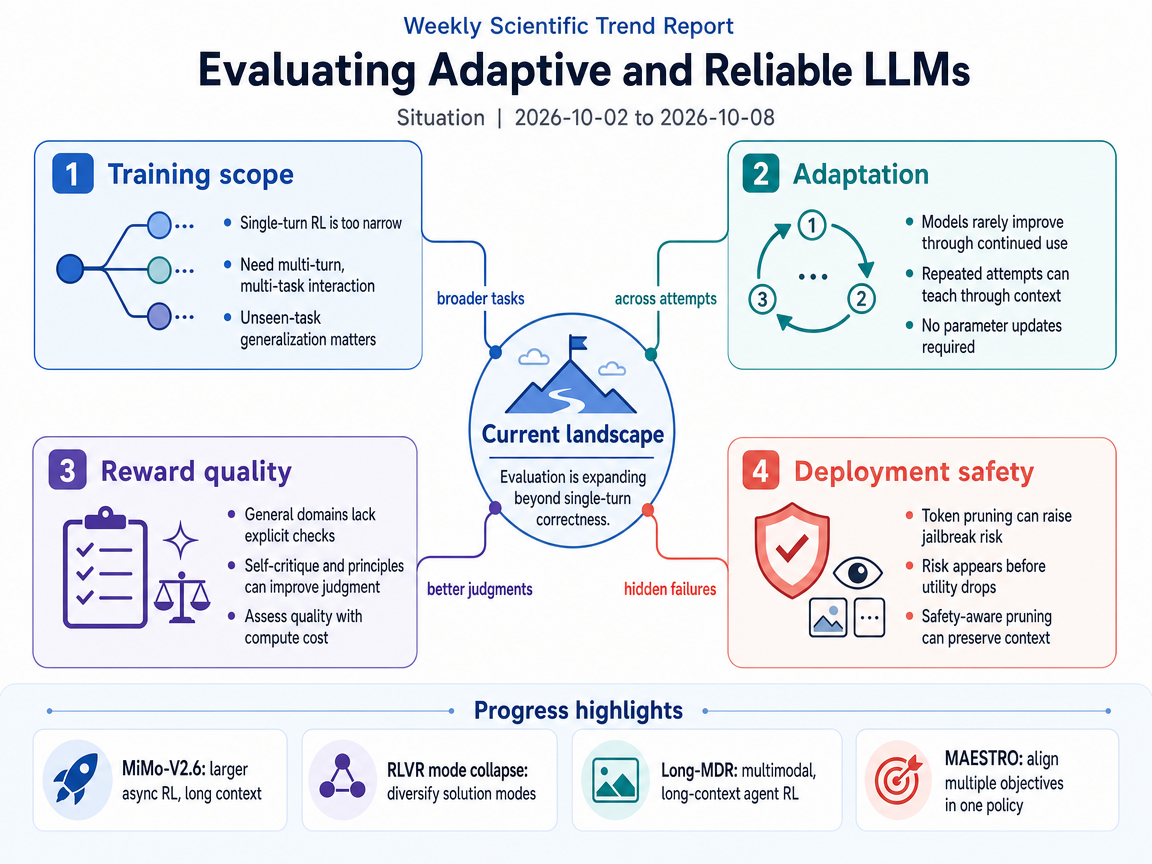
The representative Introductions identify complementary limitations in building general-purpose LLM agents. RL for LLMs has largely been limited to single-turn, single-task settings. Deployed models rarely improve through continued interaction. Rewards in general domains lack the explicit correctness checks that exist for parts of mathematics and coding. AgentRL addresses heterogeneous multi-turn training with asynchronous infrastructure, cross-policy sampling, and task advantage normalization. Orbit uses multi-episode meta-RL to train adaptation across repeated attempts using context alone, without parameter updates. Inference-Time Scaling for Generalist Reward Modeling adds a reward-side direction: it improves judgments through self-generated principles and critiques, combined with parallel sampling. Together, these papers motivate assessing unseen-task generalization, improvement across attempts, and reward quality alongside computational cost.
Current-week evidence from Understanding and Mitigating Token-Pruning-Induced Vulnerabilities in VLMs (2610.09703v1) adds a deployment-safety dimension. Its Introduction reports that several token-pruning strategies increase multimodal jailbreak vulnerability before task utility degrades, whereas query-based compression can improve safety. The proposed Safety-Aware Pruning restores benign visual context and reallocates attention. It reportedly reduces attack success while preserving efficiency and utility in the tested settings. This complements the representative emphasis on adaptive capability by showing that efficiency and task-accuracy measurements alone can miss reliability failures.
Infographic (English)
Progress
MiMo-V2.6: Scaling Reinforcement Learning Towards Self-Improvement <See Details on Fugu-MT>
MiMo-V2.6 scales asynchronous RL compute for an omni-modal model family, with contexts of up to one million tokens. It stabilizes large-scale training by freezing the MoE router and adding multilayer defenses against reward hacking.
Measuring and Mitigating Solution Mode Collapse in RLVR <See Details on Fugu-MT>
This study shows that RLVR post-training can concentrate probability on a few solution modes even as accuracy improves. Its method, Re:Max, stores one verified example per detected mode in a replay buffer and trains uniformly across the stored modes.
Long-MDR: Long-Context Reinforcement Learning for Multimodal Deep-Research Agents <See Details on Fugu-MT>
Long-MDR extends multi-turn agentic RL to multimodal deep research, training with 128k context and 75 tool-interaction turns. Its RL-trained 9B model ranks first on five of six benchmarks among the compared 7B–9B agents.
Which Preferences to Train On? End-to-End Multi-Objective Alignment with an Adversarial Preference Distribution <See Details on Fugu-MT>
MAESTRO frames multi-objective alignment as a minimax problem over preference distributions and trains a single prompt-conditioned policy end-to-end with RL. With up to three objectives, it reaches the best frontier on most tasks in a single training run, at the lowest training cost among the compared methods.
Outlook
Outlook Summary
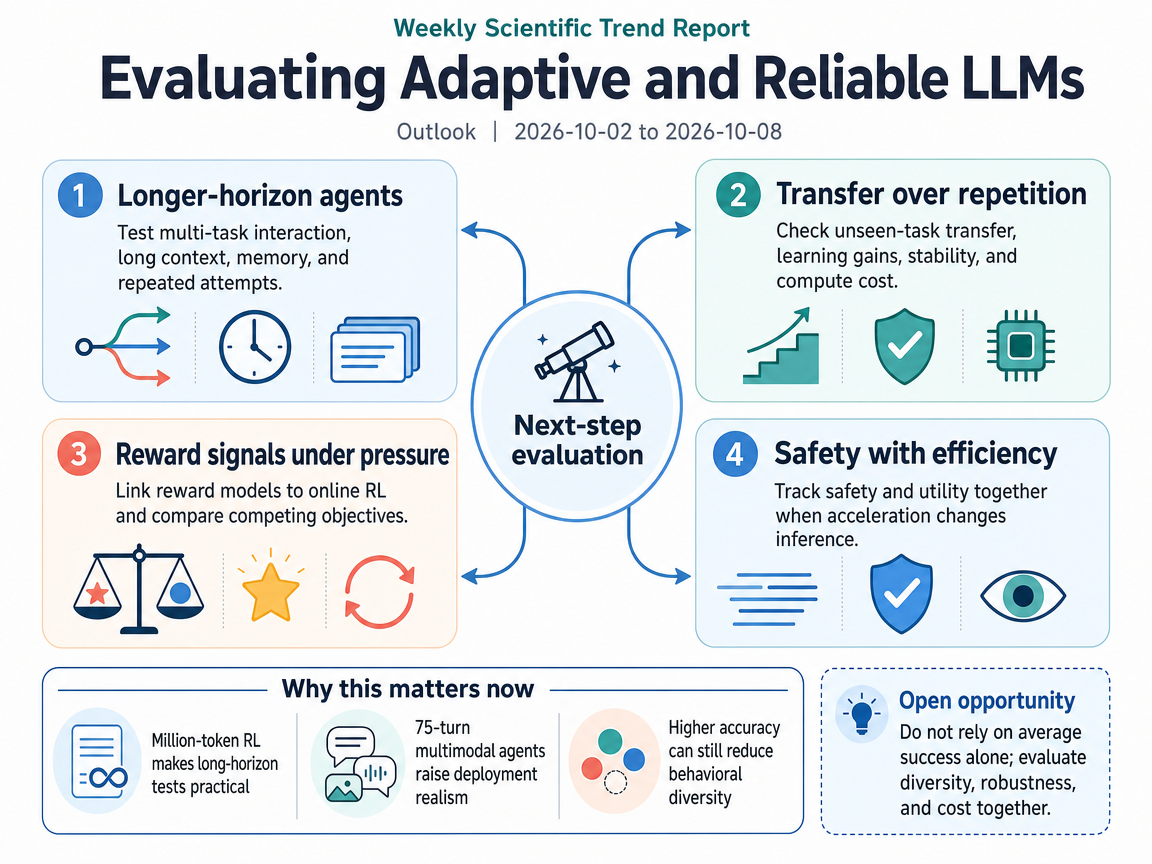
The next direction is broader evaluation of adaptive agents over longer interactions, supported by more varied training environments and better memory and credit assignment. Million-token RL training and 75-turn multimodal research workflows make this direction concrete, but longer interaction does not prove reliable learning. Tests should measure transfer to unfamiliar tasks and improvement across attempts while tracking training stability and computational cost. Higher accuracy can also hide a narrowing of useful solution strategies. A complementary direction connects reward assessment more closely with agent training and inference, including online RL and offline evaluation. Reward signals should be tested across competing criteria and under pressure from optimization. Because token pruning can weaken multimodal safety before ordinary task performance declines, safety and efficiency need joint evaluation rather than treating higher scores or lower computation as evidence of reliability.
Infographic (English)
Three-Year Movement
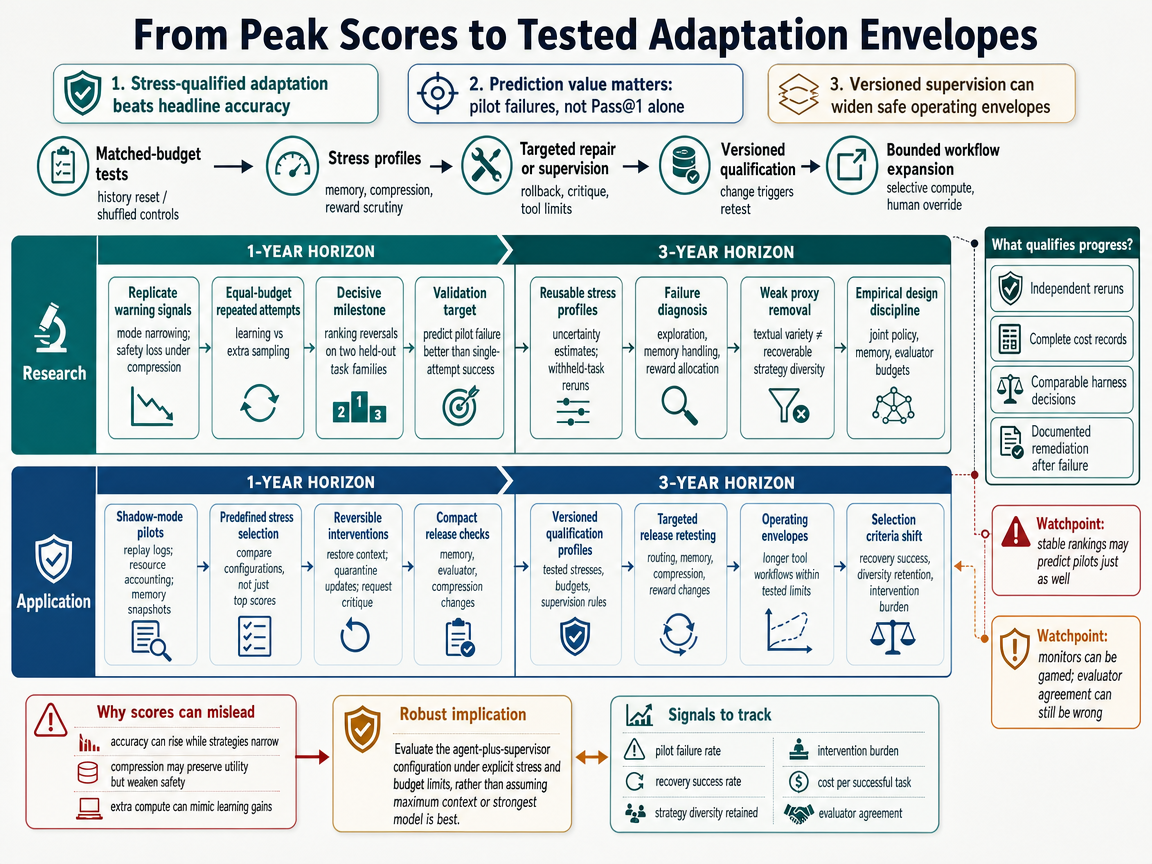
Over three years, this path would shift agent evaluation from headline success rates toward evidence of dependable adaptation within clearly defined task conditions. Its mechanism resembles testing an electricity system under difficult operating conditions: an agent's apparent capability matters less than what remains useful when conditions become harder. In the first year, researchers would compare repeated attempts on unfamiliar tasks with interaction history retained, reset, or shuffled under equal total computation budgets. This would help distinguish learning from extra sampling, while supervised pilots record failures and the effort needed to recover from them.
Progress into the second year would require independent tests across at least two unfamiliar task families to change system rankings and predict pilot failures better than single-attempt scores. Positive results would support reusable stress profiles, meaning descriptions of tested disturbances and configuration limits together with uncertainty about the observed results. Developers could then repair specific weaknesses and rerun withheld tests, creating a cycle in which evidence guides changes rather than simply encouraging larger contexts. Changes to memory or compression would trigger relevant release checks, reducing repeated testing work without assuming that earlier results apply to every new configuration.
By the third year, researchers would ask whether these controlled checks continue to predict failures in real workflows, using incident and recovery records to discard misleading measures. Alternative solution methods would count as useful diversity only when they help an agent recover after a failed approach or changed interface. Where predictions hold, teams could allow longer workflows within tested limits, using additional memory or stronger reward assessment selectively rather than everywhere. A concrete monitoring cue would be independently reproduced ranking changes followed by configuration-specific release checks that improve pilot outcomes. The path weakens if apparent learning disappears under equal budgets or ordinary accuracy predicts outcomes just as well, so unfamiliar conditions would still require supervision.
This path would connect longer agent interactions with an active supervisor that watches for signs of deterioration and responds before a failure occurs. Borrowed from control engineering, this runtime assurance mechanism means monitoring the system during use rather than relying only on tests completed before release. In the first year, researchers would vary operating conditions to see whether evaluator disagreement or lost solution diversity provides useful warnings on unfamiliar tasks. Pilots would initially record recommendations without acting, then test reversible responses such as restoring context or requesting an independent critique when a warning appears.
The threshold for moving forward would be fewer predefined violations across at least two unfamiliar task families, at matched total computation and without losing learning across attempts. Random interventions and fixed conservative settings would provide comparisons, helping researchers determine whether the supervisor adds value beyond simply applying more scrutiny to every task. In the second year, experiments would distinguish failures repairable through memory changes from failures that require stopping or human review before work continues. Successful interventions would generate independently checked recovery records, improving warning quality while teams measure whether the process merely shifts more work onto human reviewers.
By the third year, evaluation could focus on the versioned agent-supervisor pair, with permissions tied to the conditions under which useful adaptation has actually been demonstrated. A memory or reward-model change would prompt targeted retesting, while research measures how much earlier evidence remains valid and how expensive recalibration becomes. Teams could then authorize broader but bounded workflows when recovery records show that supervision preserves useful exploration without imposing excessive interruption or review costs. A key monitoring cue would be independently verified reductions in violations at matched total cost, rather than improvements achieved mainly through refusals and abandoned tasks. The path weakens if failures arrive without warning or fixed scrutiny performs better, and irreversible actions would still need conservative permissions and human override.
This path would turn concerns about compression and adaptation into a requirement that a modified agent must demonstrate reliability rather than inherit its parent's claims. The mechanism borrows from testing vehicle emissions under varied conditions: compare a modified system with its parent outside a fixed laboratory test and limit the permitted gap. In the first year, paired tests would examine resistance to attacks, useful solution diversity, and learning across unfamiliar tasks while accounting for extra computation. Early reports could inform supplier reviews, but the decisive step would be a large buyer enforcing a numerical rule and independent providers reaching comparable decisions affordably. Because comparison with an unsafe parent can mislead, an absolute minimum safety requirement and uncertainty estimates would also be needed; pilots are more plausible initially than a complete binding system.
If that requirement becomes workable, the second year would extend testing to longer workflows and check automated judges against independently verifiable outcomes for those tasks. Suppliers would identify the precise configuration that passed, while permission-based replay of selected operational traces would test whether accumulated context changes behavior after approval. Buyer requirements would encourage suppliers to address measured weaknesses, and shared testing environments would reduce duplicated setup work while providers refine thresholds using failure records.
By the third year, every covered variant update could face an automated release check, supported by fresh stress conditions rather than a familiar task list alone. Research would examine whether these checks detect regressions efficiently, and adaptation methods would gain acceptance only by demonstrating that they preserve the required capabilities. The favorable outcome would be a practical release-and-monitoring gate for specified workflows, not a general claim that every derivative system remains reliable. A concrete monitoring cue would be enforced comparison clauses accompanied by agreement between independent tests and documented rejection of variants that fail the requirement. Persistent disagreement would weaken the mechanism, while variants that satisfy automated judges but fail verifiable tasks could restrict its use to workflows with stronger outcome checks.
1-Year / 3-Year Research-Application Infographic
References
- Inference-Time Scaling for Generalist Reward Modeling - Authors: Zijun Liu, Peiyi Wang, Runxin Xu, Shirong Ma, Chong Ruan, Peng Li, Yang Liu, Yu Wu / <See Details on Fugu-MT> / License: CC-BY-SA-4.0
- AgentRL: Scaling Agentic Reinforcement Learning with a Multi-Turn, Multi-Task Framework - Authors: Hanchen Zhang, Xiao Liu, Bowen Lv, Xueqiao Sun, Bohao Jing, Iat Long Iong, Zhenyu Hou, Zehan Qi, Hanyu Lai, Yifan Xu, Rui Lu, Hongning Wang, Jie Tang, Yuxiao Dong / <See Details on Fugu-MT> / License: CC-BY-4.0
- Scaling In-Context Online Learning Capability of LLMs via Cross-Episode Meta-RL - Authors: Xiaofeng Lin, Sirou Zhu, Yilei Chen, Mingyu Chen, Hejian Sang, Ioannis Paschalidis, Zhipeng Wang, Aldo Pacchiano, Xuezhou Zhang / <See Details on Fugu-MT> / License: CC-BY-4.0
- Understanding and Mitigating Token-Pruning-Induced Vulnerabilities in VLMs - Authors: Shuailong Wang, Xinyu Lyu, Shengming Yuan, Jingkuan Song, Heng Tao Shen, Lianli Gao / <See Details on Fugu-MT> / License: CC BY 4.0