Summary
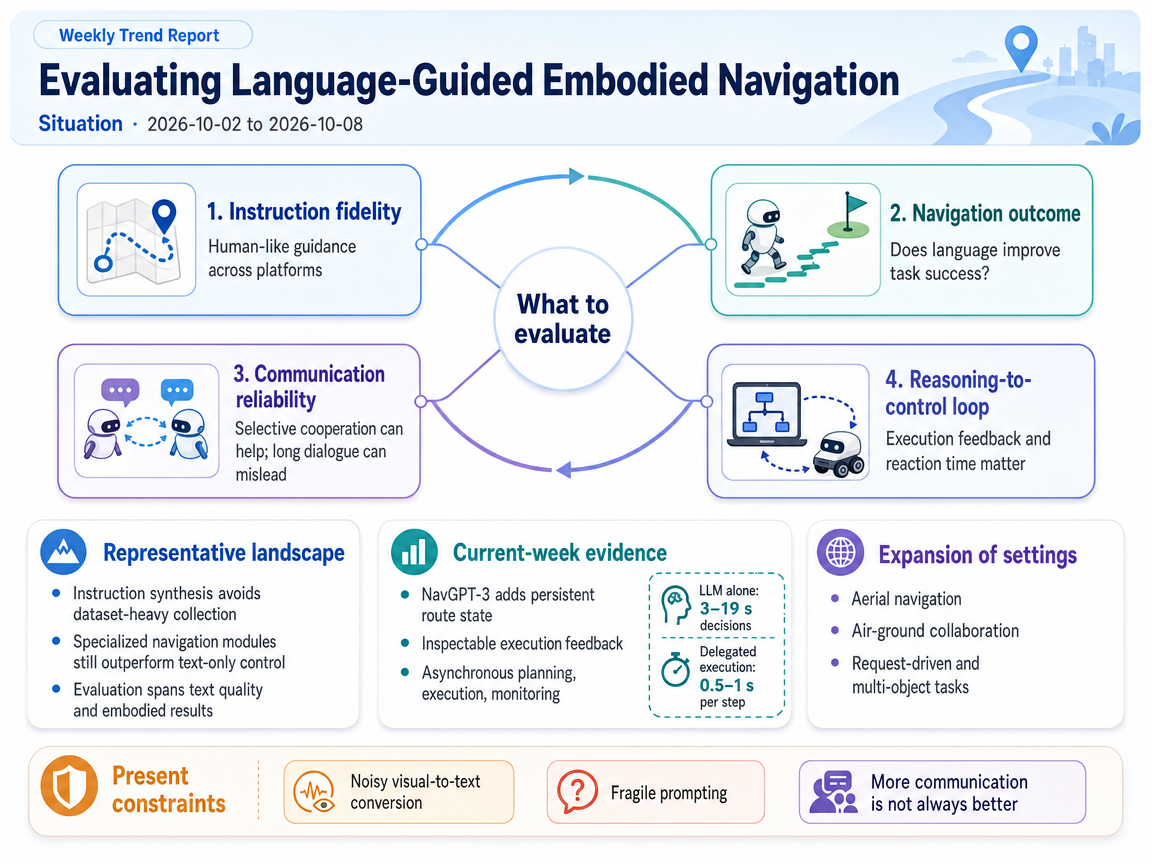
The theme centers on evaluating whether language-model instructions, reasoning, and communication translate into effective embodied navigation rather than merely plausible text. Representative studies cover cross-platform instruction synthesis, specialist-supported navigation, and the risks of excessive agent dialogue. This week's NavGPT-3 evidence extends these concerns to execution feedback and asynchronous control, and other new papers carry evaluation into aerial, collaborative, and request-driven settings.
Situation
The representative Introductions identify complementary evaluation challenges. "Can LLMs Generate Human-Like Wayfinding Instructions?" addresses platform-specific, labor-intensive instruction datasets through training-free synthesis. It assesses the results through both human judgments and downstream navigation performance. NavGPT-2 highlights noisy visual-to-text conversion, fragile prompting, and the gap between language-model navigation and specialized agents, which motivates combining VLM reasoning with navigation modules. The ObjectNav communication study shows that more communication is not necessarily better. Selective cooperation improved performance over an unassisted baseline, while full cooperation reduced it, and longer exchanges were associated with more preemptive hallucinations.
Current-week evidence from "NavGPT-3: Harnessing Context in a Hierarchical Navigation Runtime" (2610.10787v1, provisional) extends this baseline to the interface between reasoning and physical execution. Its Introduction describes persistent route state, inspectable execution feedback, and asynchronous planning, execution, and monitoring. It reports that a language model acting alone decides only once every 3–19 seconds, whereas delegating execution to a VLA lowers minimum reaction time to 0.5–1 second per step. Together, these papers point to evaluation across instruction fidelity, navigation outcomes, communication reliability, and the responsiveness of the reasoning-to-control loop.
Infographic (English)
Progress
Speaking the Navigator's Language: Trajectory-Grounded Instruction Translation for Frozen Aerial VLN Agents <See Details on Fugu-MT>
TGIT translates instructions into trajectory-grounded commands for a frozen aerial navigator. It targets an instruction mismatch that lowers OpenFly success from 31.03% to 11.33%, extending instruction-fidelity concerns to aerial navigation.
AirGroundVLN: A Large-Scale Benchmark for Goal-Oriented Air-Ground Collaborative Vision-and-Language Navigation <See Details on Fugu-MT>
AirGroundVLN broadens language-guided navigation evaluation to collaborative aerial and ground agents. It provides 10,281 episodes across 19 environments, together with a framework that combines collaborative memory and aerial-guided planning.
NavGPT-3: Harnessing Context in a Hierarchical Navigation Runtime <See Details on Fugu-MT>
NavGPT-3 reports state-of-the-art R2R-CE performance using a hierarchical navigation runtime, along with human-level results on RxR-CE. It pairs asynchronous control with a VLA trained on 19.28 million examples that allocates visual tokens according to scene change.
WareFly-VLA: A Vision-Language-Action Framework for UAV Navigation and Human Tracking in Smart Warehouses <See Details on Fugu-MT>
WareFly-VLA extends embodied language evaluation to UAV human search, localization, and tracking in warehouses. It benchmarks four open-source VLA architectures at two control rates under a leakage-free, episode-level protocol.
SuperNav: An Agentic Navigation System for Any Task in Any Scene <See Details on Fugu-MT>
SuperNav broadens navigation evaluation to instance-level, multi-object, and request-driven tasks. Its agent harness uses a pretrained MLLM without navigation-specific fine-tuning and reports gains over the evaluated baselines.
Outlook
Outlook Summary
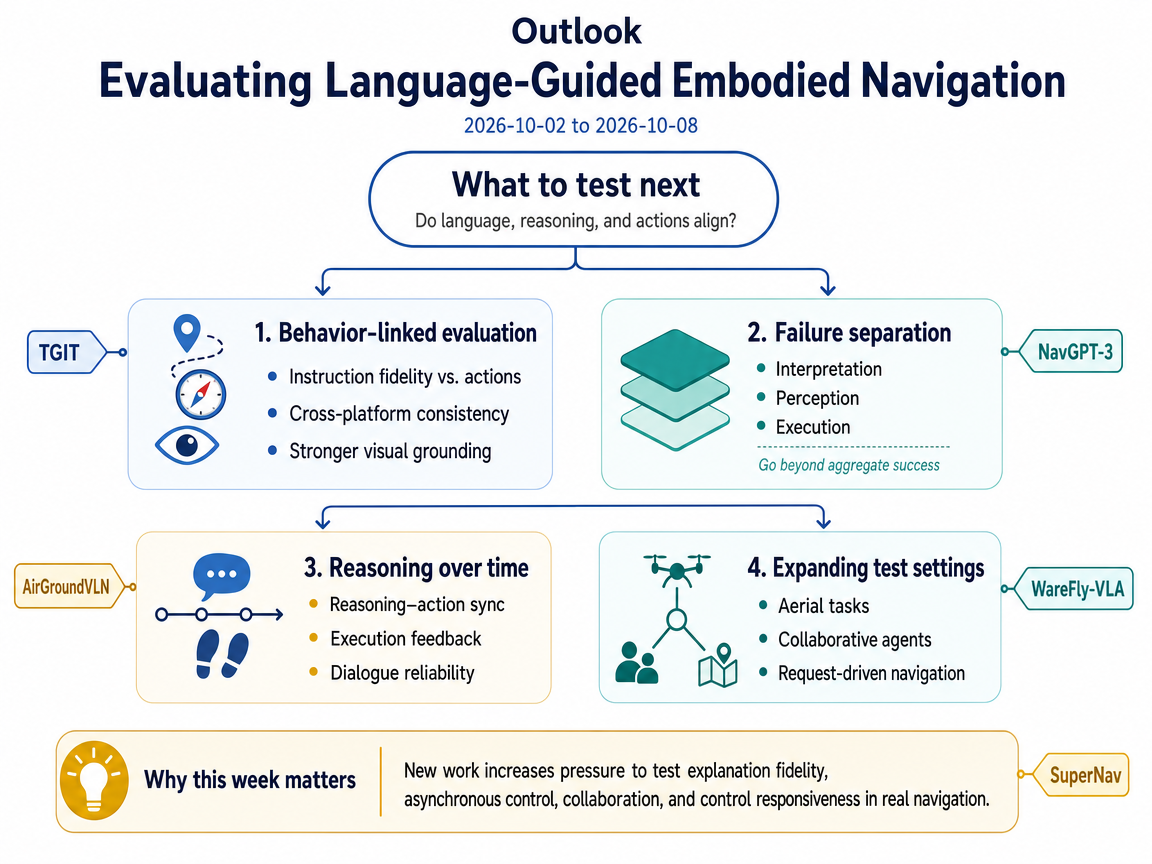
Navigation evaluation should connect instruction fidelity and explanatory reasoning to actual behavior. Priorities include cross-platform consistency, less copying of reference wording into generated instructions, and stronger visual grounding in non-photorealistic scenes. Tests should distinguish instruction interpretation, scene perception, and execution failures rather than report success alone. A second priority is whether reasoning and communication remain consistent with actions over time. Asynchronous control and collaborative memory provide settings to test this through execution feedback and responsiveness. ObjectNav findings also motivate checks for embodied hallucinations and localization errors. NavGPT-3’s provisional results suggest better coordination of planning and control, but do not yet establish faithful explanations or reliable collaboration across environments.
Infographic (English)
Three-Year Movement
The longer-term direction is to evaluate navigation language and robot behavior together, rather than assess fluent instructions and successful arrival separately. Earlier work shows that generated instructions can inherit perception errors and that explanations can diverge from actions. Longer conversations between agents can also worsen navigation. These findings motivate checking whether statements about movement have support in observed execution.
This week’s reports offer two complementary settings for that evaluation. Trajectory-grounded translation adapts instructions for an aerial navigator whose underlying model remains unchanged. An asynchronous runtime combines persistent route information with execution feedback while allowing planning and control to run at different speeds. Collaborative and warehouse tasks broaden the settings in which these mechanisms can be tested. The central monitoring question is when a claimed action has enough evidence to become a fact used by later decisions. This supports a more concrete evaluation program, but the supplied account does not specify annual milestones, and the NavGPT-3 claims remain provisional.
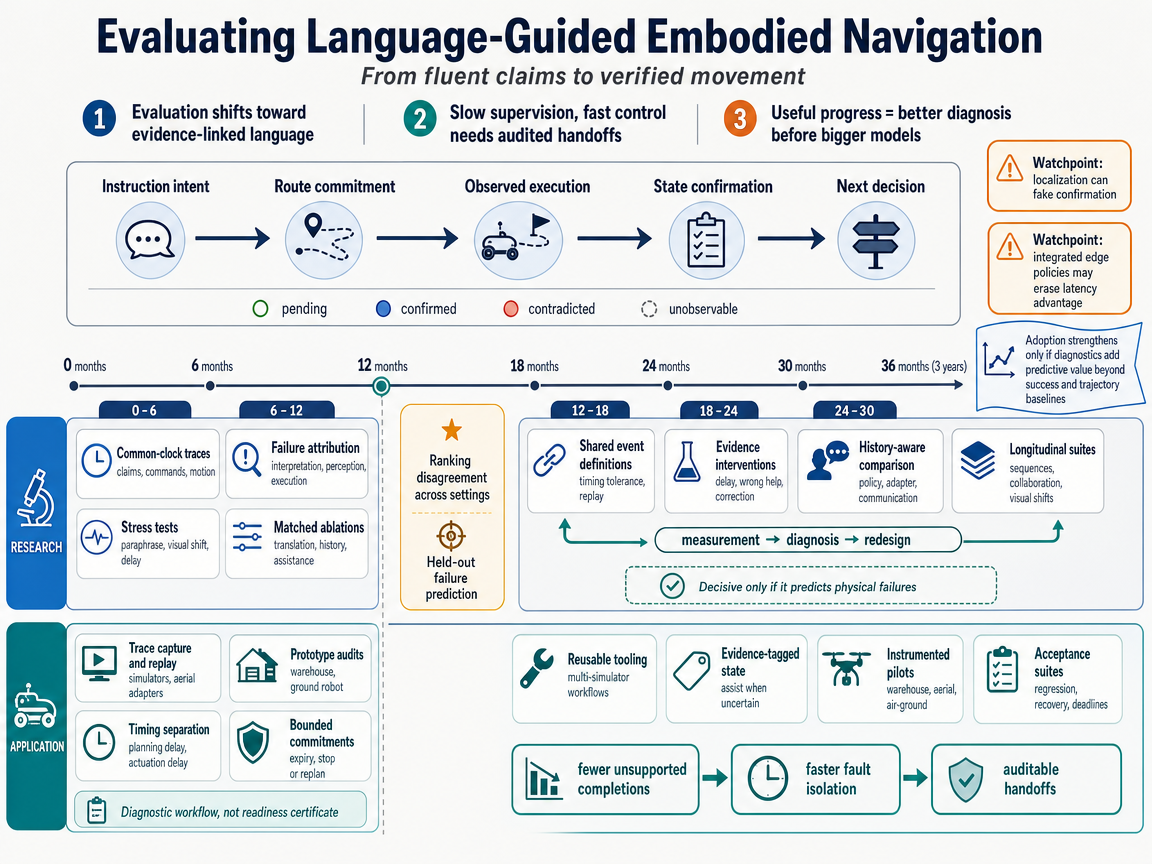
Over three years, this scenario would develop clearer boundaries between a slower language supervisor that assigns routes and a faster movement policy that handles immediate conditions. In the first year, researchers would measure both on a common clock, distinguishing planning intervals from the delay between observing an obstacle and responding. Tests would also check whether translated instructions preserve meaning across wording changes and unfamiliar visual styles, without copying reference language. Bounded prototypes would record commands alongside observations, so movement is confirmed by physical evidence rather than by another generated message.
In the second year, reusable route records and verification rules could help laboratories compare interface failures and test whether memory improves both actions and explanations. Practical pilots would introduce declared response-time limits and tested fallback behavior, using smaller supervisory components where the hardware permits them. The mechanism resembles air-traffic control: a slower authority assigns a route, while a faster controller responds to immediate conditions without treating an assigned movement as completed. Evidence from recorded failures would then guide changes to scheduling and confirmation rules, making verification central to progress rather than relying on larger models alone.
By the third year, this approach could extend to air-ground teams and supervised demonstrations involving several robots, with assistance requested only when measured limits are crossed. Those limits could reflect stale state estimates, uncertain localization, or repeated response delays, but would require calibration rather than universal thresholds. Shared benchmarks could assess whether verified handoffs improve communication without slowing control, while exposing failures that overall task success would hide. A useful monitoring cue would be independent reuse of route-state interfaces alongside repeatable reductions in errors that presume an action has already occurred. The scenario weakens if integrated policies deliver equally reliable reasoning and control on matched hardware within the same computing limits. The analogy clarifies authority and verification, but does not establish safety or guarantee shared standards.
Over three years, this scenario could make verified action records a condition for accepting navigation results, rather than merely an optional diagnostic tool. In the first year, researchers would pair system statements with observed movement and align planning events with control steps to reveal mismatches hidden by task success. Comparisons of no assistance, selective assistance, and full cooperation would test whether communication helps, while instruction translation would be judged on preserving the user’s request. The decisive early milestone would be a benchmark or pilot declining to accept unsupported explanation claims as comparable evidence, not simply adopting another recording tool.
The mechanism is reconciliation: matching declarations to measured execution through timestamps and confirmations, much as a signaling message alone cannot prove that a connection carried data. Each check could uncover another mismatch and strengthen demand for further checking, allowing evaluation practices to spread even without a large improvement in navigation capability. In the second year, a shared event format could support repeated checks after system changes, while researchers test whether memory improves explanations as well as actions. When onboard resources are inadequate, external computers could compare records, but teams would need to measure missing events and the burden of transmitting those records. The checking system would itself need validation, because incorrect perception could make it reproduce the navigator’s errors rather than detect them.
By the third year, programs that enforce these rules could restrict trials lacking verifiable action records and challenge translators that discard difficult parts of a request. Their prototypes could combine fast control with slower inspectable planning and a reconciliation layer, without implying readiness for unrestricted deployment. The strongest monitoring cue would be benchmark participation or pilot continuation becoming conditional on evidence from recorded movement, rather than on success scores alone. This path remains uncertain because continuous movement may be only partly completed, and robotics lacks a universal clock or automatic enforcement mechanism. Credible verification performed locally would weaken the stronger claim that external checking becomes a required gate, even if better diagnostics continue to spread.
1-Year / 3-Year Research-Application Infographic
References
- Can LLMs Generate Human-Like Wayfinding Instructions? Towards Platform-Agnostic Embodied Instruction Synthesis - Authors: Vishnu Sashank Dorbala, Sanjoy Chowdhury, Dinesh Manocha / <See Details on Fugu-MT> / License: CC-BY-4.0
- NavGPT-2: Unleashing Navigational Reasoning Capability for Large Vision-Language Models - Authors: Gengze Zhou, Yicong Hong, Zun Wang, Xin Eric Wang, Qi Wu / <See Details on Fugu-MT> / License: CC-BY-SA-4.0
- Is Generative Communication between Embodied Agents Good for Zero-Shot ObjectNav? - Authors: Vishnu Sashank Dorbala, Vishnu Dutt Sharma, Pratap Tokekar, Dinesh Manocha / <See Details on Fugu-MT> / License: CC-BY-4.0
- NavGPT-3: Harnessing Context in a Hierarchical Navigation Runtime - Authors: Gengze Zhou, Yicong Hong, Jiazhao Zhang, Xunyi Zhao, Jian Zhou, Zixing Lei, Zun Wang, Chongyang Zhao, Xionghui Chen, Stephen Gould, Anton van den Hengel, Qi Wu / <See Details on Fugu-MT> / License: CC BY 4.0