Summary
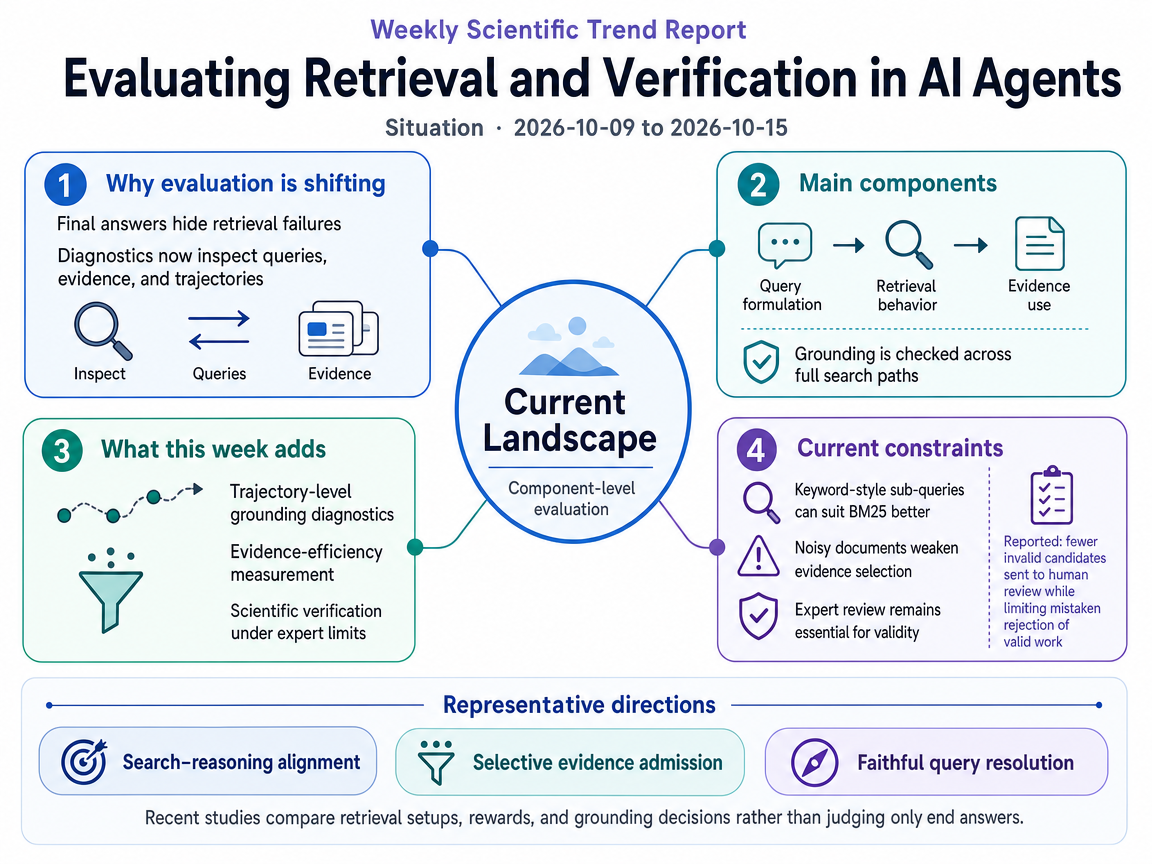
The representative studies evaluate retrieval as a component of agent reasoning, exposing mismatches between generated queries, retriever capabilities, and evidence use that final-answer scores alone do not reveal. This week's evidence adds trajectory-level grounding diagnostics and evidence-efficiency measurements. It also extends the evaluation focus to scientific verification, measuring how much invalid work can be filtered before expert review while limiting rejection of valid results.
Situation
The representative Introductions highlight the need to diagnose retrieval behavior rather than assess only final answers. SAGE provides 1,200 scientific-search queries over 200,000 papers, combining verifiable short-form questions with open-ended research tasks. Its evaluation finds that keyword-oriented agent sub-queries favor BM25 over LLM-based retrievers by about 30%, despite the latter's semantic capabilities. AutoRefine addresses a complementary weakness: noisy retrieved documents and outcome-only rewards give little guidance for evidence selection, which motivates explicit refinement and retrieval-specific rewards. QUESTER adds an efficiency and interpretability perspective. It trains a small LLM to generate keyword queries for BM25, evaluated on retrieval effectiveness and query latency, and avoids rebuilding neural indices.
Current-week evidence from "One-Sided Verification Under Limited Expert Review" (2610.18089v1) broadens this component-level evaluation perspective to scientific validation. Its OSVerify framework separates proposing errors from validating them. It measures how many invalid candidates are rejected while constraining how many valid solutions are mistakenly rejected. The Introduction reports 46% fewer invalid candidates requiring human review relative to baselines, rising to 57% with validator training. This makes limited expert review capacity a central evaluation constraint, while treating human experts as essential to establishing scientific validity.
Infographic (English)
Progress
QREF: Improving DeepSearch Agents by Aligning Search with Reasoning via Query Refinement and Evidence Filtering <See Details on Fugu-MT>
QREF aligns search with ongoing reasoning through query refinement and evidence filtering. It conditions query rewriting on current reasoning intent and keeps only evidence relevant to both the search batch and the reasoning objective.
SEEDS: Preview-Guided Evidence Admission for Search Agents <See Details on Fugu-MT>
SEEDS evaluates selective evidence admission across nine knowledge-intensive QA benchmarks, using both local corpora and live web search. It extends assessment from answer quality to evidence consumption, reporting improved search efficiency and substantially reduced full-evidence consumption.
Benchmarking and Training Reward Models for Cross-Source Evidence Grounding in Search Agents <See Details on Fugu-MT>
This work benchmarks cross-source evidence grounding in search agents using a fine-grained six-layer decision tree. It moves diagnosis from final answers to grounding decisions across complete search trajectories.
Faithful Query Resolution for Conversational Search <See Details on Fugu-MT>
This study compares five conversational query-generation configurations under BM25 and SPLADE retrieval. It adds a fidelity-focused comparison, contrasting a minimal resolver that preserves user wording with rank fusion of learned rewrites and raw utterances.
Information-Gain Calibrated On-Policy Distillation for Deep Search Agents <See Details on Fugu-MT>
This work identifies evidence-blind supervision, a failure mode in which deep-search queries are supervised only from pre-retrieval context. It uses post-retrieval information gain to calibrate query preferences toward the evidence that is actually retrieved.
Outlook
Outlook Summary
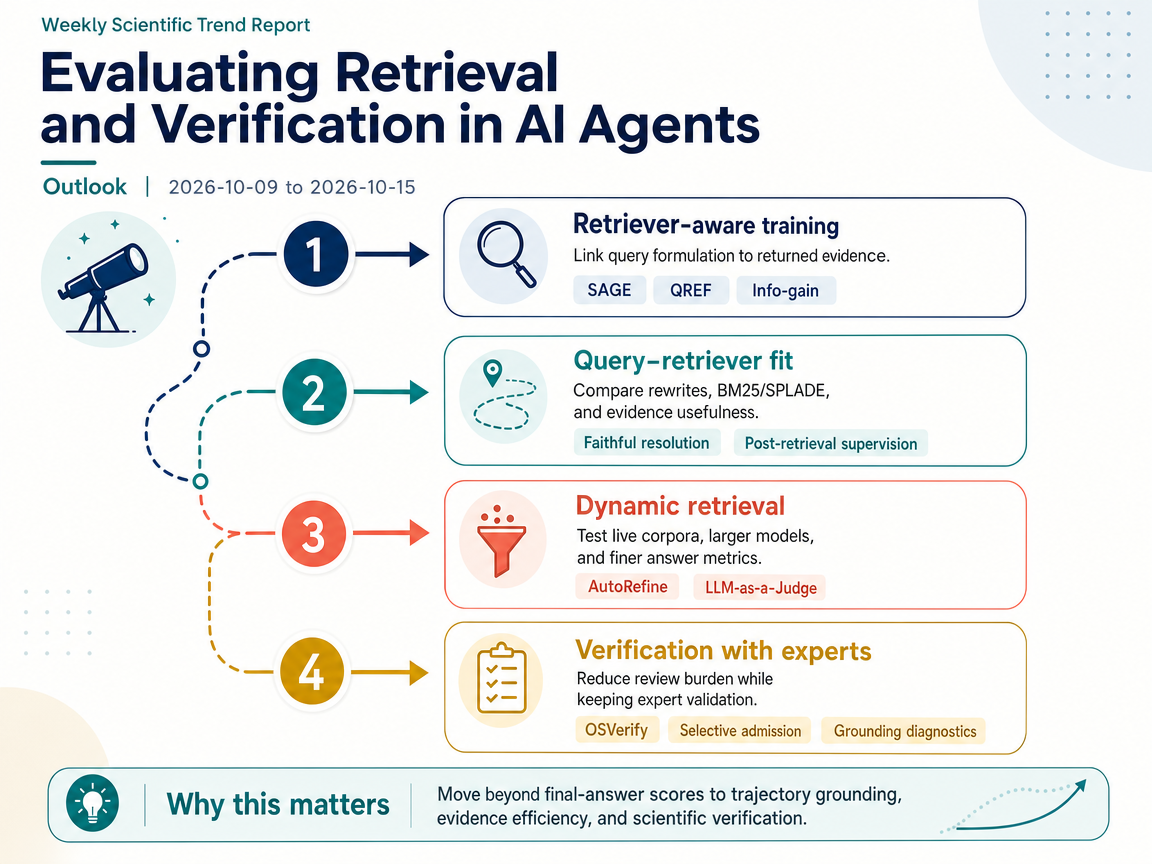
A likely next direction is retriever-aware evaluation and training: judging queries by the usefulness of returned evidence, not only final-answer accuracy. SAGE identifies this direction but cautions that results may differ across agent designs and training methods. QUESTER proposes richer structured queries and further optimization. Evaluation may also move toward changing collections and closer checks of evidence use. AutoRefine plans tests with larger models, meaning-sensitive answer scoring, and evolving sources. Selective evidence admission and search-process diagnostics could help measure efficiency and reliability, while automated verification should reduce review work without replacing expert judgment of scientific validity.
Infographic (English)
Three-Year Movement
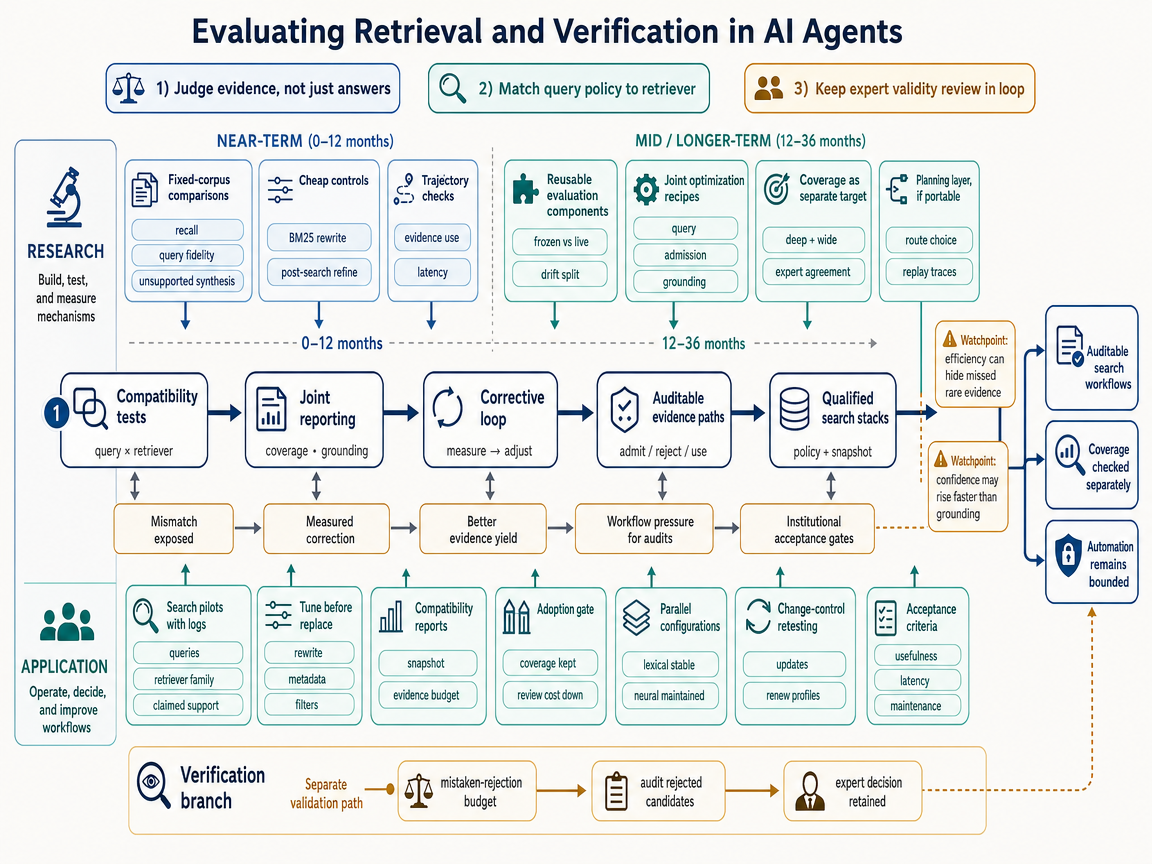
Over three years, the standard path would move from comparing search components to building auditable research workflows that retain the evidence behind their answers. The starting point is retriever-aware evaluation, which asks whether an agent's query style works well with the search method receiving it. In the first year, teams would compare query styles on fixed collections while measuring relevant-document coverage, preservation of user intent, and evidence support. Early literature-search pilots would use these records to locate failures and test inexpensive query changes before replacing the underlying retrieval system.
In the second year, reusable evaluation tools would compare changing collections with frozen versions to separate source changes from poorly matched query policies. Researchers could then connect query generation with evidence selection and refinement, testing whether improvements transfer across agents rather than assuming they generalize. The mechanism is a feedback loop: measured mismatches guide corrections, and the resulting evidence shows whether those corrections actually helped the search process. Teams would also check whether stronger answer confidence reflects better evidence support, since confidence alone cannot establish that an answer is well grounded.
By the third year, successful workflows would preserve evidence paths so users can inspect why a passage was accepted or excluded from an answer. Evaluation would distinguish finding one correct answer from collecting enough material to cover a broad research question, including candidates that might otherwise be missed. Structured queries could help express explicit constraints, while comparisons with expert annotations would test whether automated judgments reliably assess the complete search process. A useful monitoring cue would be repeatable improvements in evidence usefulness and coverage without an unacceptable increase in processing time or expert review. Apparent efficiency gains would weaken this path if they disappeared once rare decisive evidence and complete candidate coverage were protected during evaluation. Scientific validity would still require expert judgment, and repeated failures across different agents or changing collections would argue against adopting the workflow more broadly.
The contender path would place a separate planning layer between a research agent and its search tools, rather than improving query wording alone. Borrowing from database query planning, it would separate the evidence a task requires from the steps used to obtain that evidence. In the first year, researchers would test a narrow language for evidence requirements that preserves difficult meanings such as negation and time limits. Literature-search pilots would initially display plans for users to inspect, with automatic routing introduced only for task classes that had passed controlled tests.
Expansion would require lower combined execution and expert-review effort across at least two agent designs and two collection versions, without material losses in intent preservation or coverage. In the second year, the focus would shift to changing collections, where old estimates of useful search routes can become unreliable after updates. Tools would detect stale plans and return to conservative search when necessary, rather than continuing to trust previously successful routes without checking them. Researchers would also test cross-source joins, meaning connections between claims in different documents, because individually relevant passages can still support an invalid combined conclusion. Related-work tables would make missing candidates and unanswered attributes visible, giving users a practical way to identify unfinished searches and direct human review.
By the third year, a small adopter group could share tested search connectors and replayable process records before any broader interface convention emerged. Those records would reveal unproductive steps and improve later route choices, creating a feedback loop that can be evaluated separately from the whole agent. Where gains persist, the planning layer could receive limited authority over retrieval choices and search effort while keeping unresolved evidence requirements visible to users. A strong monitoring cue would be reusable plans that reduce correction time without losing rare evidence that could change the research conclusion. Simpler query rewriting matching these gains with less overhead would weaken the case for broader planning infrastructure, and scientific validity would remain an expert responsibility.
The maybe path asks whether documented compatibility between an agent and its search system could become a requirement for use in scientific-search workflows. Its starting point is that a system can answer correctly while still missing decisive evidence or producing an incomplete collection of related work. In the first year, paired experiments would vary query forms and retrievers while keeping the agent and collection fixed to isolate interface effects. Research teams could turn the results into short compatibility sheets identifying the query policy, retrieval method, and collection version used in each evaluation.
In the second year, stronger requirements would become plausible only if repeated failures showed that compatibility problems mattered in practical work, not just isolated tests. Researchers would test whether a successful configuration still works with another agent or updated documents, while comparing automated evidence judgments with expert assessments. If institutions adopted these checks as acceptance requirements, system updates would need renewed evidence that the agent still works with its named index. The mechanism resembles connection rules for electricity systems: a component's standalone capability is insufficient when its behavior at the connection point creates problems. Unlike those physical systems, however, research collections lack a single operating authority, so any approval process would likely remain local and institution-led.
By the third year, participating organizations could approve specific search configurations rather than treating an individual model as suitable for every research workflow. Each approval would identify the tested interface and its limits, while keeping answer quality, evidence coverage, and document consumption as separate measures. Independent coverage checks would test whether reduced reading effort concealed missing evidence, and system changes could trigger retesting before continued use was accepted. The clearest monitoring cue would be a workflow that actually requires renewed compatibility evidence after an update, rather than merely publishing diagnostic scores. Portable query adapters that work reliably across agents and changing collections would weaken the need for version-specific approval, while scientific validity would still require experts.
1-Year / 3-Year Research-Application Infographic
References
- Search and Refine During Think: Autonomous Retrieval-Augmented Reasoning of LLMs - Authors: Yaorui Shi, Shihan Li, Chang Wu, Zhiyuan Liu, Junfeng Fang, Hengxing Cai, An Zhang, Xiang Wang / <See Details on Fugu-MT> / License: CC-BY-SA-4.0
- QUESTER: Query Specification for Generative Retrieval - Authors: Arthur Satouf, Yuxuan Zong, Habiboulaye Amadou-Boubacar, Pablo Piantanida, Benjamin Piwowarski / <See Details on Fugu-MT> / License: CC-BY-4.0
- SAGE: Benchmarking and Improving Retrieval for Deep Research Agents - Authors: Tiansheng Hu, Yilun Zhao, Canyu Zhang, Arman Cohan, Chen Zhao / <See Details on Fugu-MT> / License: CC-BY-4.0
- One-Sided Verification Under Limited Expert Review - Authors: Fan Nie, Haotian Ye, Shurui Liu, Zihao Wang, Stefano Ermon, James Zou / <See Details on Fugu-MT> / License: CC BY 4.0