Summary
This week's theme links language-model evaluation with data efficiency, multilingual coverage, compression, and instruction following. Representative studies examine child-scale instruction tuning, bilingual encoder–decoder modeling, and compression across languages. Current-week work adds multilingual BabyLM data studies, language-specific compression and summarization benchmarks, and translation evaluation that scores quality and instruction compliance separately.
Situation
The representative Introductions frame evaluation around what language models learn under different data, architectural, and deployment constraints. CLASS-IT asks whether BabyLMs trained on child-scale linguistic input benefit from conversational versus question-answering instruction tuning and from curriculum ordering. OpenBA broadens the architectural baseline with an open bilingual encoder–decoder model evaluated across tasks and prompting settings. Towards Inclusive NLP examines how pruning and quantization affect accuracy and confidence in Arabic, English, and Kannada. Together, these studies motivate evaluating capability alongside training resources, language coverage, and deployment efficiency.
Current-week evidence from Qwen-MT-Lumen at WMT2026 (2610.19758v1) extends this concern to specialized translation, arguing that general-purpose LLM translators struggle to reliably follow fine-grained requirements on terminology, style, and structured formats. Its Introduction describes a 14B system covering 23 translation directions that combines staged adaptation, online preference optimization, and on-policy distillation, and reports separate LLM-judge scores for translation quality and instruction following. This offers a concrete application-level case for distinguishing general task performance from compliance with user constraints.
Infographic (English)
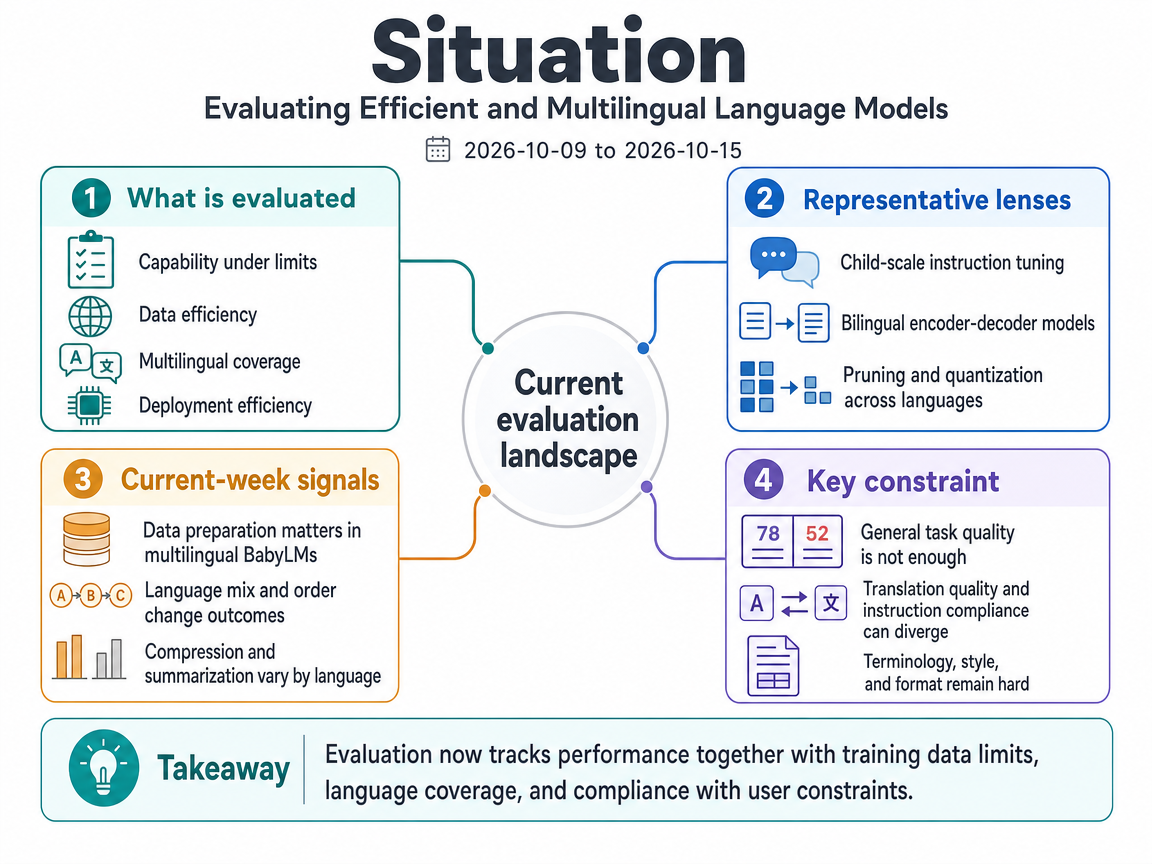
Progress
Qwenfant: Train Big Character-level BabyLMs on Concise Parallel Text <See Details on Fugu-MT>
Qwenfant improves on the multilingual BabyLM baseline using LLM-summarized and translated training data. It shifts attention from instruction-tuning choices to data preparation, and ranked first in the multilingual track at submission.
Language Exposure Matters: Distribution and Order in Multilingual BabyLM Pre-training <See Details on Fugu-MT>
This study evaluates how language exposure is distributed and ordered in limited-data pretraining across English, Dutch, and Chinese. It extends curriculum questions to multilingual settings, finding that some mixtures dominated by certain languages outscore balanced exposure.
Evaluating Large Language Models for Multilingual Abstractive Summarization: A Comprehensive Study of English and Bengali <See Details on Fugu-MT>
This study benchmarks eight closed and open-weight LLMs on size-matched English and Bengali summarization sets with lexical, semantic, factuality, and LLM-as-a-Judge measures. A model's lead on several English lexical metrics does not carry over to Bengali, making language-dependent performance explicit.
Lightweight but Linguistically Fair? Quantisation Robustness across Bavarian, German, and English <See Details on Fugu-MT>
This study evaluates post-training quantization across Bavarian, Standard German, and English using the BAVGROUND benchmark. It extends compression evaluation to whether regional varieties retain capabilities as reliably as standard languages.
Calibration Language Shapes Block-Influence Pruning in Multilingual Language Models <See Details on Fugu-MT>
This study tests whether English-calibrated block-influence pruning transfers to Indic languages across three small models. It adds calibration-language choice as a variable in multilingual compression, using English, Hindi, Marathi, and Tamil data.
Qwen-MT-Lumen at WMT2026: Instruction-Specialized Translation via Quality-Aware Training and On-Policy Distillation <See Details on Fugu-MT>
Lumen reports translation quality and translation-instruction following as separate scores for its WMT2026 system. Its staged training targets terminology, style, and structured-output requirements rather than generic translation quality alone.
SEA-HELM Audio: Evaluating Multilingual ASR-LLM Pipeline Performance Across SEA-HELM Subsets <See Details on Fugu-MT>
SEA-HELM Audio extends a text benchmark to ASR–LLM pipelines, comparing synthetic-speech and text inputs across five languages. It adds input modality to multilingual evaluation, with Tamil showing the largest degradation at over 40%.
Outlook
Outlook Summary
Research should test whether better data preparation, exposure order, and instruction tuning transfer to unfamiliar tasks, using multilingual limited-data studies as concrete comparisons. Interactive benchmarks should distinguish task quality from instruction compliance, including in translation and long-form generation. Multilingual compression needs dialect-sensitive tests alongside systematic checks of hallucination and bias. Regional-variety quantization and cross-language pruning raise questions about retained abilities and which language to use for calibration. Matched comparisons across languages and text versus speech input should establish whether resource savings come with uneven capability losses.
Infographic (English)
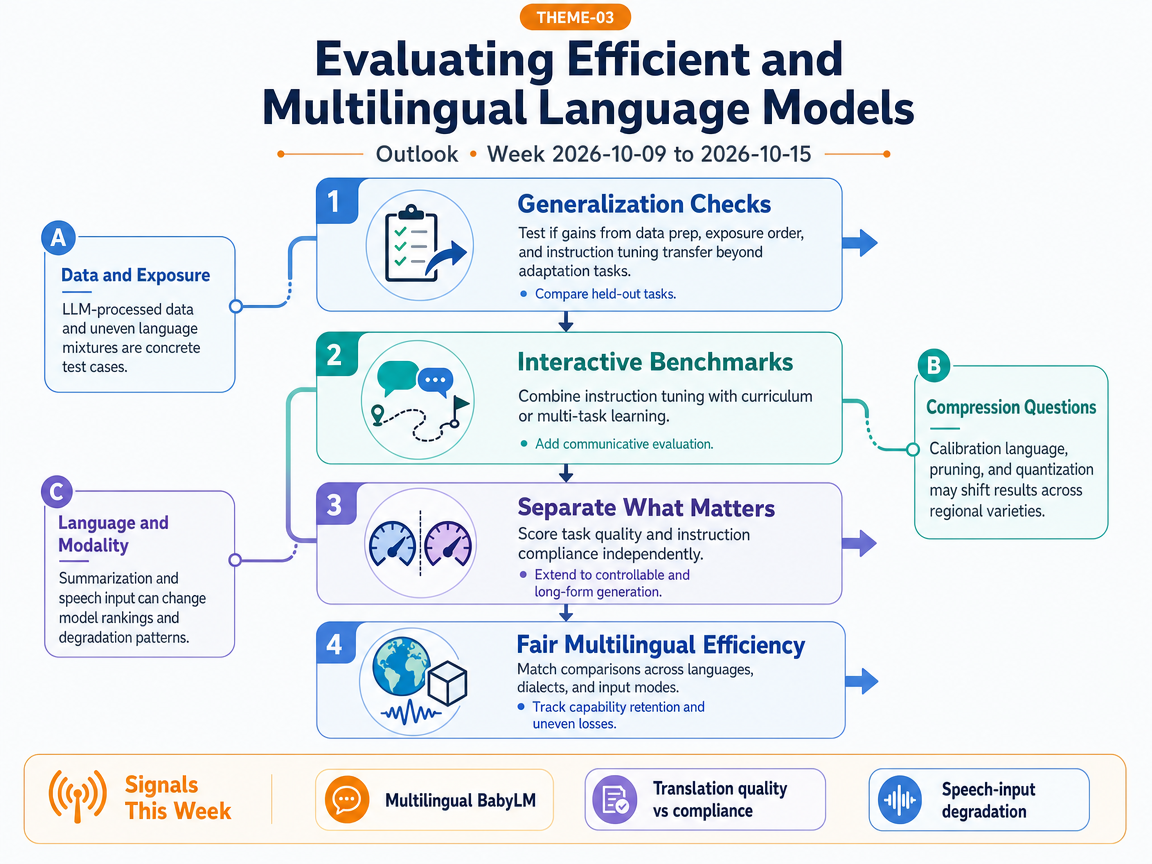
Three-Year Movement
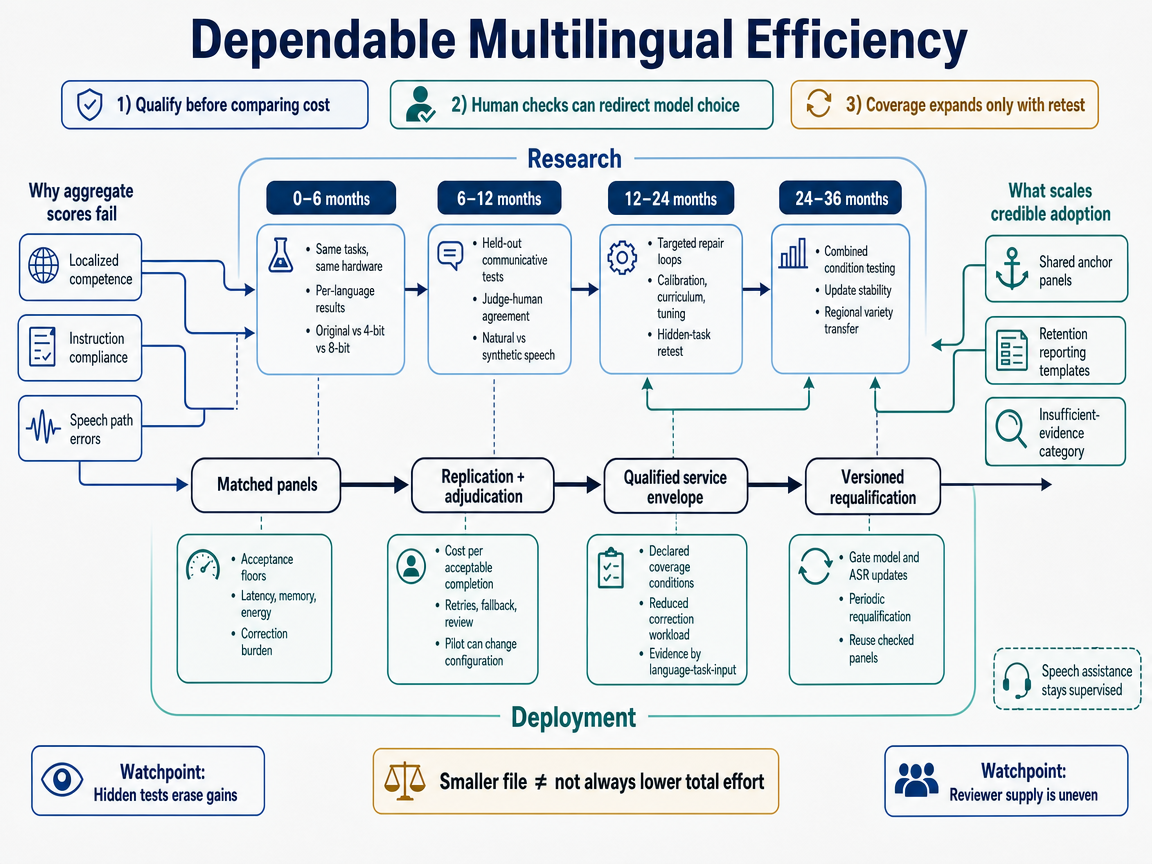
In the first year, researchers would test whether gains from data preparation and adaptation survive unfamiliar tasks, while comparing original and compressed models under matched conditions. Each sampled language would receive separate results, with bilingual reviewers checking disputed outputs rather than allowing an overall score to hide local failures. Translation tests would separate quality from instruction compliance, while speech tests would distinguish recognition errors from model errors and compare synthetic with natural speech. The turning point would require two independent comparisons to reproduce a practically important selection difference, human reviewers to confirm it, and a pilot to change configuration accordingly. Pilots would also measure resources and correction effort per acceptable completion, because capability differences alone would not establish lower total cost.
In the second year, teams would first identify configurations that meet minimum requirements and only then compare their resource use, rather than treating smaller models as automatically preferable. The electricity-grid analogy captures this mechanism: nominal capacity does not guarantee dependable output, just as compression does not guarantee efficiency under actual user requirements. Targeted repairs would face independent tests on unfamiliar tasks before successful pilots expanded their validated coverage—the conditions under which a configuration has passed evaluation.
By the third year, this process could become a reusable evaluation practice that checks whether repairs survive updates and transfer to additional regional varieties. Researchers would also combine language, instruction, and speech conditions, because passing separate tests does not establish that a system handles them together. Version-specific checks would precede system changes, while new varieties or input types would need fresh evidence rather than inherit approval.
A useful monitoring cue is whether confirmed failures repeatedly change model selection and repairs expand coverage without removing resource savings. The path weakens if overall rankings already predict acceptable performance or gains disappear on unfamiliar tests. The result would remain qualification for particular workflows, not a universal reliability certificate.
In the first year, researchers would test evaluators alongside models, comparing automatic judgments with native-speaker ratings separately for each language rather than assuming multilingual scoring is equally reliable. Small human anchor panels—carefully reviewed examples used to check automated scores—would support reusable comparisons, while unfamiliar tasks would test whether adaptation gains genuinely transfer. Speech studies would check natural accents and noise, and application pilots would record reviewer time alongside technical resource use to clarify the full effort required. This setup matters because the supplied evidence does not yet establish that human review is more costly than running or adapting models.
The decisive trigger would be replicated evidence that automatic judges agree with people much less reliably in some languages, followed by review requirements that exceed available capacity. In the second year, that pressure could separate human-validated findings from claims supported only by automated judges, changing which results teams trust when selecting systems. The rented-hives analogy explains the mechanism: scarce review capacity moves toward established demand, and languages with reusable anchors attract further research that strengthens their existing advantage. Teams could concentrate review on disputed outputs, but random human audits would remain necessary because several automated judges can share the same mistake.
By the third year, shared panels could support broader evaluation of model behavior, while application checklists would state validated coverage and identify who performed the review. Systems would expand most credibly where those checks remain current, with correction and escalation built into speech workflows rather than assuming automated approval is sufficient. Community partnerships and shared institutional support could extend reliable evaluation to neglected varieties instead of allowing review capacity to remain concentrated.
Monitoring should track recruitment delays and review hours per accepted claim alongside the spread of validated coverage. Reusable examples could reduce scarcity, although exposed or outdated examples would require maintenance. The scenario weakens if broadly transferable judges pass independent audits or community programs expand qualified review at falling cost.
The starting point is a stricter definition of efficiency: a smaller or cheaper model must retain the abilities needed for its intended use. Near-term comparisons would examine regional language performance, instruction compliance, and speech input rather than treating a general benchmark score as sufficient evidence. Earlier results favor quantization over aggressive pruning within the tested settings, but they do not establish a universal approval threshold.
Over a three-year horizon, the scenario points toward use-specific approval based on comparison with a named reference model. The generic-drug analogy supplies the mechanism: require evidence that a cheaper variant performs sufficiently close to that reference before approving it for a particular application. The key evidence to watch would be retained capability under the intended conditions, not model size alone. However, the supplied narrative provides neither detailed weekly results nor a year-by-year implementation path, so it supports this conditional direction rather than an established qualification system.
1-Year / 3-Year Research-Application Infographic
References
- OpenBA: An Open-sourced 15B Bilingual Asymmetric seq2seq Model Pre-trained from Scratch - Authors: Juntao Li, Zecheng Tang, Yuyang Ding, Pinzheng Wang, Pei Guo, Wangjie You, Dan Qiao, Wenliang Chen, Guohong Fu, Qiaoming Zhu, Guodong Zhou, Min Zhang / <See Details on Fugu-MT> / License: CC-BY-4.0
- CLASS-IT: Conversational and Lecture-Aligned Small-Scale Instruction Tuning for BabyLMs - Authors: Luca Capone, Alessandro Bondielli, Alessandro Lenci / <See Details on Fugu-MT> / License: CC-BY-4.0
- Qwen-MT-Lumen at WMT2026: Instruction-Specialized Translation via Quality-Aware Training and On-Policy Distillation - Authors: Hao Wang, Yangyang Liu, Xiaohu Zhao, Heng Liu, Zifu Shang, Tianhao Li, Ruize Gao, Jialong Tang, Liangying Shao, Haoran Wei, Baosong Yang, Linlong Xu, Longyue Wang, Weihua Luo / <See Details on Fugu-MT> / License: CC BY 4.0