Summary
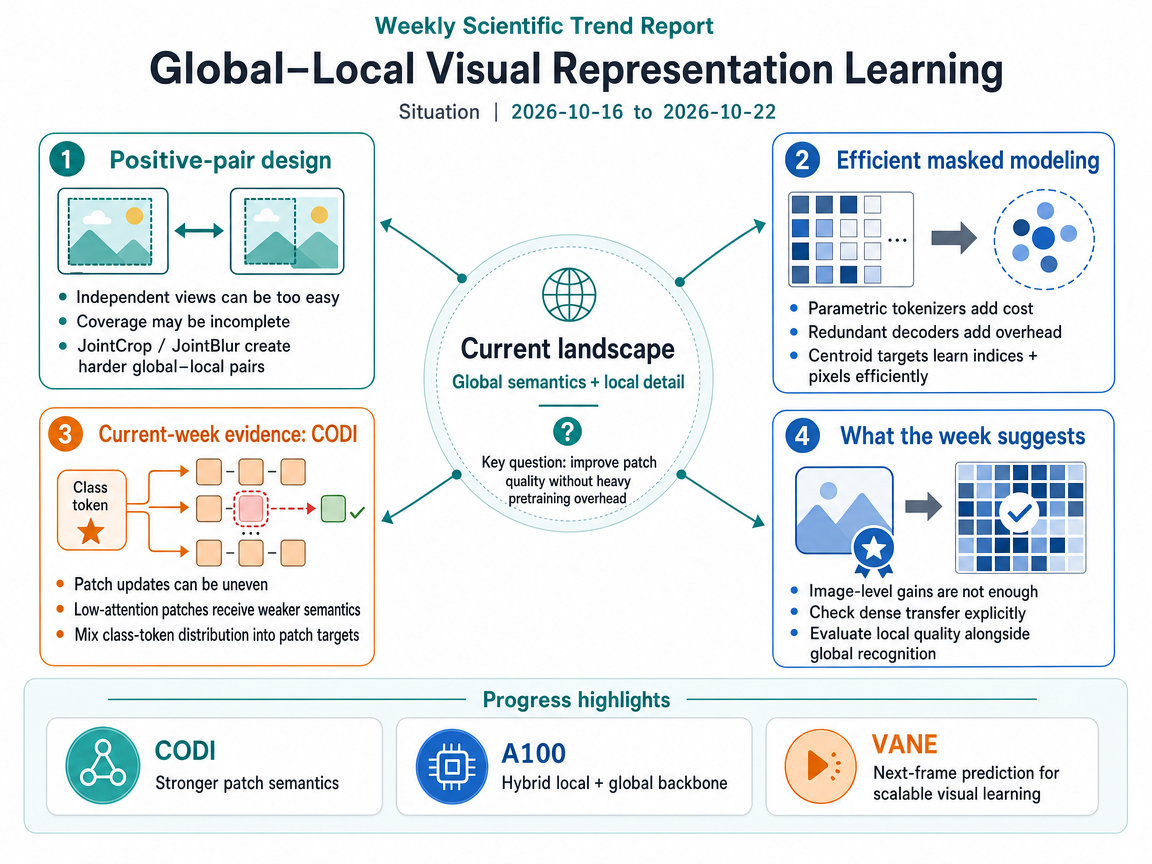
This week's theme concerns how self-supervised vision models connect global semantics with local detail while limiting pretraining overhead. Representative work addresses positive-pair design and centroid-based masked modeling. Current-week CODI extends this focus by correcting uneven semantic supervision of patch tokens, showing that image-level gains alone do not establish dense-transfer quality.
Situation
The representative Introductions identify complementary weaknesses in self-supervised visual learning. “Enhancing Contrastive Learning Inspired by the Philosophy of ‘The Blind Men and the Elephant’” argues that independently sampled augmentations often produce positive pairs that are trivial or lack comprehensive coverage. Its JointCrop and JointBlur methods instead couple the augmentation parameters of a pair to create more challenging global–local relationships. “Centroid-centered Modeling for Efficient Vision Transformer Pre-training” targets the cost of parametric tokenizers and redundant decoders in masked image modeling. It uses k-means centroids as patch targets and jointly learns centroid indices and pixels with little extra pretraining overhead.
Current-week evidence from “CODI: Improving Self-Supervised Vision Transformers with Cross Distillation” (2610.30639v1) extends this global–local concern to how semantics reach patches during self-distillation. Its Introduction reports that selective class-token attention gives low-attention patches weaker semantic updates, and that dense-transfer performance can decline late in DINOv2-style pretraining. CODI mixes a small share of the teacher class-token distribution into masked patch targets. It reports gains over an aligned DINOv2 counterpart across classification and dense-prediction settings. Together, these papers suggest that local representation quality should be evaluated alongside global recognition rather than assumed to improve with it.
Infographic (English)
Progress
CODI: Improving Self-Supervised Vision Transformers with Cross Distillation <See Details on Fugu-MT>
CODI strengthens patch semantics by mixing teacher class-token distributions into patch-token targets. Where DINOv2-style training supervises patches unevenly, CODI reports improved dense and image-level performance under aligned pretraining settings.
A100: A Hybrid Vision Foundation Model for Agricultural Plant Image Analysis <See Details on Fugu-MT>
A100 pairs MBConv stages for local features with Transformer stages for global context, pretrained self-supervised on three million unlabeled agricultural images. It brings global–local representation learning to a specialized domain, reporting 95.37% crop-classification accuracy with a frozen backbone, 2.56 points above an ImageNet-12K baseline.
Learning from Next-Frame Prediction: Towards Unified and Scalable Visual Representation Learning <See Details on Fugu-MT>
VANE extends self-supervised visual pretraining to next-frame prediction in embedding space. Moving beyond static-image objectives, it reports better model and data scaling and state-of-the-art results on most prediction, recognition, and dense-perception benchmarks.
Outlook
Outlook Summary
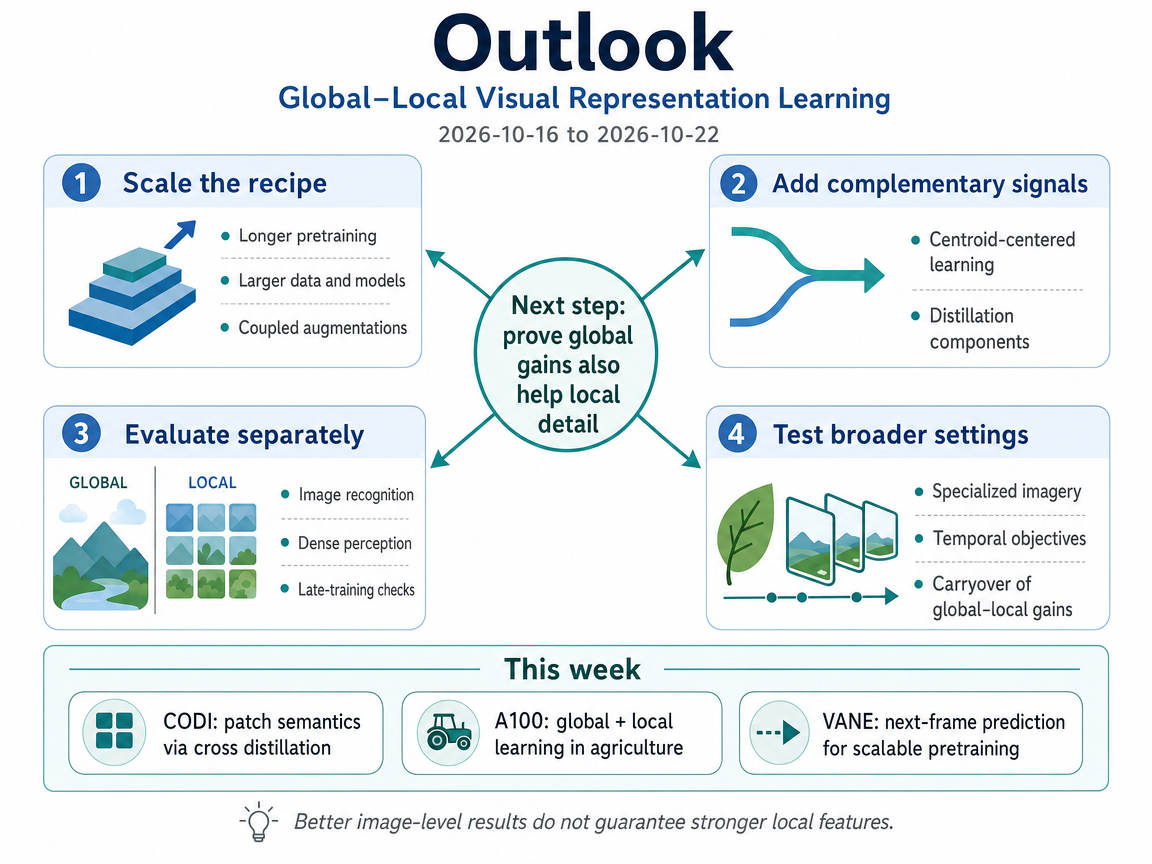
Next steps include longer pretraining and coordinated image augmentations, alongside larger-scale centroid-based learning with complementary distillation. Benefits under larger computational budgets remain unproven. CODI sharpens the need to test whether these extensions improve local patch features and dense tasks, such as segmentation, especially late in training. Agricultural imagery and next-frame prediction provide further transfer tests. Evaluations should report classification and dense-perception quality separately, since stronger whole-image recognition does not establish better local features.
Infographic (English)
Three-Year Movement
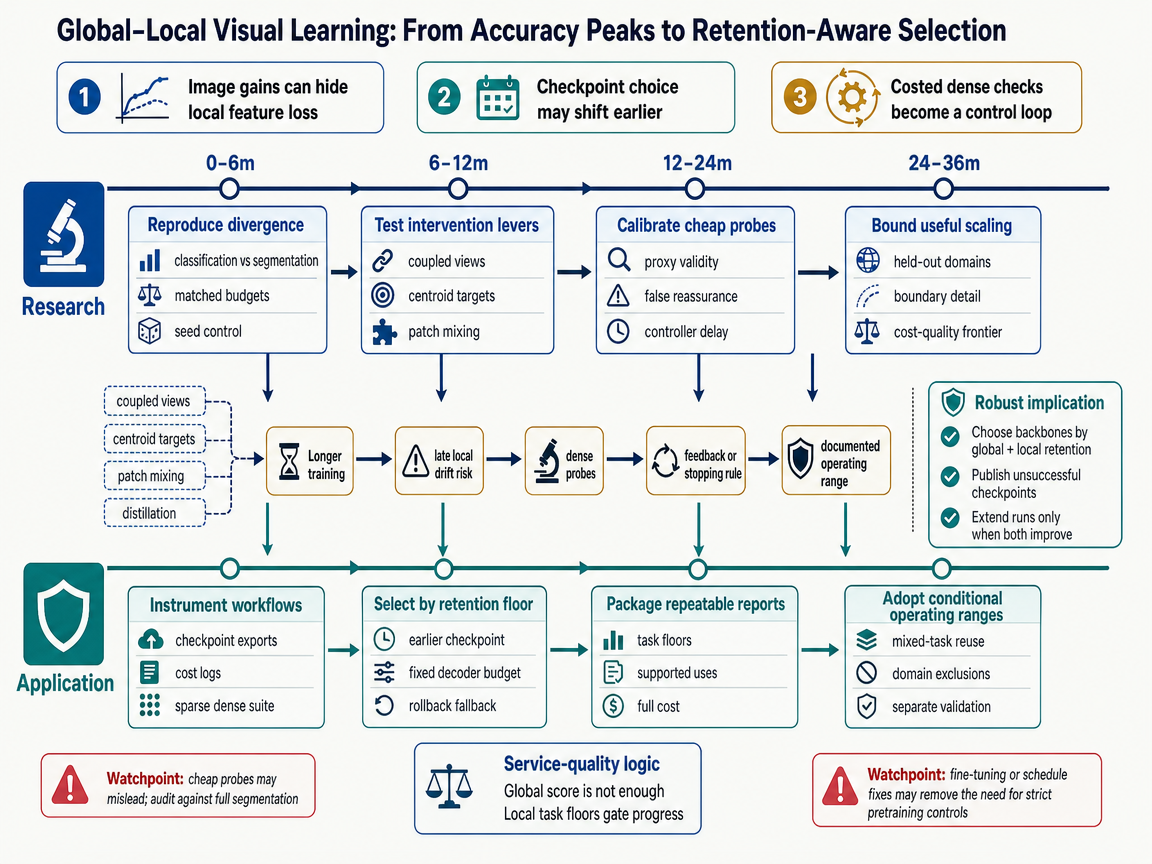
Over three years, this pathway would shift backbone selection from final classification scores toward documented performance across whole-image and local tasks. A backbone is the shared visual model used by downstream applications, whose requirements may differ even when they use the same images. In the first year, researchers would compare saved training checkpoints to test whether longer training improves recognition while weakening segmentation, which assigns labels to image regions. Controlled experiments would separate changes to image augmentation from changes to patch supervision, using comparable training budgets and repeated runs to check reliability.
A key monitoring cue would be reproducible disagreement between classification rankings and checkpoint rankings that require local-task quality to remain above a predefined minimum. If that disagreement appears in at least two training settings beyond evaluation noise, users could begin choosing earlier checkpoints for mixed-task workloads. In the second year, researchers would test whether inexpensive patch measurements can predict full segmentation results accurately enough to guide training decisions. Those shortcuts would need regular audits, since an unreliable measurement could favor a backbone that performs poorly on the intended downstream task. Reliable checks could then support adjustments to supervision during longer runs, while reusable reports explain supported tasks and total computational cost.
By the third year, the approach would face harder tests on held-out agricultural imagery and temporal objectives rather than rely only on familiar benchmarks. Researchers would inspect fine boundaries and different image regions because stronger patch semantics, or meaning, might still erase details needed for segmentation. Successful results would establish operating ranges showing which checkpoints support particular tasks under stated evaluation conditions, without implying universal transfer or deployment readiness. The mechanism is a feedback loop: training records expose weaknesses, researchers adjust training, and demonstrated downstream benefits justify maintaining the checks. This pathway would weaken if controlled studies remove the decline, classification reliably predicts local quality, or repeated evaluation costs more than it saves.
The proposed direction is to replace a single, fixed supervision mixture with adjustments based on where useful learning signals are missing. Centroid-based targets provide relatively inexpensive patch guidance, while coordinated augmentations deliberately relate the image views used during training. CODI adds another possible control by mixing some whole-image teacher information into patch-level targets.
These ingredients suggest a research pathway toward supervision that changes during training, but the supplied account does not establish a combined system or a year-by-year sequence. The central monitoring question is whether those adjustments improve local features as well as image recognition, especially late in longer runs. Any three-year prospect therefore remains conditional on showing that the components work together and preserve local quality at larger scales, rather than assuming that their separate results establish the benefits of an adaptive approach.
Over three years, this pathway would make separate checks of image recognition and local-feature quality a condition for access to compute resources within participating programs. Its starting point is the possibility that classification improves late in training while dense transfer, meaning usefulness for pixel-level or region-level tasks, deteriorates. In the first year, researchers would reproduce those separate performance curves and test whether ordinary training-schedule changes remove the mismatch before proposing stronger requirements. A compute program could then draft checkpoint-reporting rules with comparable computational budgets, while an agricultural or inspection pilot defines its own segmentation acceptance tests.
The decisive monitoring cue would be adoption with practical consequences: reports become a resource-access requirement and influence whether an application accepts a model. This creates the scenario's mechanism, because changing required tests changes which weaknesses researchers must address rather than merely adding optional evaluation tables. In the second year, participating programs would distinguish genuine late-training decline from evaluation noise and refine the acceptable limits for particular tasks. Researchers would test combinations of coordinated image views and patch targets, checking whether added distillation preserves local quality without undermining computational efficiency. Repeatable audit tools could make these checks easier to maintain, while the results influence which training recipes receive resources or pass acceptance.
By the third year, checkpoint audits could become routine pipeline gates within participating programs, with selected backbones rechecked on held-out agricultural or inspection data. Extending the approach to next-frame prediction would require suitable temporal tests rather than simply reusing benchmarks designed for individual static images. Rotating tasks and repeating domain checks would help prevent teams from optimizing a fixed segmentation test without improving the broader usefulness of local features. Independent replications and a pilot showing better backbone selection would strengthen the case, but the supplied evidence does not establish production deployment. If schedule changes resolve the problem, mandatory reporting is rejected, or audits add no useful information, the outcome would remain narrower or optional reporting.
1-Year / 3-Year Research-Application Infographic
References
- Centroid-centered Modeling for Efficient Vision Transformer Pre-training - Authors: Xin Yan, Zuchao Li, Lefei Zhang, Bo Du, and Dacheng Tao / <See Details on Fugu-MT> / License: CC-BY-4.0
- Enhancing Contrastive Learning Inspired by the Philosophy of "The Blind Men and the Elephant" - Authors: Yudong Zhang, Ruobing Xie, Jiansheng Chen, Xingwu Sun, Zhanhui Kang, Yu Wang / <See Details on Fugu-MT> / License: CC-BY-4.0
- Self-Distillation for Supervised Fine-Tuning - Authors: Wenxuan Zhu, Bang An, Shuming Liu, Wenqing Cui, Tianqi Xu, Bing Li, Yibo Yang, Peter Wonka, Bernard Ghanem / <See Details on Fugu-MT> / License: CC BY 4.0
- TamedFlow: Trajectory-Aware Distillation\\for Teacher-Assisted Diffusion Sampling - Authors: Shuaiqi Cheng, Jiahao Zhang, Boyuan Gu, Siyu You, Yuxi Chen, Haiying Xu, Zexin Lu, Huiyu Zhou, Xuming Hu / <See Details on Fugu-MT> / License: CC BY 4.0
- MoDDiT: Simple Token Routing in Diffusion Transformers - Authors: Jarek Liesen, Matthew T. Jackson, Benjamin Ellis, Shimon Whiteson, Jakob N. Foerster / <See Details on Fugu-MT> / License: CC BY 4.0
- CODI: Improving Self-Supervised Vision Transformers with Cross Distillation - Authors: Siran Dai, Qianqian Xu, Peisong Wen, Yang Liu, Xiaochun Cao, Qingming Huang / <See Details on Fugu-MT> / License: CC BY 4.0