Summary
This week's papers treat the environmental impact of AI infrastructure as a direct evaluation concern. One study quantifies localized land-surface warming caused by AI data centers, while another uses innovation diffusion models to forecast the long-run environmental footprint of generative AI adoption.
Situation
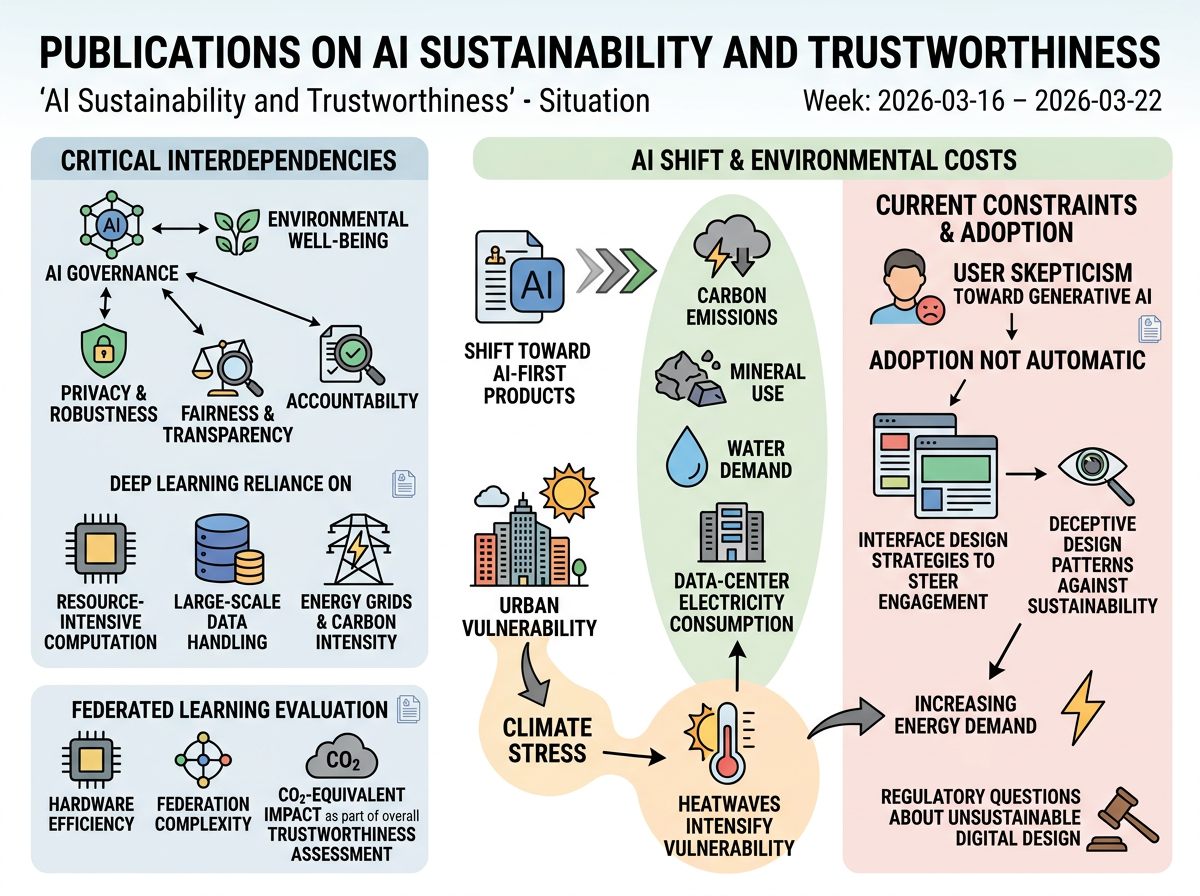
Recent work situates AI within a broader sustainability and trustworthiness agenda. One line of research argues that AI governance should account not only for privacy, robustness, fairness, transparency, and accountability, but also for environmental well-being, since deep learning systems rely on resource-intensive computation, large-scale data handling, and energy grids with varying carbon intensity. In federated learning, this has motivated explicit evaluation of hardware efficiency, federation complexity, and CO2-equivalent impact as part of overall trustworthiness assessment.
A second line of work highlights that the shift toward AI-first products carries significant environmental costs, including carbon emissions, mineral use, water demand, and expanding data-center electricity consumption. It also notes that adoption is not automatic: user skepticism toward generative AI has led companies to use interface design strategies to steer engagement, raising regulatory questions about unsustainable digital design patterns. Meanwhile, climate stress is already reshaping urban systems—heatwaves intensify vulnerability in dense cities—underscoring why the growing energy demand of AI infrastructure matters in a warming world.
Infographic (English)
Progress
The data heat island effect: quantifying the impact of AI data centers in a warming world <See Details on Fugu-MT>
Quantifies localized land-surface temperature increases near AI data centers, extending sustainability assessment beyond aggregate energy metrics. Adds an estimate of physical warming (~2°C rise) and exposed populations (~340 million), moving beyond prior work that focused on energy consumption and carbon accounting alone.
Is the future of AI green? What can innovation diffusion models say about generative AI's environmental impact? <See Details on Fugu-MT>
Applies classical innovation diffusion models to forecast the long-run environmental footprint of generative AI. Shifts from static snapshot assessments of current harms to scenario-based projections that link industry structure evolution to future environmental impact.
Outlook
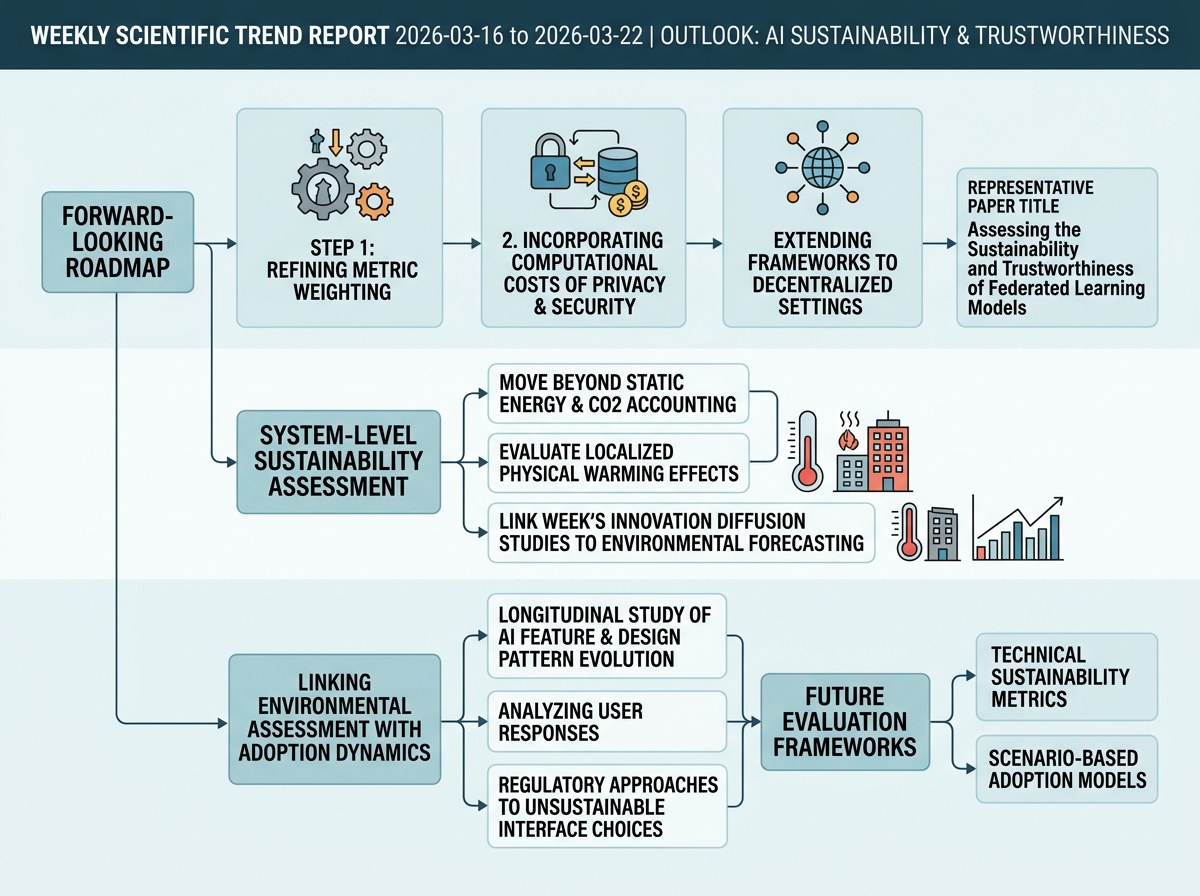
Near-term work is likely to push AI sustainability evaluation beyond static energy or CO2 accounting toward system-level assessments that include localized externalities. Building on federated-learning trustworthiness research, next steps include refining metric weighting, incorporating the computational cost of privacy and security mechanisms, and extending frameworks to decentralized settings; this week's data-center warming study suggests that physical environmental effects at the site level may become an additional evaluation dimension.
A second probable direction is linking environmental assessment with adoption dynamics. The representative papers call for longitudinal study of how AI features and associated design patterns evolve, how users respond, and how regulation might address unsustainable interface choices. This week's diffusion-based forecasting reinforces that future impacts depend on how AI use spreads across industries, suggesting that evaluation frameworks may increasingly combine technical sustainability metrics with scenario-based adoption models.
Infographic (English)
References
- Assessing the Sustainability and Trustworthiness of Federated Learning Models - Authors: Alberto Huertas Celdran, Chao Feng, Pedro Miguel Sanchez Sanchez, Lynn Zumtaugwald, Gerome Bovet, Burkhard Stiller / <See Details on Fugu-MT> / License: CC-BY-4.0
- Heatwave increases nighttime light intensity in hyperdense cities of the Global South: A double machine learning study - Authors: Ramit Debnath, Taran Chandel, Fengyuan Han, Ronita Bardhan, / <See Details on Fugu-MT> / License: CC-BY-4.0
- Imposing AI: Deceptive design patterns against sustainability - Authors: Anaëlle Beignon, Thomas Thibault, Nolwenn Maudet, / <See Details on Fugu-MT> / License: CC-BY-SA-4.0