Summary
This week's papers frame AI deployment as an environmental and governance challenge. Researchers highlight the growing energy, carbon, and infrastructure burdens of AI adoption, argue that trustworthiness assessments should explicitly include sustainability metrics, and show that product design choices can steer users toward environmentally costly AI use.
Situation
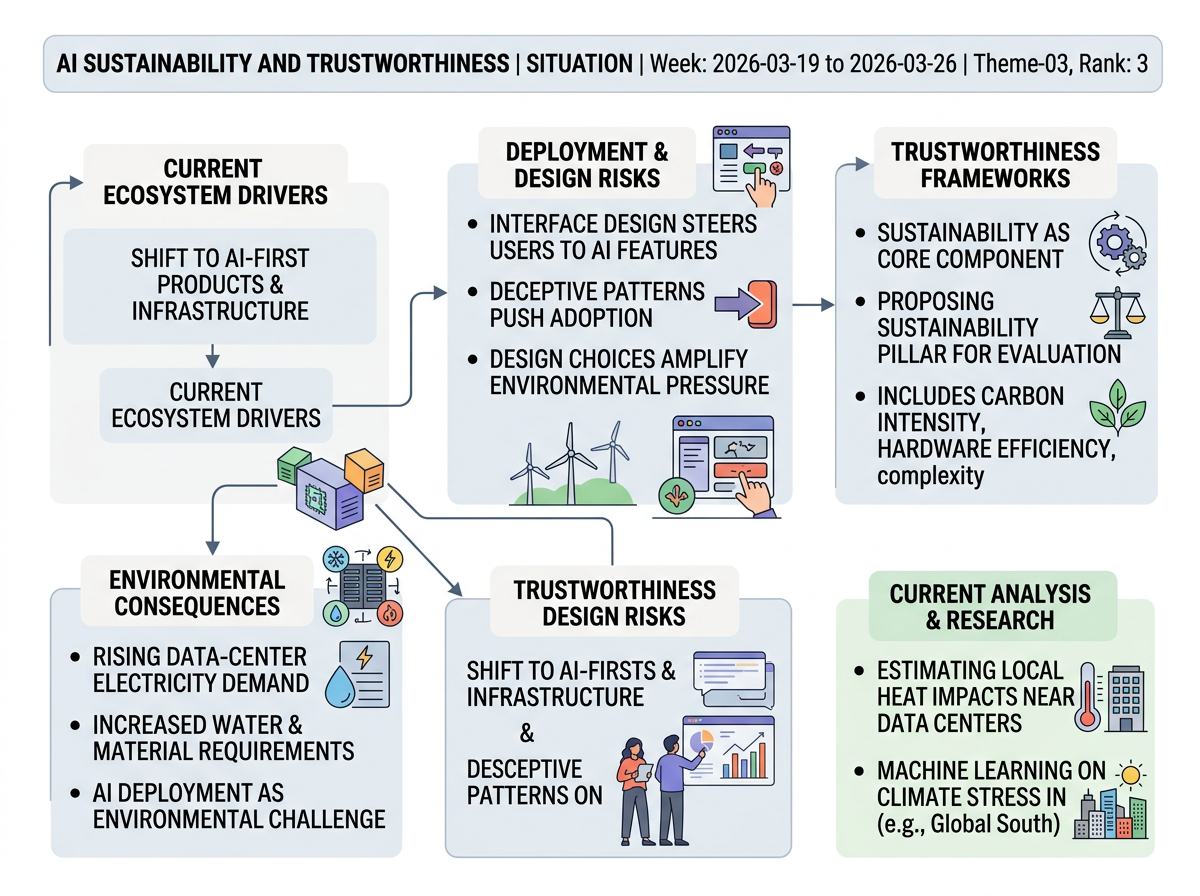
The representative papers describe a shift toward AI-first products and infrastructure, alongside growing concern about the environmental consequences. One paper documents how generative AI expansion is tied to rising data-center electricity, water, and material demands, and how companies use interface design strategies—including deceptive patterns—to push adoption of AI features in existing platforms. Another paper treats environmental well-being as a core component of trustworthy AI, proposing a sustainability pillar for federated learning evaluation that incorporates carbon intensity, hardware efficiency, and federation complexity alongside privacy, robustness, and fairness.
A third strand uses machine learning to study climate stress itself: in hyperdense Global South cities, double machine learning with nighttime light data is applied to estimate how heatwaves alter urban activity and energy use. Taken together, the papers portray AI as entangled with sustainability on multiple fronts—AI systems create environmental pressures, design choices can amplify those pressures by increasing use, and evaluation frameworks are beginning to incorporate environmental impact as a dimension of responsible deployment.
Infographic (English)
Progress
The data heat island effect: quantifying the impact of AI data centers in a warming world <See Details on Fugu-MT>
Quantifies a local climate externality of AI infrastructure by estimating land-surface temperature increases near AI data centers and the population exposed. Moves beyond broad warnings about energy and water use to provide a direct, location-specific estimate of heat impacts from AI data-center operations.
Is the future of AI green? What can innovation diffusion models say about generative AI's environmental impact? <See Details on Fugu-MT>
Applies classical innovation-diffusion models to forecast how the generative AI ecosystem may structurally evolve and what that implies for environmental impact. Adds a diffusion-based analytic framework that yields a more nuanced view of long-term environmental burden than prior aggregate alarm estimates.
Outlook
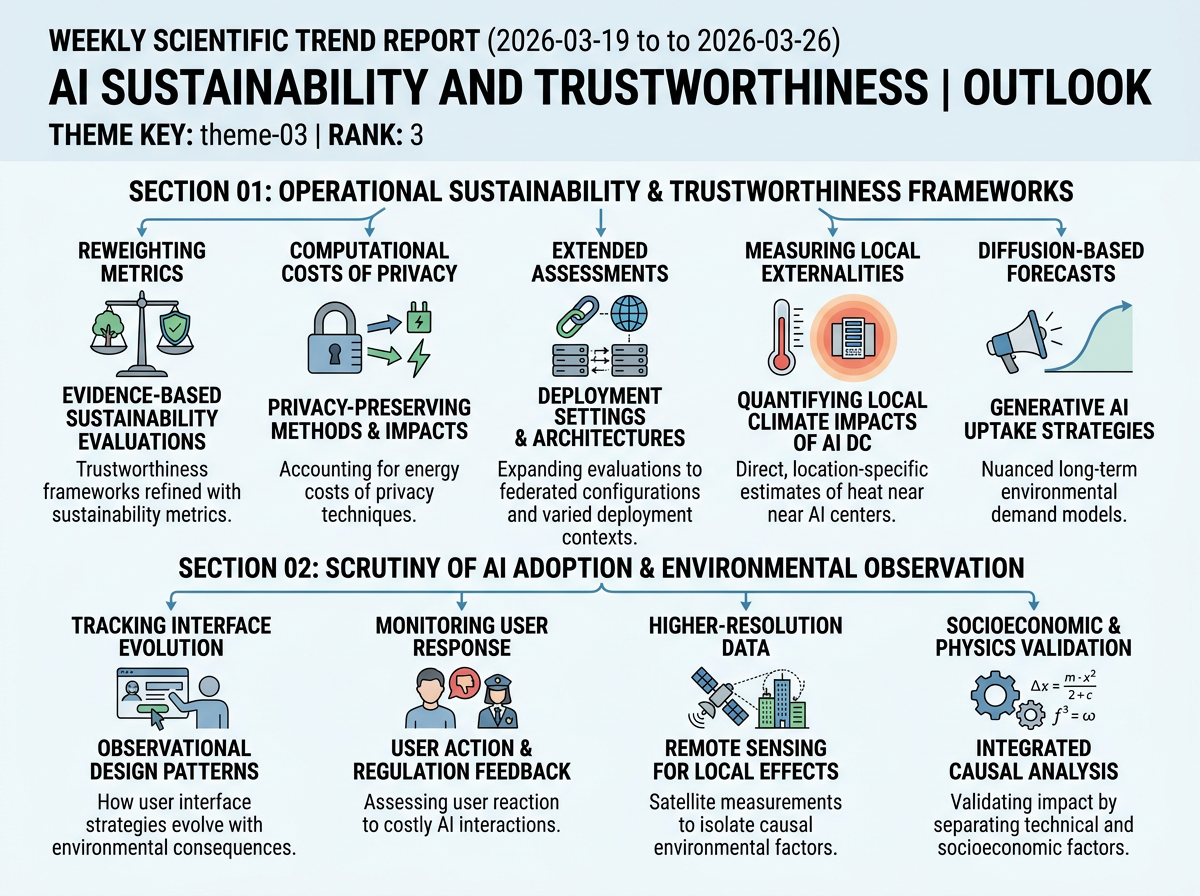
The week's progress points toward more operational, evidence-based sustainability evaluation for AI systems. Direct measurement of local externalities around data centers and diffusion-based forecasts of generative AI uptake push the field beyond generic environmental warnings. In parallel, the representative papers suggest that trustworthiness frameworks will be refined by reweighting sustainability metrics, accounting for the computational costs of privacy-preserving methods, and extending assessments to more deployment settings and federated architectures.
A second direction is closer scrutiny of how AI adoption is produced and how its impacts are observed. Future work flagged in the design-pattern paper points to tracking how AI interface strategies evolve and how users respond, which could make environmental assessments less dependent on assumed demand growth. On the measurement side, the heatwave study calls for higher-resolution satellite data, complementary socioeconomic indicators, and physics-informed validation to better separate causal effects from confounding urban and technical factors.
Infographic (English)
References
- Assessing the Sustainability and Trustworthiness of Federated Learning Models - Authors: Alberto Huertas Celdran, Chao Feng, Pedro Miguel Sanchez Sanchez, Lynn Zumtaugwald, Gerome Bovet, Burkhard Stiller / <See Details on Fugu-MT> / License: CC-BY-4.0
- Heatwave increases nighttime light intensity in hyperdense cities of the Global South: A double machine learning study - Authors: Ramit Debnath, Taran Chandel, Fengyuan Han, Ronita Bardhan, / <See Details on Fugu-MT> / License: CC-BY-4.0
- Imposing AI: Deceptive design patterns against sustainability - Authors: Anaëlle Beignon, Thomas Thibault, Nolwenn Maudet, / <See Details on Fugu-MT> / License: CC-BY-SA-4.0