Summary
This week's work centers on robot manipulation systems that move beyond reactive control by integrating predictive world models and richer contact feedback. Representative papers argue that physical reasoning should be learned through embodied interaction and evaluated with benchmarks for physical consistency, while dexterous skills require tactile sensing beyond simplified signals. Weekly progress papers reinforce these directions with tactile-aware post-training, uncertainty-gated sensing, and structured planning for long-horizon tasks.
Situation
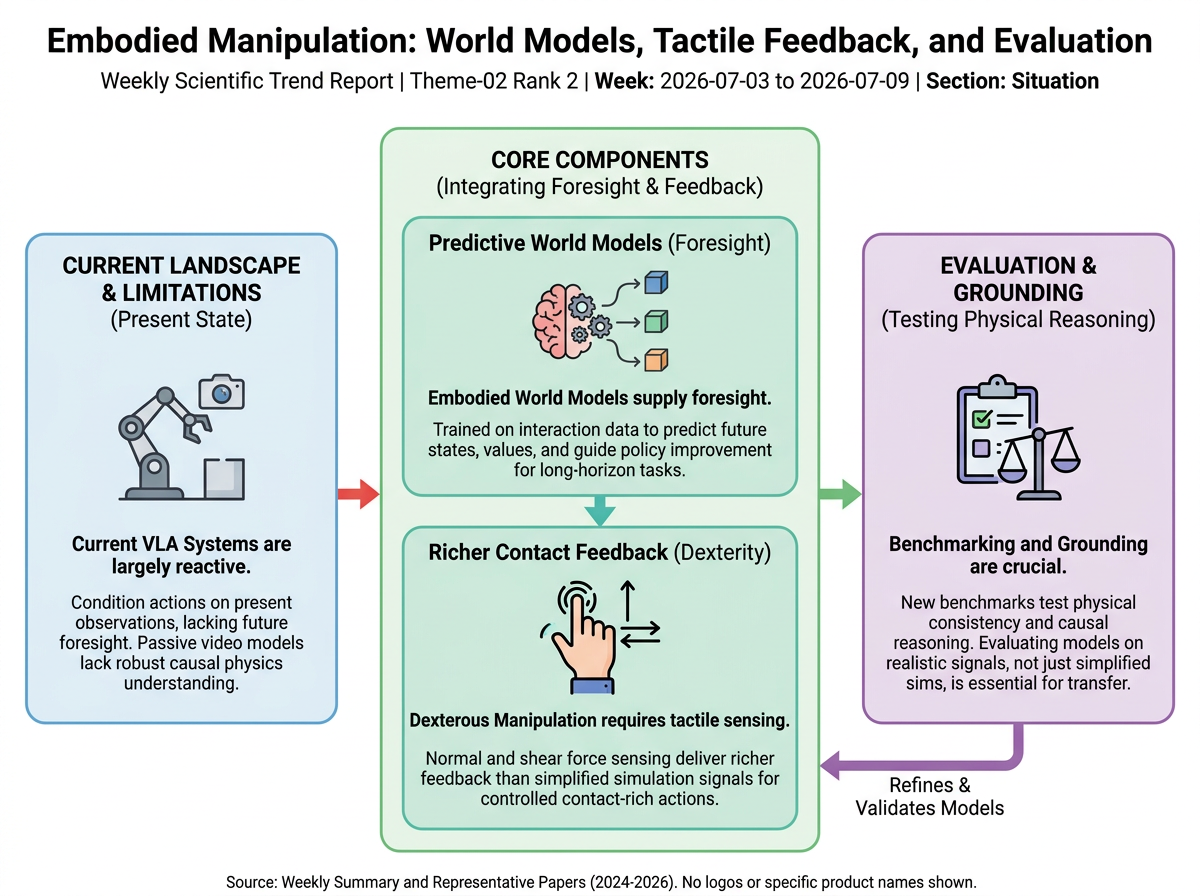
Current vision-language-action (VLA) systems for manipulation are largely reactive, conditioning actions on present observations rather than anticipating future scene evolution. Passive video-generation models can produce photorealistic outputs but lack robust causal understanding of physics, often failing on scenarios that require genuine physical reasoning. In response, recent work positions embodied world models—trained on large-scale robot interaction data—as a way to supply foresight for long-horizon manipulation by predicting future states and values to guide policy improvement.
The theme extends beyond building predictive models to testing and grounding them. One representative paper introduces a benchmark (WoWBench) specifically designed to evaluate physical consistency, causal reasoning, and instruction following, reflecting a push toward verifying whether models genuinely reason about action consequences. Another highlights that dexterous manipulation depends on richer contact feedback: tactile sensing with normal and shear forces is necessary for controlled sliding and in-hand translation, particularly where simplified simulation signals are insufficient for sim-to-real transfer.
Infographic (English)
Progress
TACO: TActile World Model as a Self-COrrector forScalable VLA Post-Training <See Details on Fugu-MT>
TACO uses a tactile-aware world model to self-correct VLA policies during post-training for contact-rich manipulation tasks. It turns tactile feedback into a scalable post-training signal rather than using it only as a runtime control input.
Feeling the Unexpected: ResTacVLA for Contact-Rich Manipulation via Residual Tactile Representation <See Details on Fugu-MT>
ResTacVLA converts sparse tactile signals into denser residual representations for contact-rich manipulation. It adaptively gates tactile integration based on visual-prior uncertainty, refining multimodal fusion under unexpected contact.
TouchWorld: A Predictive and Reactive Tactile Foundation Model for Dexterous Manipulation <See Details on Fugu-MT>
TouchWorld presents a tactile foundation model that is both predictive and reactive for dexterous manipulation. It unifies foresight and immediate tactile response in a single model rather than treating them as separate modules.
Cortex: A Bidirectionally Aligned Embodied Agent Framework for Long-horizon Manipulation <See Details on Fugu-MT>
Cortex addresses long-horizon manipulation by communicating feasible subtask plans from a high-level VLM to a low-level VLA. It adds bidirectional planning structure to overcome the purely observation-driven, Markovian nature of standard VLA policies.
Harness VLA: Steering Frozen VLAs into Reliable Manipulation Primitives via Memory-Guided Agents <See Details on Fugu-MT>
Harness VLA steers frozen VLAs into retryable contact-rich primitives via a memory-guided agent framework. It grounds action selection in execution traces, success rules, and failure models rather than relying on one-shot reactive policies.
CoorGrasp: Coordinated Contact Control for Adaptive Dexterous Grasping Under Uncertainty <See Details on Fugu-MT>
CoorGrasp proposes a tactile-driven model predictive controller for adaptive dexterous grasping under shape and pose uncertainty. It introduces coordinated contact control during uncertain grasp execution, extending the role of tactile feedback beyond simplified binary signals.
Outlook
Outlook Summary
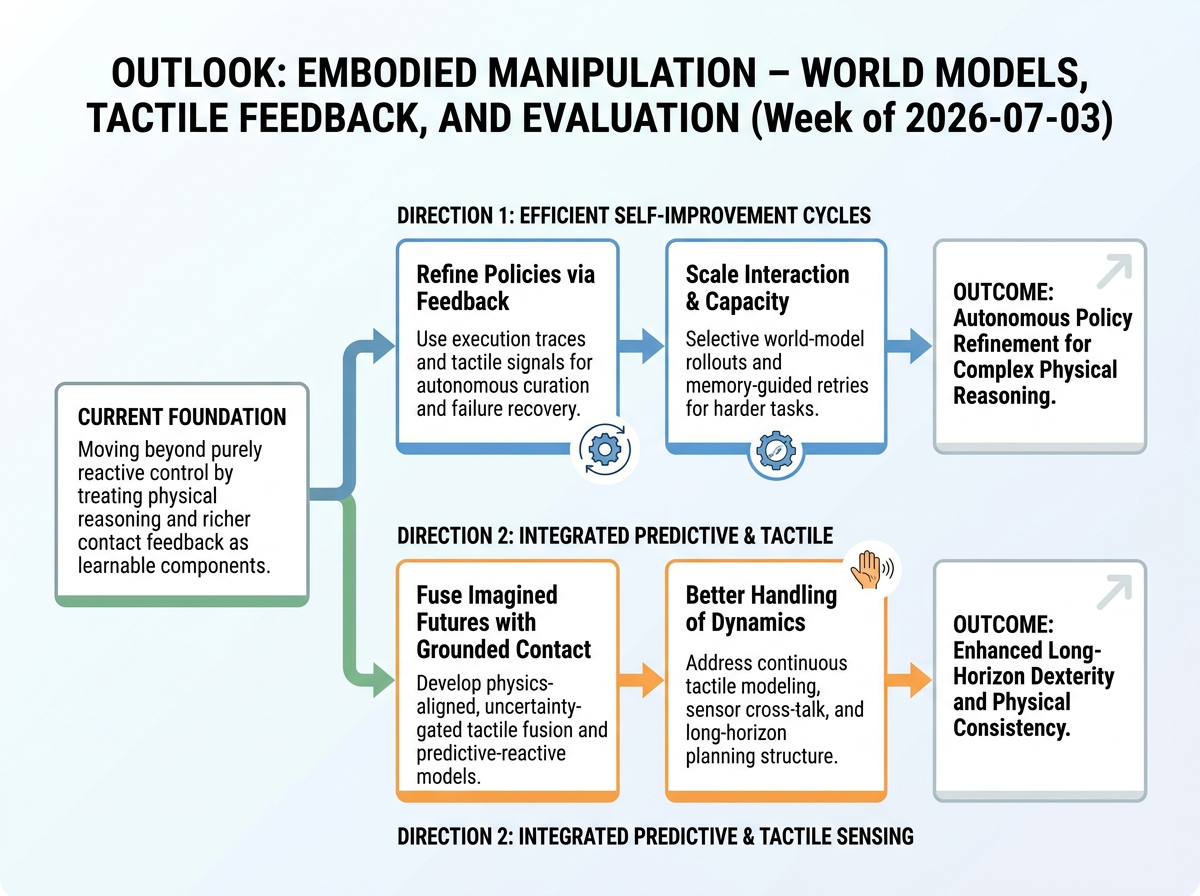
Near-term embodied manipulation will likely use more selective world-model rollouts, larger interaction datasets, and execution traces that guide automatic policy improvement. Planning structure, memory-guided retries, and tactile post-training should help robots recover from contact failures. Progress will also depend on combining predicted futures with physics-aligned touch signals while addressing sensor cross-talk, uncertainty, and the need for multi-axis tactile feedback.
Infographic (English)
Three-Year Movement
The standard path combines prediction, contact sensing, and physical-consistency checks into one robot-learning workflow. A world model imagines future states, tactile sensors report what happens during contact, and evaluation rejects futures that violate basic physics. This moves manipulation beyond policies that react only to the latest observation and often miss the long-term effects of early contact choices.
During the first year, researchers should test this workflow on long tasks such as folding, packing, and tool handling. They will increasingly select imagined trajectories by uncertainty, plausibility, or usefulness instead of accepting every generated example. Tactile measurements should also guide retries and help the system remember previous failures. The main threshold will be reproducible improvement on unseen contact-rich tasks under comparable computational limits, with consistency scores that predict physical execution.
In the second year, successful methods should spread to larger datasets collected across several robot types. Predictive models will connect more tightly to tactile modules, while inverse-dynamics components translate desired future states into candidate actions. A reinforcing loop should emerge: stronger physical filters create cleaner training data, cleaner data improves reliability, and better executions produce more useful traces for the next update.
By the third year, this refinement stack could support selected tasks involving deformable or material-sensitive objects. Few-shot property estimation may let a robot adjust its dynamics model for unfamiliar materials without rebuilding the entire policy. Reusable research platforms may then connect imagination, contact correction, and retry behavior as standard components, with evaluation covering physical faithfulness and recovery. A useful monitoring cue will be cross-laboratory evidence that combined shear and normal touch signals improve performance under normalized computation. The path would weaken if predicted futures remain physically implausible, benchmark scores fail to match hardware results, or gains disappear after computational costs are equalized.
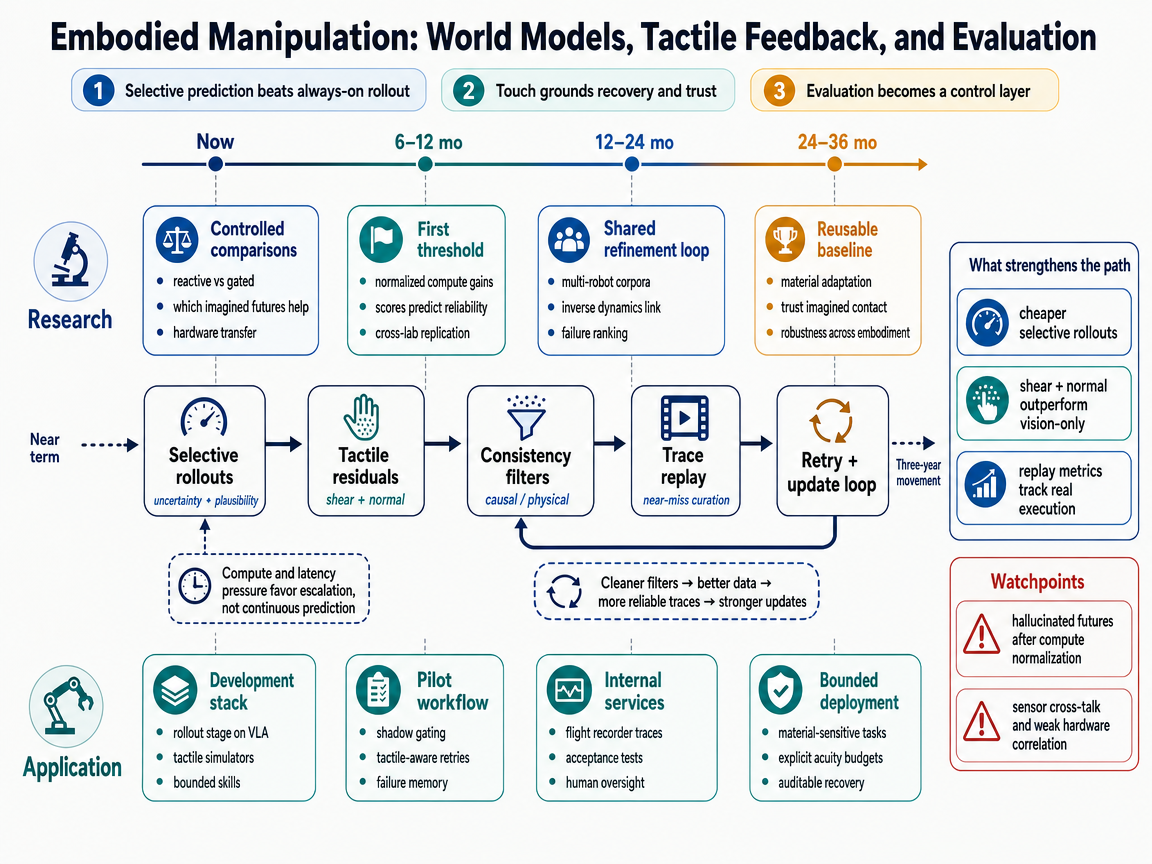
The contender path uses selective escalation rather than running an expensive predictive model continuously. A fast local policy handles routine contact, while tactile signals and prediction errors feed a lightweight monitor that estimates task difficulty. The world model is consulted only when instability or uncertainty crosses a learned threshold. This mechanism aims to preserve long-horizon performance while reducing latency and unnecessary imagined trajectories.
During the first year, researchers should compare gated systems with continuous planning and compact unified policies under shared resource limits. Warning signals may include unexpected shear, repeated retries, or disagreement between predicted and observed states. Early systems will probably run the gate in shadow mode, recording when escalation would occur while existing safeguards remain active. The decisive result will be whether selective escalation lowers computational use without missing dangerous or important contact events.
In the second year, benchmarks should divide episodes into routine and difficult segments, then test whether escalation happens at the right time. Development stacks may add tactile flight recorders that align sensor readings, predicted futures, and physical outcomes on one timeline. Informative failures can then be prioritized for model refinement instead of treating every execution record as equally useful. This creates a feedback loop in which better failure records improve the gate, and a better gate captures more valuable cases.
By the third year, the architecture could become a control plane separating fast robot-side response from slower predictive consultation. Local hardware would run tactile policies and difficulty monitors, while heavier services generate counterfactual rollouts for unusual states. Acceptance tests should report computation per task, escalation delay, and safe behavior when the predictive service is unavailable. A key monitoring cue will be cross-robot evidence that tactile residuals and retry history predict failures better than vision alone. The path would be weakened if a compact local model matches gated systems within practical power and latency limits. It would also weaken if tactile noise makes escalation thresholds unreliable across materials and sensors.
The maybe path centers on a trace-governed assurance layer for contact-rich robot learning. This layer records predicted states, tactile evidence, and execution outcomes so that failures can be replayed and compared. It also decides whether a policy is ready for physical trials. The mechanism addresses two problems: imagined futures can violate physics, and producing large numbers of unfiltered rollouts can waste computation.
During the first year, leading groups should synchronize robot actions with contact signals and retry outcomes. These records will expose recurring problems such as slip onset, false stable-contact predictions, and repeated recovery oscillation. Tactile simulators can reproduce difficult contact transitions, while shared trace formats make failures easier to classify. The practical threshold is whether replaying a small set of informative failures improves policies more efficiently than generating many unfiltered imagined trajectories.
In the second year, small trace collections should form around common contact events across different robots. Researchers will test whether cases involving slip, deformation, or incorrect contact predictions can be replayed meaningfully across policies and sensors. A policy update may first face historical trace replays, then a restricted physical trial, before receiving a wider task range. Better traces should create clearer failure categories, which improve rollout selection and produce more useful future traces.
By the third year, world models and tactile simulators could be tested against explicit failure envelopes that define acceptable behavior during contact and recovery. Practical systems may include calibration records, contact-regression results, and approved operating conditions. The assurance layer would use this evidence to decide which model and policy combination can handle a given contact class. A strong monitoring cue will be the appearance of multimodal trace datasets and release gates whose replay results predict physical failures. The scenario would weaken if replay scores do not transfer to real robots or remain incomparable across sensor types. It would also weaken if larger end-to-end models remove physical errors without trace-guided tactile validation.
1-Year / 3-Year Research-Application Infographic
References
- Learning In-Hand Translation Using Tactile Skin With Shear and Normal Force Sensing - Authors: Jessica Yin, Haozhi Qi, Jitendra Malik, James Pikul, Mark Yim, Tess Hellebrekers, / <See Details on Fugu-MT> / License: CC-BY-4.0
- WoW: Towards a World omniscient World model Through Embodied Interaction - Authors: Xiaowei Chi, Peidong Jia, Chun-Kai Fan, Xiaozhu Ju, Weishi Mi, Kevin Zhang, Zhiyuan Qin, Wanxin Tian, Kuangzhi Ge, Hao Li, Zezhong Qian, Anthony Chen, Qiang Zhou, Yueru Jia, Jiaming Liu, Yong Dai, Qingpo Wuwu, Chengyu Bai, Yu-Kai Wang, Ying Li, Lizhang Chen, Yong Bao, Zhiyuan Jiang, Jiacheng Zhu, Kai Tang, Ruichuan An, Yulin Luo, Qiuxuan Feng, Siyuan Zhou, Chi-min Chan, Chengkai Hou, Wei Xue, Sirui Han, Yike Guo, Shanghang Zhang, Jian Tang, / <See Details on Fugu-MT> / License: CC-BY-4.0
- GigaBrain-0.5M*: a VLA That Learns From World Model-Based Reinforcement Learning - Authors: GigaBrain Team, Boyuan Wang, Chaojun Ni, Guan Huang, Guosheng Zhao, Hao Li, Jie Li, Jindi Lv, Jingyu Liu, Lv Feng, Mingming Yu, Peng Li, Qiuping Deng, Tianze Liu, Xinyu Zhou, Xinze Chen, Xiaofeng Wang, Yang Wang, Yifan Li, Yifei Nie, Yilong Li, Yukun Zhou, Yun Ye, Zhichao Liu, Zheng Zhu, / <See Details on Fugu-MT> / License: CC-BY-4.0