Summary
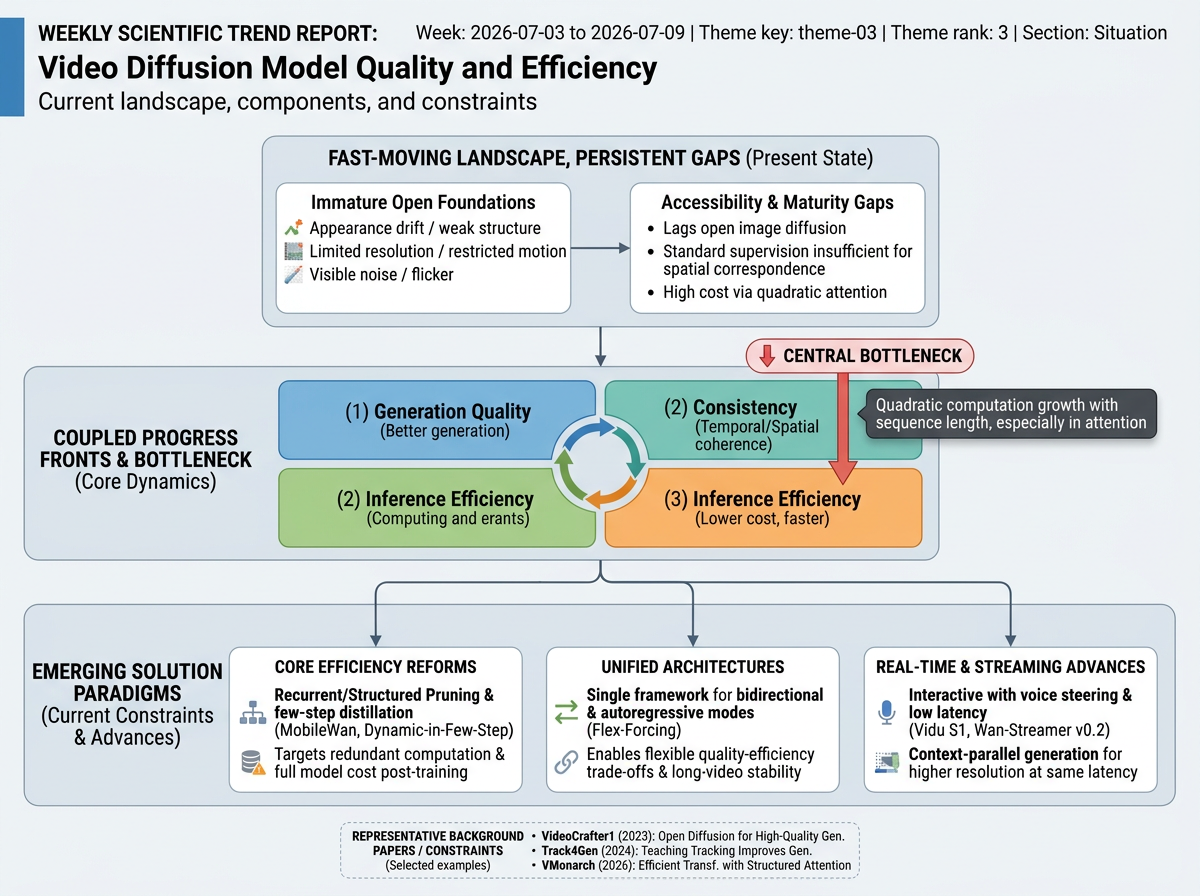
This week's work on video diffusion models advances along three coupled fronts: generation quality, temporal/spatial consistency, and inference efficiency. Representative papers highlight persistent gaps in open video foundations—appearance drift, limited resolution, and quadratic attention cost—while this week's progress pushes these concerns toward mobile deployment, unified generation paradigms, and real-time streaming settings.
Situation
Representative introductions portray a fast-moving video diffusion landscape that still struggles to match the accessibility and maturity of open image diffusion. Prior open text-to-video and image-to-video models are described as limited by low resolution, unsatisfactory visual quality, flicker, visible noise, restricted motion, or weak preservation of input content and structure, while newer models still suffer from appearance drift because standard diffusion supervision does not explicitly enforce spatial correspondence across frames.
At the same time, scaling video diffusion transformers to longer and higher-resolution generation exposes attention as a central bottleneck, with computation growing quadratically with sequence length. Representative work emphasizes structured sparse attention and feature-level tracking supervision as ways to preserve quality and coherence without prohibitive cost, and recent supplemental papers push the same logic toward recurrent, mobile, and real-time video generation settings.
Infographic (English)
Progress
MobileWan: Closing the Quality Gap for Mobile Video Diffusion <See Details on Fugu-MT>
MobileWan deploys a 5B-parameter video diffusion model on commercial mobile hardware, generating 5-second 480×832 videos in 20 seconds via recurrent reformulation and structured pruning. This moves large-scale video diffusion from server-only settings to on-device deployment, narrowing the quality gap between mobile and server-scale generation.
Flex-Forcing: Towards a Unified Autoregressive and Bidirectional Video Diffusion Model <See Details on Fugu-MT>
Flex-Forcing unifies bidirectional and autoregressive video diffusion within a single training and inference framework, enabling flexible quality–efficiency trade-offs at test time. Unlike prior approaches that commit to one paradigm, it allows a single model to operate in bidirectional, autoregressive, or hybrid modes, improving long-video stability.
Dynamic-in-Few-Step: Unifying Dynamic Computation and Few-Step Distillation for Efficient Video Generation <See Details on Fugu-MT>
Dynamic-in-Few-Step combines dynamic structure sparsity with few-step distillation in a post-training acceleration framework for video diffusion. Rather than redesigning attention alone, it targets redundant computation across the full model to reduce cost after training.
Vidu S1: A Real-Time Interactive Video Generation Model <See Details on Fugu-MT>
Vidu S1 achieves real-time interactive video generation with voice-controlled content steering at up to 42 FPS on standard GPUs. This extends video diffusion efficiency from offline batch generation to responsive interactive use, where latency is a first-class constraint.
Wan-Streamer v0.2: Higher Resolution, Same Latency <See Details on Fugu-MT>
Wan-Streamer v0.2 raises a native-streaming audio-visual video diffusion system from 192×336 to 640×368 output while preserving approximately 200 ms model-side response latency. It demonstrates that streaming video diffusion systems can increase resolution without additional latency by restructuring the serving topology with context-parallel generation.
Outlook
Outlook Summary
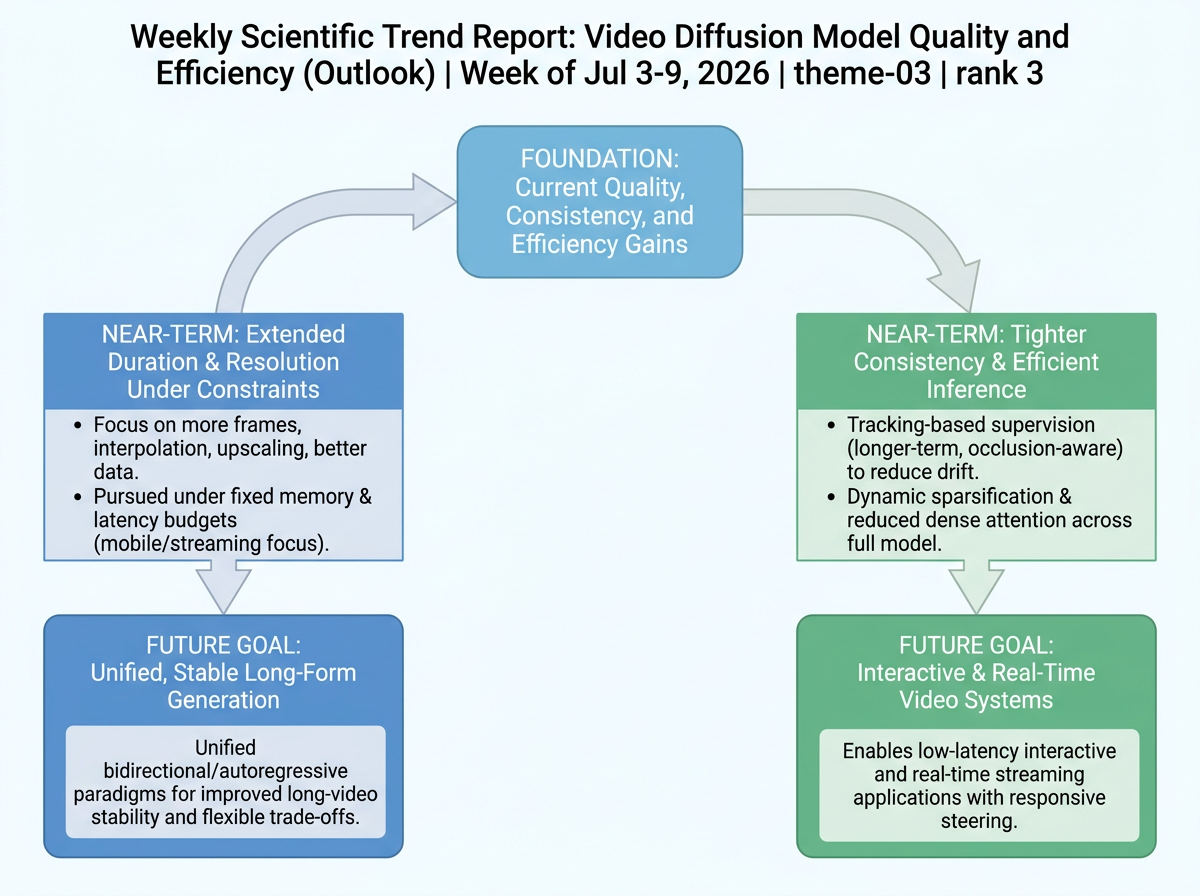
Near-term video diffusion research will push beyond short clips toward longer duration, higher resolution, and better motion while respecting fixed memory and latency limits. Likely methods include training on more frames, frame interpolation, and spatial upscaling, supported by better data. Consistency supervision will increasingly be combined with efficient inference: tracking can reduce appearance drift, while dynamic sparsity can limit costly attention. These methods should support unified generation and real-time streaming, especially for long-video and interactive systems.
Infographic (English)
Three-Year Movement
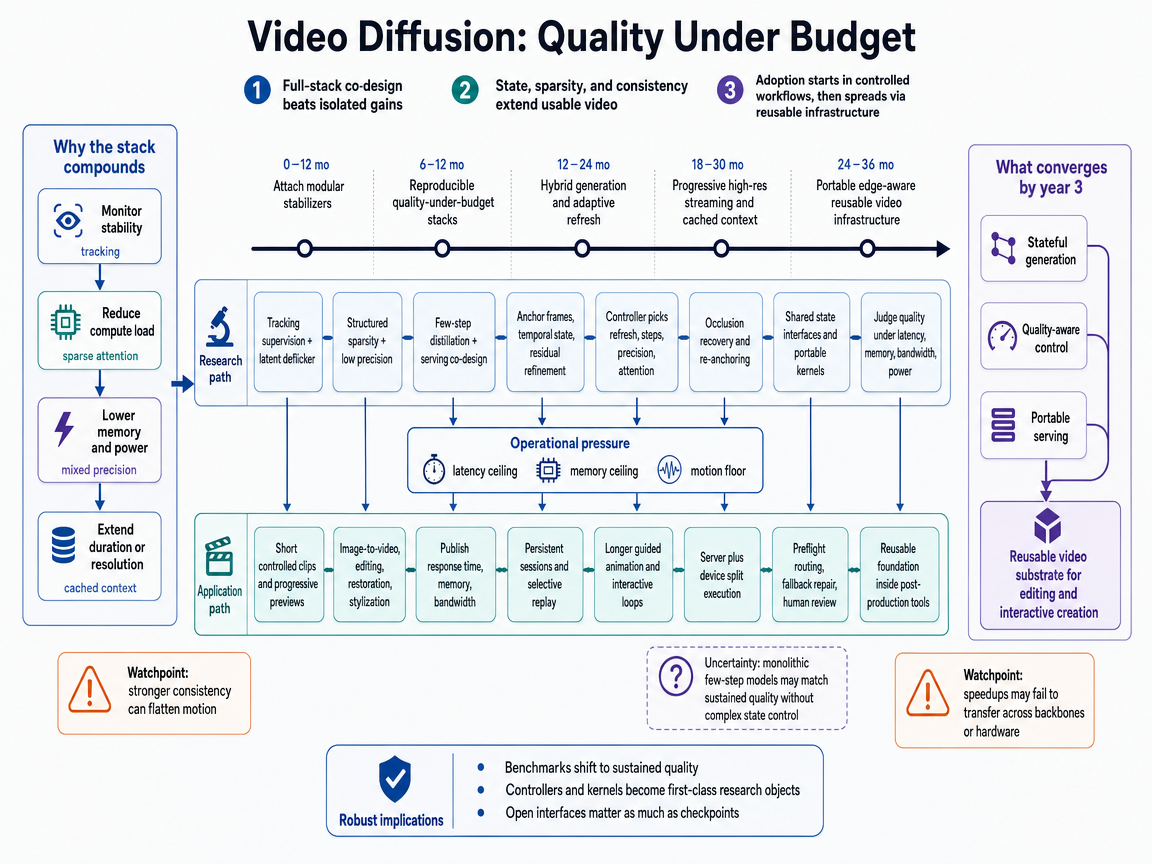
The standard path treats video generation as a full-system problem rather than a series of isolated model improvements. Temporal stability, output quality, and efficiency must improve together. Tracking-based supervision acts like continuous monitoring by helping objects preserve their appearance across frames. Sparse attention and lower-precision computation reduce processing costs without applying equal effort everywhere.
In the first year, researchers will add these methods to existing open backbones. Tracking losses and deflickering modules should improve consistency, while structured sparsity should support longer clips under practical memory limits. Tests will need to confirm that consistency controls do not flatten desirable motion. Reproducible systems will then combine faster generation, interpolation, and optimized serving while reporting both quality and resource use. Early applications will emphasize controlled workflows such as animation, editing, and restoration, with progressive previews rather than unrestricted long-form generation.
In the second year, these components should support hybrid systems that combine bidirectional refinement with autoregressive generation. Bidirectional processing uses context from both temporal directions, while autoregressive processing produces new content in sequence. Occlusion-aware tracking should help people or objects retain identity after disappearing and returning. By the third year, portable sparse formats and compact caches could enable local previews on selected devices, with demanding work divided between the device and a server. A useful monitoring cue is whether quality remains stable under fixed latency, memory, and power limits across different hardware. The path would be weakened by stalled clip duration, speedups that fail to transfer, or motion becoming visibly static.
The contender path reorganizes video diffusion as a stateful generative codec. An anchor frame establishes appearance and scene meaning, while tracked state carries stable information forward. A residual process updates meaningful changes instead of rebuilding every frame. A controller varies refresh frequency and processing effort according to motion, uncertainty, and response-time limits.
In the first year, teams will attach this persistent state to existing video backbones. Prototypes should test occlusion-aware tracking and selective refinement, then measure whether identity recovers after objects leave and re-enter a scene. They must also distinguish true consistency from motion freezing. Later work will train controllers to decide when to create a new anchor, how much attention to activate, and how many generation steps to run. Controlled uses such as animation, restoration, and interactive preview are likely to appear first because an existing image or edited frame can provide a reliable anchor.
In the second year, successful prototypes should become jointly trained systems that connect anchor creation, temporal state, and adaptive control. Shared state interfaces may allow controllers or optimized processing components to move between several open models. Longer runs will reveal delayed drift and failed recovery, producing evidence that can improve refresh policies. By the third year, the same foundation could support mobile previews, interactive streams, and higher-quality rendering through different controller settings. Systems would spend little effort on stable segments and refresh aggressively when uncertainty rises. A key monitoring cue is whether adaptive refresh beats fixed intervals under the same end-to-end resource limits. The scenario is weakened if errors compound after occlusion, controller overhead consumes the savings, or simpler efficient models achieve the same sustained quality.
The maybe path places open video diffusion inside a production control layer rather than relying on one model for every clip. This layer routes each segment through generation, repair, or human review according to measured quality and resource limits. Tracking and flicker tests act as sensors, while routing policies decide whether a failed span should be processed again or escalated. The goal is not maximum visual quality in every case, but lower total generation and correction effort within a defined quality range.
In the first year, researchers will build tests for source preservation, temporal stability, and sufficient motion. Full pipelines will be assessed under fixed memory and response-time limits rather than through isolated model results. Regression suites should cover difficult events such as occlusion, scene changes, and rapid camera movement. Early deployment will suit bounded workflows such as short animation, restoration, and internal visualization because these tasks already include human review. Rejected clips can provide structured evidence about drift or motion suppression, helping routing rules improve over time.
In the second year, shared temporal tests and uncertainty estimates should help controllers recognize when an automatic metric is unreliable. The control layer could then select between fast generation, careful repair, and escalation without tying every task to one model. By the third year, organizations may use continuous-integration-style admission control, meaning that every model or system update must pass an automated regression suite before deployment. Open generators would become replaceable components beneath this layer, while people would retain authority over meaning-sensitive output. A useful monitoring cue is whether automated pass rates predict human acceptance and reduce manual correction time across hardware. The path is weakened if metrics disagree with reviewers, consistency controls make outputs static, or repair overhead removes the original speed advantage.
1-Year / 3-Year Research-Application Infographic
References
- VideoCrafter1: Open Diffusion Models for High-Quality Video Generation - Authors: Haoxin Chen, Menghan Xia, Yingqing He, Yong Zhang, Xiaodong Cun, Shaoshu Yang, Jinbo Xing, Yaofang Liu, Qifeng Chen, Xintao Wang, Chao Weng, Ying Shan / <See Details on Fugu-MT> / License: CC-BY-4.0
- Track4Gen: Teaching Video Diffusion Models to Track Points Improves Video Generation - Authors: Hyeonho Jeong, Chun-Hao Paul Huang, Jong Chul Ye, Niloy Mitra, Duygu Ceylan, / <See Details on Fugu-MT> / License: CC-BY-4.0
- VMonarch: Efficient Video Diffusion Transformers with Structured Attention - Authors: Cheng Liang, Haoxian Chen, Liang Hou, Qi Fan, Gangshan Wu, Xin Tao, Limin Wang, / <See Details on Fugu-MT> / License: CC-BY-4.0