Summary
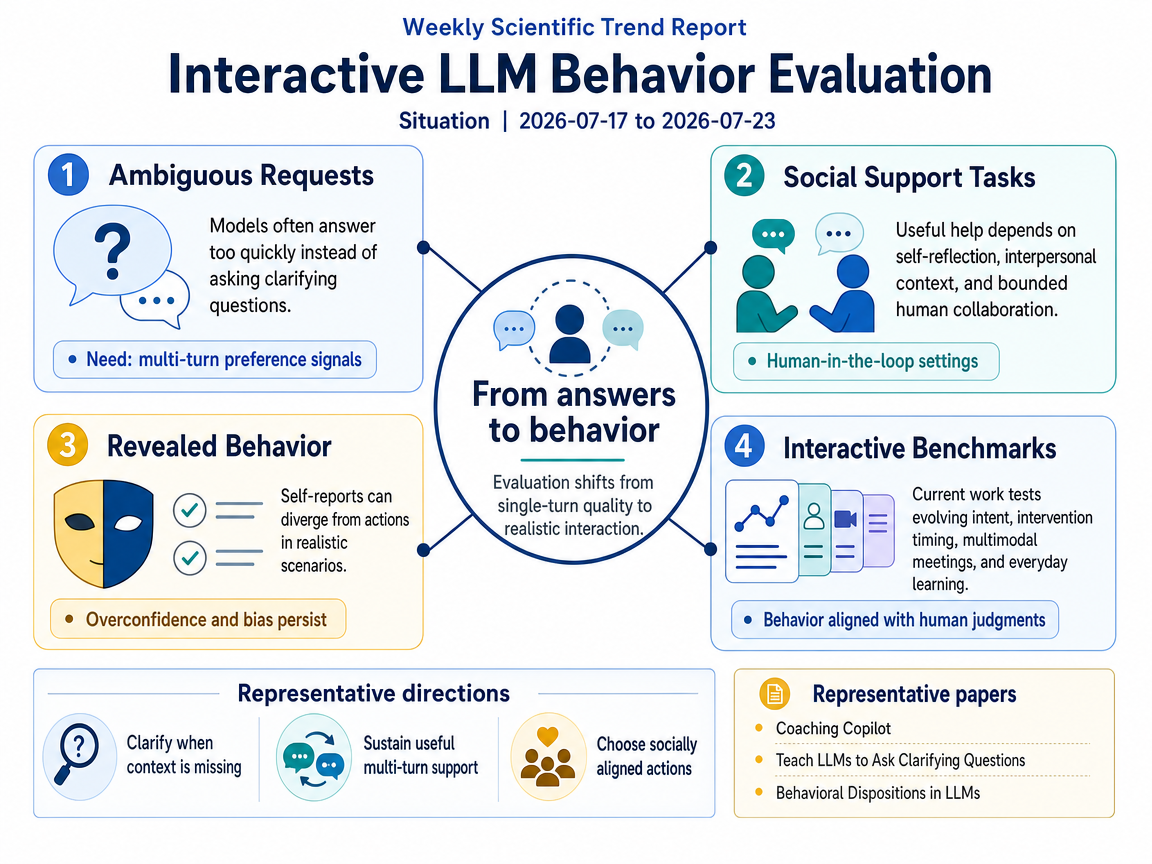
This week's theme centers on evaluating LLM behavior in interactive, socially grounded settings rather than judging single-turn text quality alone. Representative papers show that ambiguity, missing user context, and open-ended social decisions expose gaps in current evaluation and training pipelines, motivating multi-turn preference methods, human-in-the-loop deployments, and revealed-behavior tests aligned with human judgments.
Situation
Representative papers frame a common problem: LLMs are increasingly used in settings where a single fluent answer is not enough. In ambiguous user requests, models often answer presumptuously instead of asking clarifying questions, a limitation linked to single-turn preference annotation that cannot capture the downstream value of clarification. In professional support settings such as executive coaching, effective assistance requires deep self-reflection, sensitivity to interpersonal context, and carefully bounded collaboration with human experts. A third line of work shows that models' self-reported behavioral dispositions diverge from their revealed behavior in realistic scenarios, and that overconfidence and trait-specific biases persist even in frontier models.
These works push evaluation toward behavior in realistic interaction. Rather than relying on what models say about themselves or on isolated response ranking, they evaluate whether models ask for clarification when needed, sustain useful multi-turn support, and choose actions in realistic social scenarios that align with human preferences or consensus. Together, the representative introductions document a shift from static response assessment toward measuring socially competent, context-aware, and behaviorally aligned LLMs.
Infographic (English)
Progress
Informal Learning Emerges in Everyday Human-LLM Interaction <See Details on Fugu-MT>
Analyzes turn-level learning behaviors in 128,569 natural human-LLM conversations, extending evaluation to everyday interaction outcomes. Instead of judging isolated answer quality, it identifies selective and conditional signs of informal learning in real exchanges.
LLMs Get Lost in Evolving User Intent <See Details on Fugu-MT>
Introduces a framework that converts static single-turn tasks into dynamic multi-turn dialogues with evolving user intent. Shows that strong static-task performance does not transfer when models must track changing intent across turns.
LLM-as-a-Coach: Experiential Learning for Non-Verifiable Tasks <See Details on Fugu-MT>
Repurposes LLM feedback into experiential learning signals for open-ended, non-verifiable tasks. Compared with rubric-based RL signals, coaching-style feedback yields stronger generalization on held-out tasks.
AI Assistants Overassist <See Details on Fugu-MT>
Introduces Int-Bench to evaluate when and how AI tutors should intervene while a student reasons through a problem. Shifts evaluation from final answers to intervention timing and style, where current assistant behavior is poorly understood.
MeetingToM: Evaluating Multimodal LLMs on Theory-of-Mind Reasoning in Multi-Party Meetings <See Details on Fugu-MT>
Introduces MeetingToM, a benchmark for theory-of-mind reasoning in naturalistic multi-party meetings. Extends interactive evaluation to multimodal social understanding at increasing levels of social granularity.
Outlook
Outlook Summary
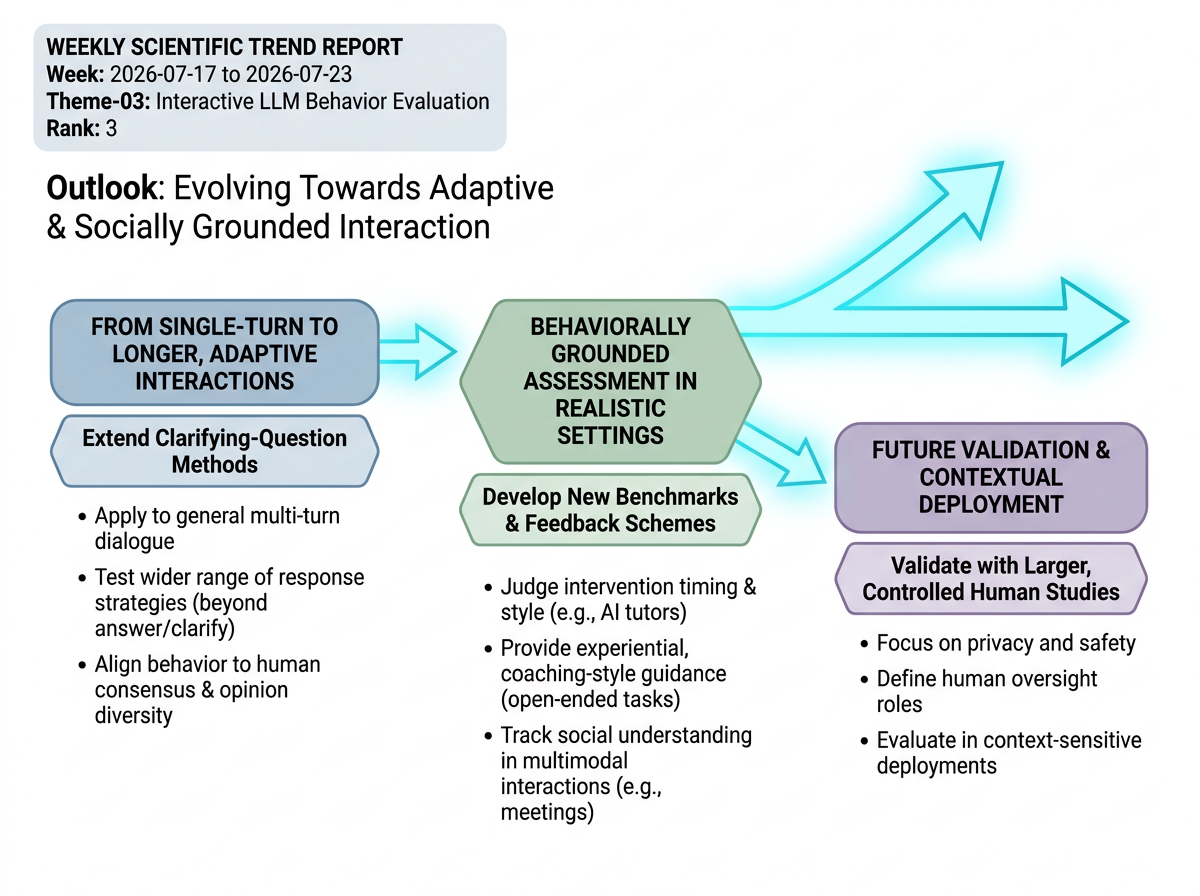
Evaluation and training are likely to move beyond isolated responses toward longer, adaptive conversations. Systems will be tested on whether they clarify changing intent, choose an appropriate response strategy, and reflect both strong human agreement and legitimate differences of opinion. Assessment will also become more grounded in realistic social settings, including intervention timing and open-ended guidance. Larger controlled studies will be needed to confirm these methods, with clear privacy protections, safety limits, and human oversight.
Infographic (English)
Three-Year Movement
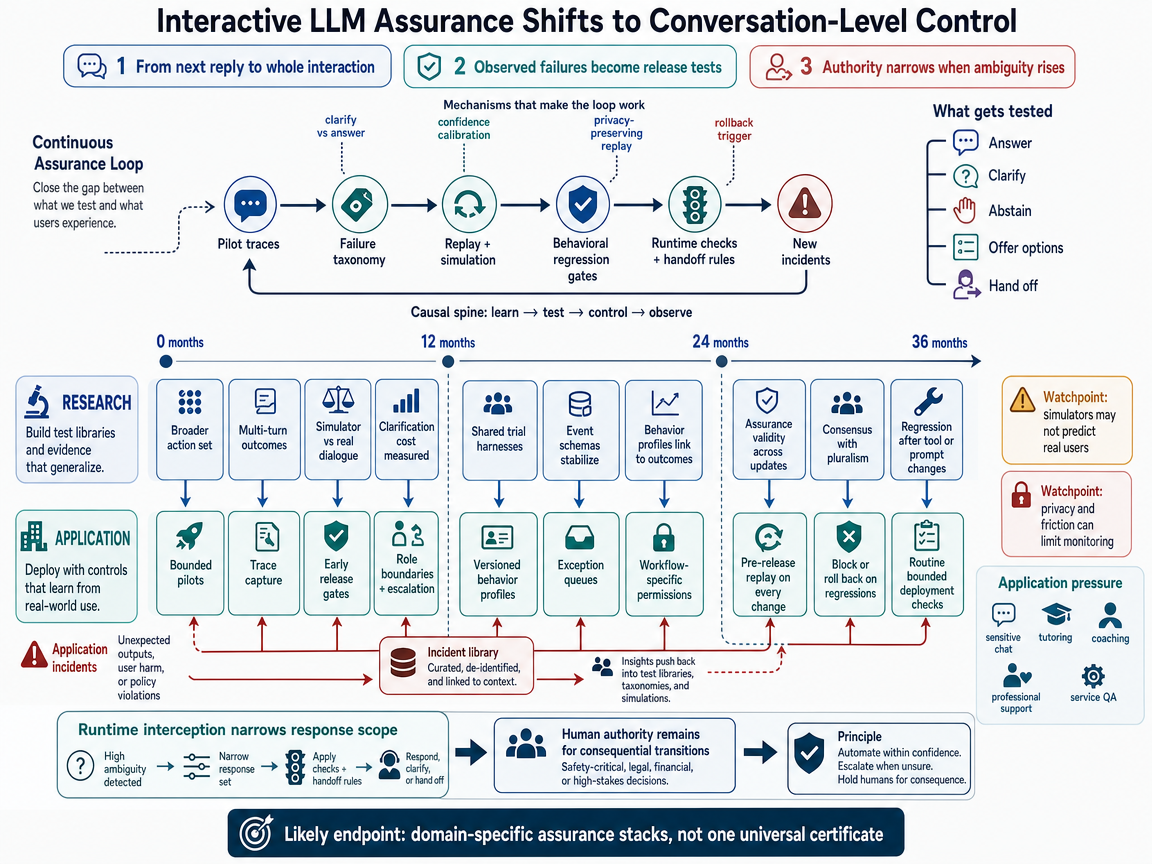
The near-term shift is from scoring isolated answers to evaluating decisions across a whole conversation. In the first year, tests should cover whether an assistant answers, clarifies, or defers at the right moment. Researchers will examine later turns to see whether the choice resolved ambiguity, maintained suitable confidence, and improved the eventual outcome.
Bounded pilots in areas such as tutoring and coaching will provide realistic interaction records. Teams may convert recurring failures into regression tests, which check whether a new system version repeats an earlier mistake. These records should also reveal whether results from simulated users transfer to natural conversations across different settings.
By the second year, reusable evaluation harnesses may combine simulators, scenario libraries, and conversation replay. If their scores predict real user outcomes, systems could gain versioned descriptions of their tested settings and known weak conditions. Human reviewers would then focus on exceptions such as unresolved ambiguity, sensitive disclosures, or misplaced confidence.
Around the third year, this could become a routine assurance loop similar to pharmacovigilance, where recurring failures are classified and fed back into testing. A change to a model, prompt, or connected tool could trigger behavioral replay before release. Worsening clarification, handoff timing, or privacy behavior could block or reverse an update, while incident reviews would create new test scenarios. A strong monitoring cue would be organizations making actual release decisions from multi-turn regression results rather than merely publishing evaluation dashboards. The path would weaken if simulations fail to match natural conversations, human studies show no lasting benefit, or privacy constraints prevent useful replay. Because assistant behavior changes with context and culture, the likely outcome is several setting-specific assurance practices rather than one universal certification system.
The near-term movement is toward longer evaluation in which an assistant receives only the authority justified by the current conversation. This follows a zero-trust mechanism: passing one benchmark does not grant unrestricted permission for every later action. Each consequential response is checked against current intent, uncertainty, and likely effects before it is delivered.
During the first year, researchers should compare direct answers, targeted questions, and human escalation within the same scenario families. Interaction traces will record the reason for a choice and the user's later reaction. Controlled studies will need to show that runtime gates, which inspect proposed responses before delivery, reduce harmful assumptions without making conversations slow or evasive.
Early applications will remain bounded, especially in tutoring, coaching, and professional support. A runtime gate might narrow an answer, request clarification, or begin a handoff. Near misses from these pilots could become regression tests, creating a loop in which deployment evidence improves both later tests and operating rules.
By the second year, shared definitions may emerge for failed clarification, excessive intervention, and missed escalation. Evaluation would increasingly cover the model, its runtime controls, and the human-review process as one combined system. Researchers would also test whether these controls transfer across cultures and longer conversations without forcing one response where people reasonably disagree.
Around the third year, selected high-context systems could place continuous behavioral checks inside normal release and operating workflows. Stored interaction paths would be replayed after changes to a model, prompt, or connected tool, while higher-consequence transitions would receive more human review. A useful monitoring cue would be the appearance of native interception interfaces and controlled comparisons between gated and ungated systems. The scenario would weaken if simulated future turns poorly predict real reactions, clarification reduces usefulness, or escalation workloads become unmanageable. Zero-trust controls can limit an assistant's authority, but they cannot mechanically determine one correct social response when goals and preferences legitimately differ.
The near-term shift is from judging whether one answer sounds good to measuring behavior over a complete interaction. Researchers will examine whether an assistant notices changing intent, recovers after correction, and transfers control when necessary. Contact-center and help-desk quality assurance provide a practical setting because conversations are routinely reviewed and escalation rules already exist.
In the first year, studies should compare simulated users, redacted conversation replays, and human judgments. Researchers will test whether trajectory measures, meaning scores based on the path of a conversation, reveal failures missed by single-turn evaluation. The key threshold is whether these measures predict operational outcomes such as repeated contacts, supervisor overrides, or increased user burden.
Early operators may translate existing quality manuals and complaint categories into multi-turn replay suites. Privacy controls will favor redacted records and sampled review instead of unrestricted access to conversations. Some releases could then be blocked when a system update worsens escalation decisions, unsupported certainty, or recovery after correction.
By the second year, researchers and operators may agree on a small event schema describing what the assistant did and how the user responded. Strong human agreement could support firm limits, while legitimate disagreement would call for clarification or review. If replay scores repeatedly match real outcomes, large service users may require trace access and update notices from system providers.
Around the third year, privacy-filtered monitoring could continuously detect drift, meaning behavior moving outside a previously tested range. Systems might then narrow permissions, increase human sampling, or require a supervisor at consequential points. This follows a HACCP-like mechanism: important conversational junctions become control points, trace records provide evidence, and failed controls trigger corrective action. A key monitoring cue would be release gates that use the same replay suites across multiple providers. The path would weaken if trajectory scores fail to predict outcomes, oversight costs become excessive, or systems improve scores through scripted disclaimers and unnecessary handoffs. Since social judgments are less stable than physical hazards, human review and regular policy revision would remain necessary.
1-Year / 3-Year Research-Application Infographic
References
- Coaching Copilot: Blended Form of an LLM-Powered Chatbot and a Human Coach to Effectively Support Self-Reflection for Leadership Growth - Authors: Riku Arakawa, Hiromu Yakura, / <See Details on Fugu-MT> / License: CC-BY-4.0
- Modeling Future Conversation Turns to Teach LLMs to Ask Clarifying Questions - Authors: Michael J. Q. Zhang, W. Bradley Knox, Eunsol Choi, / <See Details on Fugu-MT> / License: CC-BY-SA-4.0
- Evaluating Alignment of Behavioral Dispositions in LLMs - Authors: Amir Taubenfeld, Zorik Gekhman, Lior Nezry, Omri Feldman, Natalie Harris, Shashir Reddy, Romina Stella, Ariel Goldstein, Marian Croak, Yossi Matias, Amir Feder, / <See Details on Fugu-MT> / License: CC-BY-4.0