Summary
This theme centers on rethinking what reinforcement learning should optimize, beyond standard expected-return training. Representative papers target three recurring gaps: bias in trajectory-level risk-sensitive objectives, brittle policies from spurious correlations, and limited expressiveness under Gaussian maximum-entropy formulations. The current week extends this line with work on preserving upper-tail rollouts, localizing errors within trajectories, and stabilizing advantage estimation.
Situation
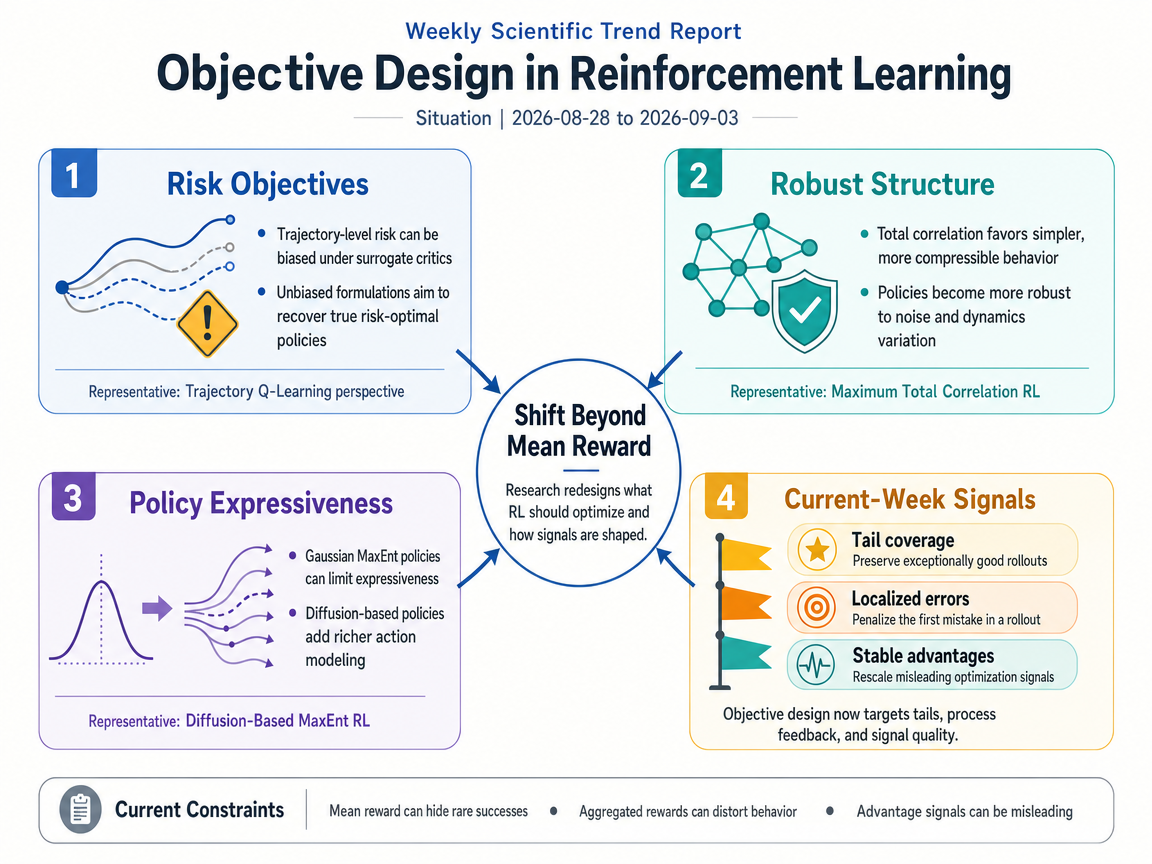
The representative-paper introductions frame a common shift in RL research from reward maximization alone toward better-shaped objectives and policy classes. One line argues that existing risk-sensitive RL methods built on distributional critics can optimize biased surrogates and fail to recover policies that are truly optimal for trajectory-level risk measures, motivating unbiased formulations such as Trajectory Q-Learning. A second line adds information-theoretic structure at the trajectory level: maximizing total correlation is proposed as a way to favor simpler, more compressible, and more robust behavior under noise and dynamics variation. A third line revisits maximum-entropy RL itself, noting that Gaussian policies constrain expressiveness and motivating diffusion-based policies together with tractable lower bounds on the MaxEnt objective.
Current-week evidence sharpens this trend toward alternative RL objectives. Tail-Likelihood Reinforcement Learning (arXiv:2609.02987v1) argues that expected reward can hide whether a policy preserves rare but exceptionally good rollouts, which matters both for continued policy improvement and for Best-of-k inference. Its introduction explicitly recasts continuous rewards through tail probabilities over thresholds, pushing RL toward objectives that preserve upper-tail coverage rather than only improving the mean.
Infographic (English)
Progress
Tail-Likelihood Reinforcement Learning <See Details on Fugu-MT>
TailRL advances the theme by optimizing the log-probability of exceeding random reward thresholds instead of only expected return. It newly shifts objective design toward preserving upper-tail rollouts while remaining compatible with standard advantage-based RL pipelines.
Uncovering and Mitigating Aggregation-Induced Reward Hacking in Multi-Reward Reinforcement Learning <See Details on Fugu-MT>
This work extends objective design to multi-reward settings by showing that naive reward aggregation can induce hacking. Its contribution is an online reweighting rule that adjusts combined rewards using underperformance, volatility, and recent progress signals.
Cliff: Learning Process Rewards from the First Mistake <See Details on Fugu-MT>
Cliff advances the theme by turning verifier-based RL into a process-reward setup that penalizes the first mistake in a rollout. Compared with prior trajectory-level objective redesigns, it newly injects localized stepwise error information into the reward signal.
Spurious Advantage Hidden in GRPO <See Details on Fugu-MT>
This paper refines the theme by exposing how GRPO can assign misleading advantages when successful rollouts arise from guessing. It focuses on correcting the optimization signal itself through global scaling and class-wise rescaling, rather than redefining the target reward.
Outlook
Outlook Summary
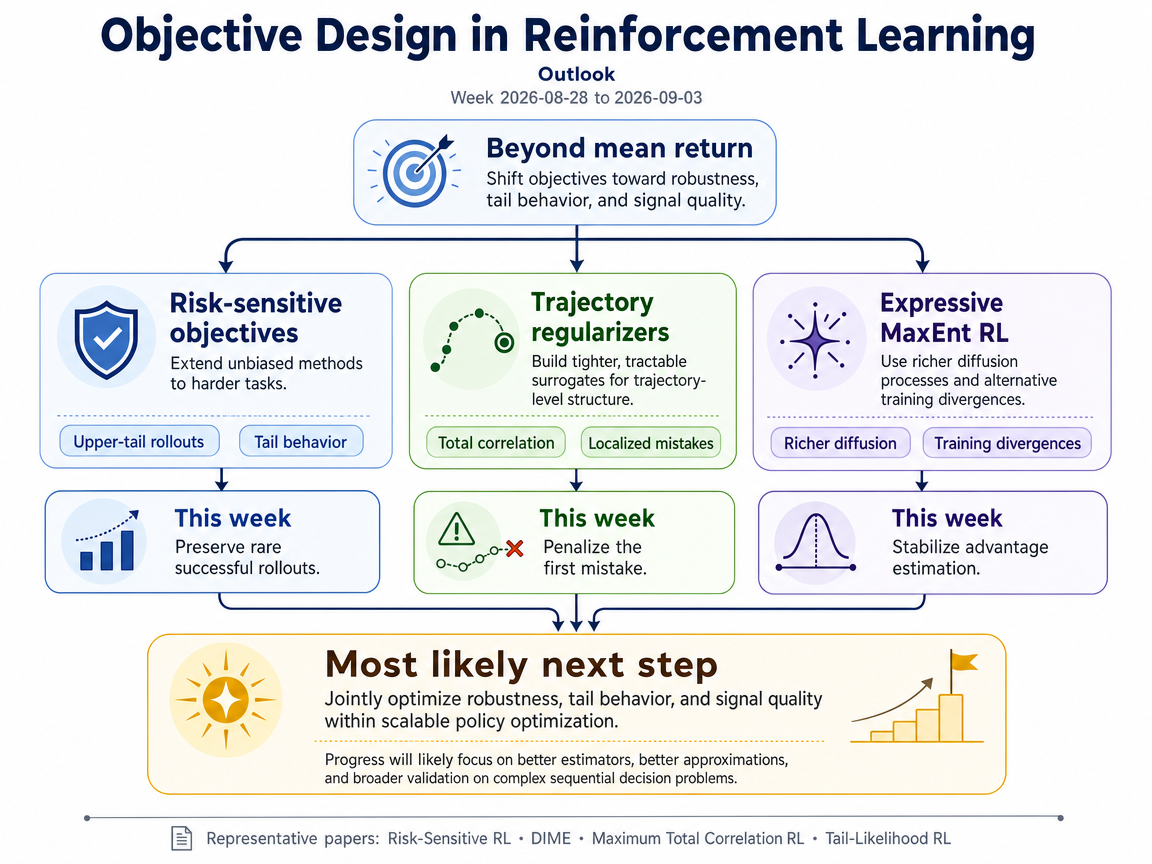
Near-term RL research will likely move beyond average reward toward objectives that preserve useful trajectories, control risk, and improve training signals. Priorities include testing unbiased risk-sensitive methods on harder tasks, developing tractable approximations for trajectory-level regularization, and improving diffusion-based policies. This week's work adds pressure to retain rare successes, locate errors within action sequences, and stabilize estimates of action quality. The likely direction is integrated objective design, supported by better estimators and broader testing where rare successes and noisy feedback matter, while remaining compatible with scalable training pipelines.
Infographic (English)
Three-Year Movement
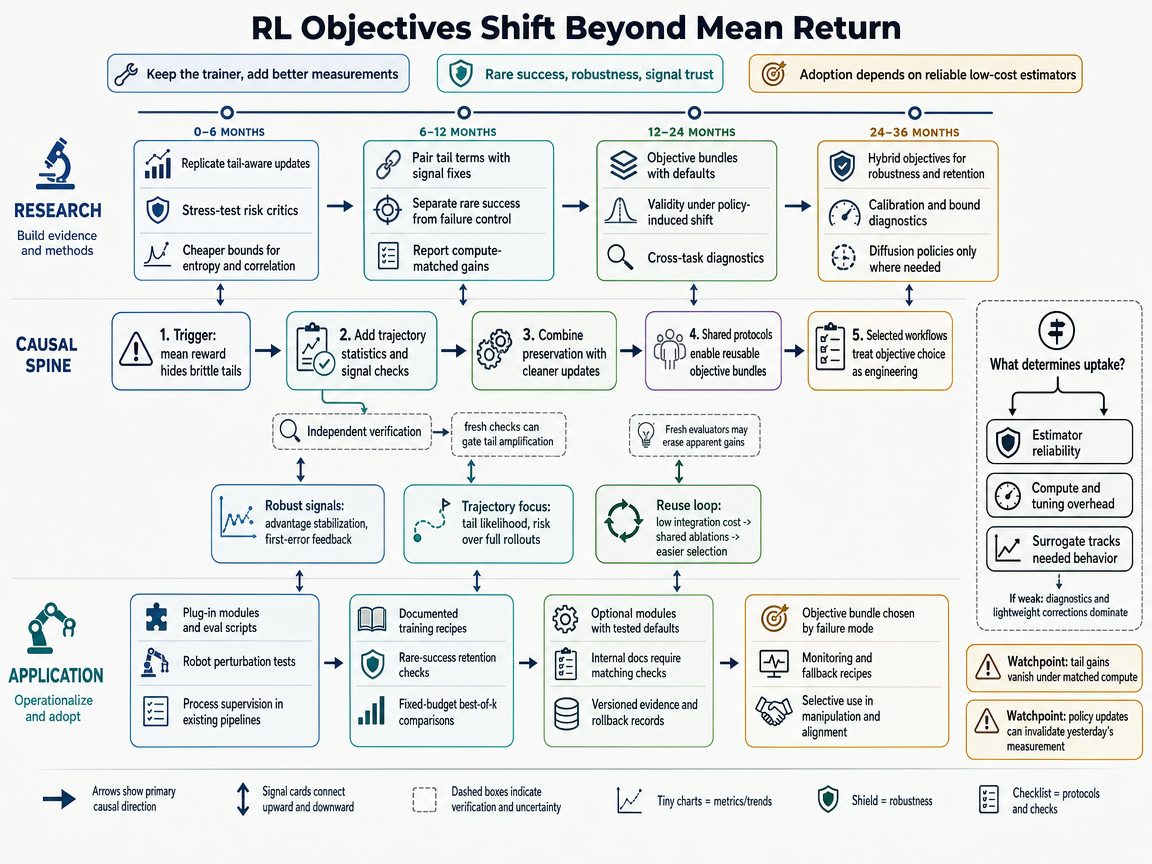
Over three years, this scenario moves from separate improvements in RL objectives toward reusable combinations that preserve useful behavior and make training signals more reliable. Its mechanism resembles statistical process control: retain the existing training pipeline, but add measurements that expose problems hidden by a rising average reward. During the first year, researchers would test whether rare successes remain reproducible and whether practical approximations actually measure the trajectory-level behavior they are meant to capture. They would then combine a preservation objective with a signal correction, while evaluating exceptional successes separately from severe failures because improving one does not guarantee the other.
In the second year, reproducible combinations could become documented training modules with tested defaults, allowing application teams to reuse them without rebuilding their trainers. Researchers would examine whether these combinations remain reliable as learning changes the situations a policy encounters, and whether simpler objectives would work equally well. Robot-control and LLM-agent teams could share evaluation concepts while keeping task-specific definitions of success and failure, rather than treating their settings as interchangeable. Low integration costs would encourage reuse, and comparable experiments would help teams identify which combinations genuinely improve behavior rather than merely add complexity.
By the third year, selecting an objective combination could become a routine engineering choice in some workflows, guided by a documented failure mode rather than average reward alone. Acceptance checks would consider robustness and retained successes, with monitoring and simpler fallback methods available when the richer approach becomes unreliable during training. Diffusion policies, which can represent several distinct successful actions, could become common in selected high-dimensional control tasks but would not displace equally effective simpler policies. A key monitoring cue is independent improvement under equal computing and sampling budgets, alongside stable updates when methods are combined. The main caveat is that a policy changes its own training data, so a previously useful measurement can become misleading. If gains disappear or tuning becomes excessive, the three-year outcome would narrow to lightweight corrections and better diagnostics rather than broadly integrated objectives.
This scenario shifts the three-year agenda from preserving rare high-reward behavior to deciding when that behavior is trustworthy enough to reinforce during subsequent training. Its mechanism borrows from adaptive experiments: fresh evidence determines which promising action sequences receive additional checking and which receive greater weight in learning. In the first year, researchers would compare learned reward with independently checked task success, especially among exceptional rollouts where an impressive score may conceal failure. A controller would increase training emphasis only when verified success improves without materially worsening a separately measured failure outcome, while keeping disputed successes available for exploration.
The first threshold is a replicated improvement over simpler weighting rules after counting all training and verification costs, rather than a gain explained by collecting more labels. If that threshold is met, second-year work would establish how quickly evidence becomes stale as policies change and when fresh evaluation samples are needed. Teams would record the policy and evaluation conditions behind each objective revision, making it possible to trace a failed change and reverse it. Reusable interfaces could connect this checking process to existing trainers, creating a loop in which optimization discovers behavior and independent evaluation redirects subsequent learning.
By the third year, the decisive test would be whether these controllers still help when tasks and evaluators change, using fresh checks excluded from development. Successful programs could let controllers approve, defer, or reverse objective revisions, making verification a planned training input rather than mainly a final assessment. This would remain a bounded workflow change for suitable agent and robot-control tasks, not a general replacement for existing RL methods across all settings. An early monitoring cue is whether documented disagreements between reward and verified success actually cause training weights to change in response to fresh evidence. The path would weaken if ordinary training uses the same resources more effectively, or if replacing evaluators removes the apparent gains. Statistical checking also depends on justified assumptions and meaningful success criteria; no controller can make an invalid evaluation target reliable.
This scenario asks whether richer RL objectives can preserve unusual successful behavior, rather than merely improve average reward. Near-term tail-preservation methods and feedback about errors within action sequences offer a possible starting point because they can fit existing training pipelines. Their wider effectiveness, however, is not established by the supplied evidence.
The mechanism resembles preserving rare varieties in a seed collection: reproducing the collection can lose uncommon varieties even while overall yield improves. Likewise, a policy update can raise average reward while making a rare successful behavior harder to reproduce. The longer-term direction therefore centers on assessing what objectives actually preserve, with reproducibility of unusual successes serving as the key monitoring cue. The narrative does not establish a year-by-year path to 36 months; its central possibility is that assessing retained behavior becomes the bottleneck, rather than designing another objective formula.
1-Year / 3-Year Research-Application Infographic
References
- Is Risk-Sensitive Reinforcement Learning Properly Resolved? - Authors: Ruiwen Zhou, Minghuan Liu, Kan Ren, Xufang Luo, Weinan Zhang, Dongsheng Li / <See Details on Fugu-MT> / License: CC-BY-4.0
- DIME:Diffusion-Based Maximum Entropy Reinforcement Learning - Authors: Onur Celik, Zechu Li, Denis Blessing, Ge Li, Daniel Palanicek, Jan Peters, Georgia Chalvatzaki, Gerhard Neumann, / <See Details on Fugu-MT> / License: CC-BY-4.0
- Maximum Total Correlation Reinforcement Learning - Authors: Bang You, Puze Liu, Huaping Liu, Jan Peters, Oleg Arenz, / <See Details on Fugu-MT> / License: CC-BY-4.0
- Tail-Likelihood Reinforcement Learning - Authors: Shrinivas Ramasubramanian, Daman Arora, Fahim Tajwar, Guanning Zeng, Qingyang Wu, Zhongzhu Zhou, Chenfeng Xu, Haiwen Feng, Yuda Song, Aarti Singh, Ruslan Salakhutdinov, J. Andrew Bagnell, Jeff Schneider, Andrea Zanette / <See Details on Fugu-MT> / License: CC BY 4.0