Summary
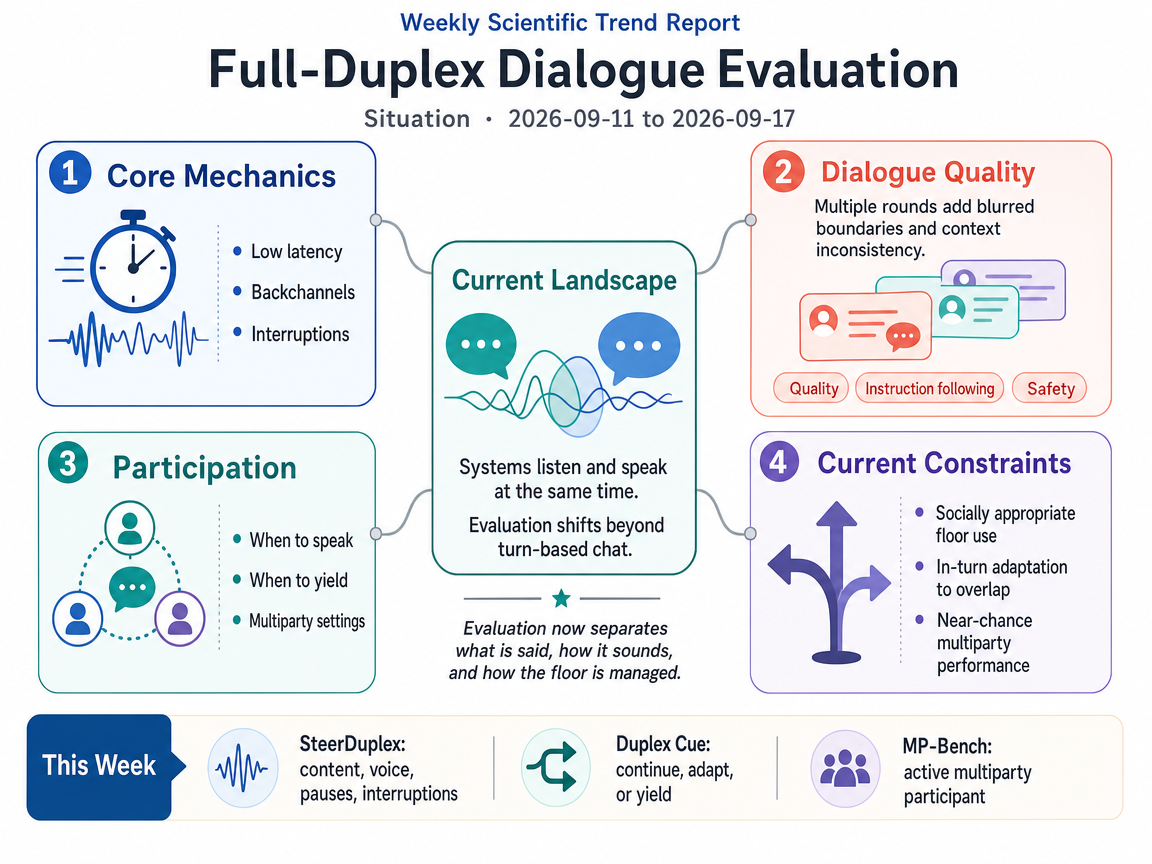
This theme centers on evaluating speech-language systems that listen and speak concurrently, moving beyond conventional turn-based assessment. Representative and current-week papers frame a shift from coarse latency and interruption metrics toward broader benchmarking of multi-round dialogue quality, multiparty participation, steerability, and socially appropriate floor management.
Situation
Representative introductions describe full-duplex dialogue as a setting where models must process streaming input while generating speech, making evaluation fundamentally different from round-based chat. The baseline evidence emphasizes that useful assessment must capture low-latency response, interruption and backchannel behavior, autonomy in deciding when to speak or yield, and—in multi-round settings—the added difficulties of blurred turn boundaries and context inconsistency.
Recent benchmark work broadens the target of evaluation beyond conversational mechanics alone. MTR-DuplexBench argues that full-duplex systems should be tested across dialogue quality, instruction following, and safety over multiple rounds, while Proactive Conversational Agents with Inner Thoughts highlights the need to measure socially appropriate participation rather than simple next-speaker prediction. As current-week evidence, SteerDuplex (2609.12623v1) further pushes this agenda by separating what a model says from how it sounds and how it manages the floor, introducing SteerBench to assess requested content, vocal delivery, pauses, and interruption behavior together.
Infographic (English)
Progress
Realtime-Venus: A full-duplex interaction system with asynchronous delegation <See Details on Fugu-MT>
Realtime-Venus: A full-duplex interaction system with asynchronous delegation: 音声対話のためのリアルタイム・リアルタイム・オムニ・オーディオ・インタラクションとリアルタイム・オーディオ・スポーケンを提示する。 それぞれのモデルは完全な会話として機能し、連続認識、会話制御、およびネイティブ音声生成を統合する。 It connects to Model Evaluation / Benchmarking through the paper's concrete task, method, evidence, or application setting.
Continue, Adapt, or Yield: In-Turn Adaptation to Overlapping Speech in Full-Duplex Agents <See Details on Fugu-MT>
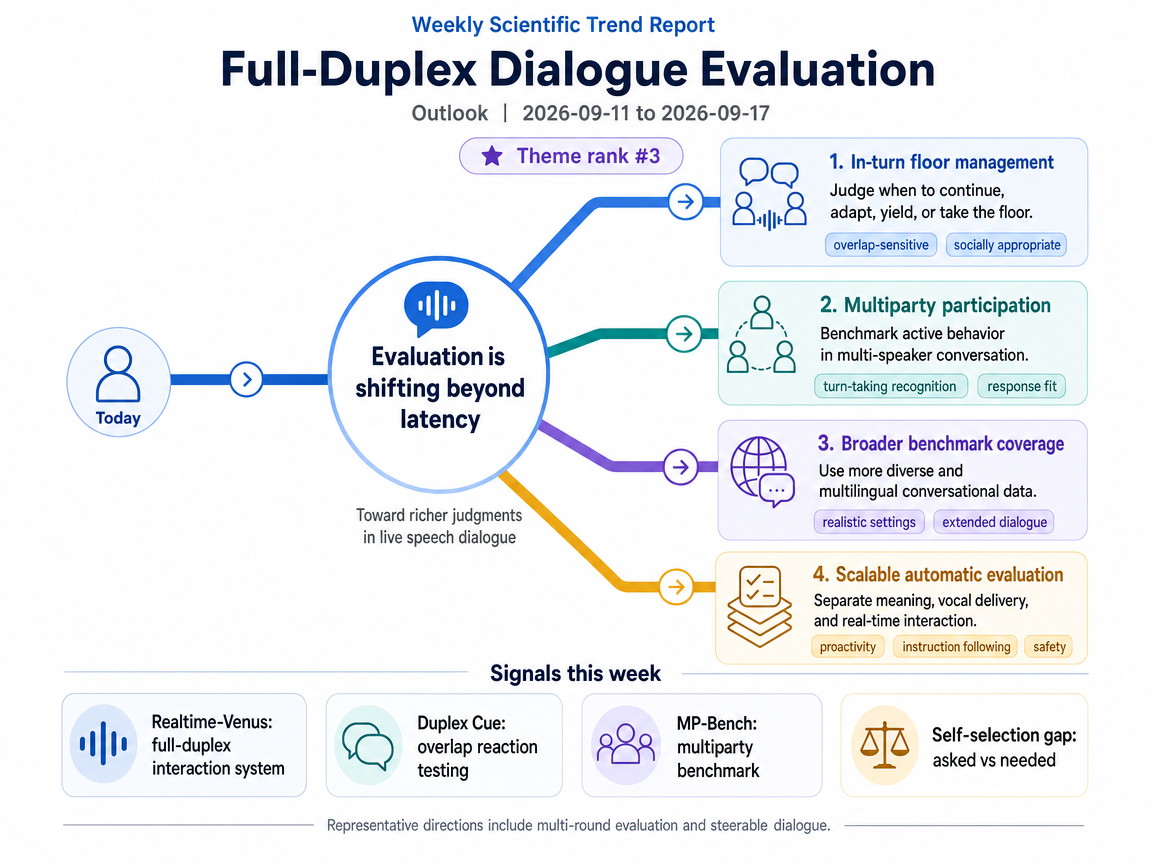
Duplex Cue introduces an evaluation method for how full-duplex agents react to overlapping speech inside an ongoing turn. Compared with earlier focus on generic interruption handling, it tests finer in-turn choices such as continuing, adapting, or yielding to listener cues.
MP-Bench: Evaluating Voice Agents as a Multiparty Conversation Participant <See Details on Fugu-MT>
MP-Bench provides the first benchmark for voice agents acting as active participants in multiparty conversation. It broadens evaluation beyond dyadic turn-taking by measuring turn-taking recognition and response appropriateness in multi-speaker settings, where current agents perform near chance level.
Full-Duplex Speech Models Take the Floor When Asked, Not When Needed <See Details on Fugu-MT>
This paper exposes a gap between being asked to speak and autonomously deciding to take the floor when intervention is needed. Relative to prior benchmarks focused on latency and turn management, it sharpens evaluation toward socially necessary self-selection by the model.
Outlook
Outlook Summary
Full-duplex evaluation will likely move beyond response speed and interruption counts toward judging how agents manage participation during ongoing speech, including when to yield or contribute unprompted. Multi-round and multiparty tests should reveal interaction failures that short exchanges miss. Broader multilingual data will also matter, alongside separate measures of meaning, vocal delivery, and real-time behavior. Stronger automatic metrics could make testing more scalable, but they must assess proactivity, instruction following, and safety across extended conversations as speech capabilities enter multimodal models.
Infographic (English)
Three-Year Movement
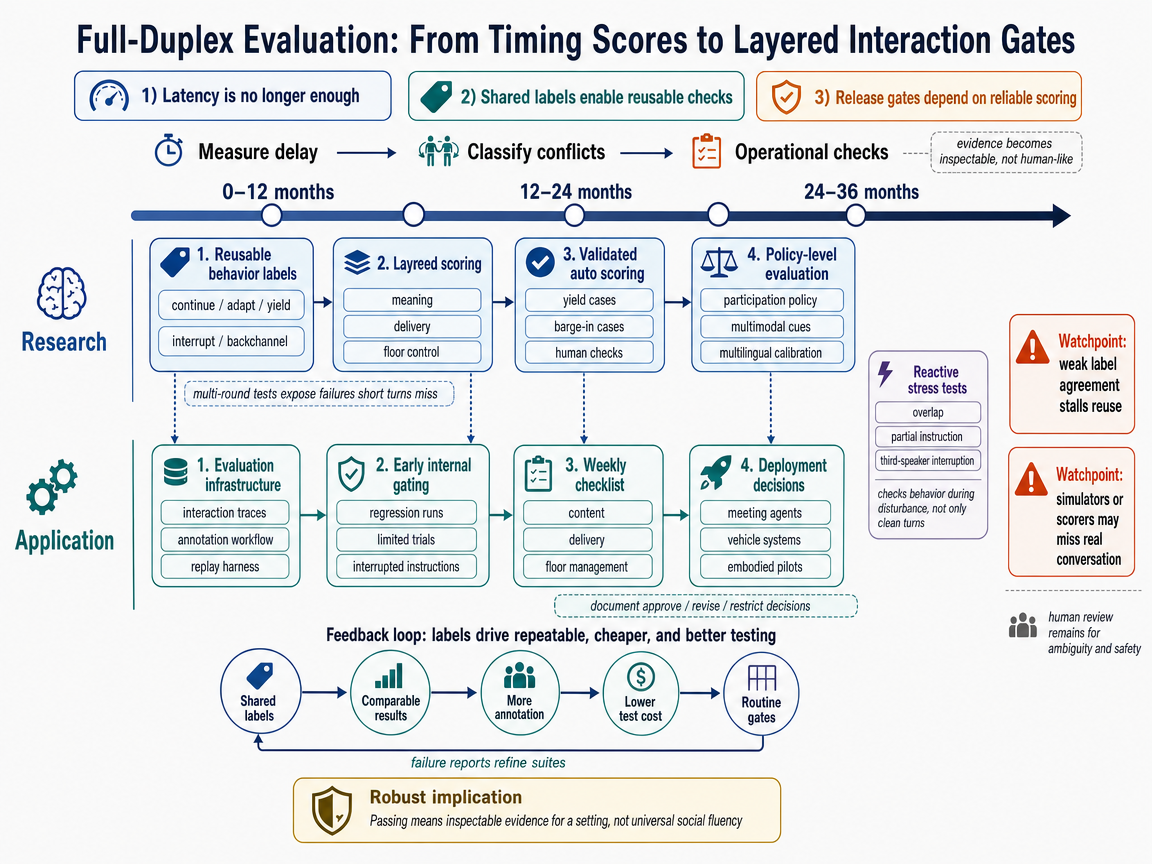
Over three years, evaluation could shift from measuring how quickly an agent responds to requiring evidence that it manages the shared opportunity to speak appropriately. The mechanism resembles intersection inspection: measure delays first, identify conflicting actions next, and then turn repeatable findings into operational checks rather than relying on speed alone. In the first year, researchers would define reusable participation labels and report separate scores for meaning, vocal delivery, and control of the conversational floor. Recorded interaction traces and replay tools would help teams examine interrupted exchanges, while multi-round tests would need to accommodate conversations that depart from reference scripts.
In the second year, shared labels could make results comparable enough to support further annotation, which would improve automatic scoring and lower the cost of repeated testing. Speech recognition and tools that identify who spoke when would connect audio events to judgments about whether an agent should continue speaking or yield. Human reviewers would concentrate on ambiguous participation and safety cases, while checking that automatic scores still agree with people on clearer examples of appropriate behavior. If this feedback loop works, teams could run a layered checklist each week instead of arranging a separate user study for every model revision.
By the third year, meeting agents, vehicle systems, and embodied pilots could use setting-specific versions of these checks to support decisions about release or restricted use. Research would assess participation policies through interaction outcomes, with gaze and vocal cues tested alongside response time and computational cost rather than treated as isolated predictions. Multilingual and multiparty calibration would become central because successful behavior in a two-person English exchange does not establish reliability across other languages or social settings. The clearest monitoring cue would be independently reused benchmarks whose separate scores appear in documented release decisions, showing that evaluation has become part of routine development. Poor agreement on yielding or weak alignment between automatic and human scores would undermine that transition, leaving difficult judgments dependent on specialized human studies.
Over three years, this scenario could move full-duplex evaluation toward reactive stress tests that judge acceptable behavior during disruption, rather than mainly counting interruptions or measuring speed. Its mechanism resembles power-grid disturbance testing: a response envelope defines acceptable actions and timing bounds while overlapping speech changes the conditions of an ongoing conversation. In the first year, simulated interlocutors would react to actual model output, introducing unfinished instructions or another speaker instead of forcing every system through a fixed script. Human studies would check whether those disturbances are realistic and whether the resulting failures matter to listeners, since a responsive simulator can still provoke misleading behavior.
A key early signal would be a reproducible ranking reversal, where systems that perform well on simple speed measures fail during sustained overlap or lose instructions across rounds. In the second year, a shared simulator with a versioned specification could let laboratories reproduce such failures and help developers rerun identical checks after model updates. Human studies would increasingly calibrate automated checks, while developers would record when systems choose to speak, wait, or yield so that failures can be traced. If several agents begin sharing conversational spaces, reports of collective disruption could create demand for coexistence tests even when each agent performs acceptably on its own.
By the third year, a layered testing regime could require systems to preserve instructions and safety constraints before awarding credit for useful contributions made without prompting. Automated scoring could handle repetitive checks in validated settings, while people assess unfamiliar situations and recalibrate acceptable behavior for different languages and conversational contexts. Repeated failures would expand the test catalog, giving developers clearer targets, but this same process could reward agents that avoid mistakes by becoming excessively quiet. Engagement checks and human preferences would therefore remain necessary, because acceptable timing alone does not establish that a contribution is useful or socially appropriate. Independent reuse and release decisions tied to named test versions would support this path; persistent simulator disagreement or unchanged rankings would weaken the case for a new regime.
Over three years, this scenario could make buyer acceptance requirements a major force in full-duplex evaluation, rather than assuming that research benchmarks will establish shared practice on their own. The mechanism resembles repeatable telecom tests for simultaneous speech: standardized disturbances make behavior measurable, while purchasing requirements give the resulting measurements practical authority beyond individual research teams. In the first year, researchers would define interruption timing and overlap scoring, keeping content, vocal delivery, and conversational control separate so that speed cannot hide inappropriate responses. Vehicle-assistant and public-contact-center developers would initially use these tools to check whether updates break working behavior, including cases involving multilingual or disfluent speech.
The decisive trigger would be a buyer requiring numeric acceptance criteria, potentially following a proposed interruption protocol from a driver-distraction or accessibility body. In the second year, that requirement could start a reinforcing cycle in which vendors publish results and testing groups reuse shared definitions, making evaluation easier to obtain. Developers could then automate release checks and expose inspectable control outputs that explain participation decisions, even when their speech models otherwise handle those decisions internally. Researchers would compare protocol scores with unfamiliar conversations, because improving on a fixed test does not necessarily mean that an agent has become a better conversational participant. Human-calibrated judgments of appropriateness would supplement scripted tests, while proactive contributions and multiparty participation would remain harder to evaluate through fixed scenarios alone.
By the third year, the deployment package could combine repeatable overlap tests with multi-round instruction and safety checks, with each evaluation layer reported separately rather than collapsed into one score. Rotating held-out conversations and recalibrating human judgments would help expose narrow test learning, while meeting-agent and robot trials could examine whether supplementary assessments transfer to new settings. A concrete monitoring cue is whether a buyer introduces explicit overlap acceptance criteria by September 2027; their absence would substantially weaken this proposed path. Even with adoption, standardized two-person tests would not establish general social competence, because appropriate yielding depends on language and context rather than a single physical reference.
1-Year / 3-Year Research-Application Infographic
References
- A Full-duplex Speech Dialogue Scheme Based On Large Language Models - Authors: Peng Wang, Songshuo Lu, Yaohua Tang, Sijie Yan, Yuanjun Xiong, Wei Xia, / <See Details on Fugu-MT> / License: CC-BY-SA-4.0
- Proactive Conversational Agents with Inner Thoughts - Authors: Xingyu Bruce Liu, Shitao Fang, Weiyan Shi, Chien-Sheng Wu, Takeo Igarashi, Xiang `Anthony' Chen, / <See Details on Fugu-MT> / License: CC-BY-4.0
- MTR-DuplexBench: Towards a Comprehensive Evaluation of Multi-Round Conversations for Full-Duplex Speech Language Models - Authors: He Zhang, Wenqian Cui, Haoning Xu, Xiaohui Li, Lei Zhu, Shaohua Ma, Irwin King, / <See Details on Fugu-MT> / License: CC-BY-4.0
- SteerDuplex: Steerable Duplex Speech Dialogue Models - Authors: Utkarsh Tyagi, Ramaneswaran Selvakumar, Advait Gosai, Sonal Kumar, Nikhil Barhate, Isabell Sagar, Steven Li, Miheer Bavare, Daniel Quigley, Fabiola Tapia Carrillo, Jose M Patron E, Diego Macías Gutiérrez, Paul Song, Ramani Duraiswami, Dinesh Manocha, Yunzhong He / <See Details on Fugu-MT> / License: CC BY-SA 4.0