Summary
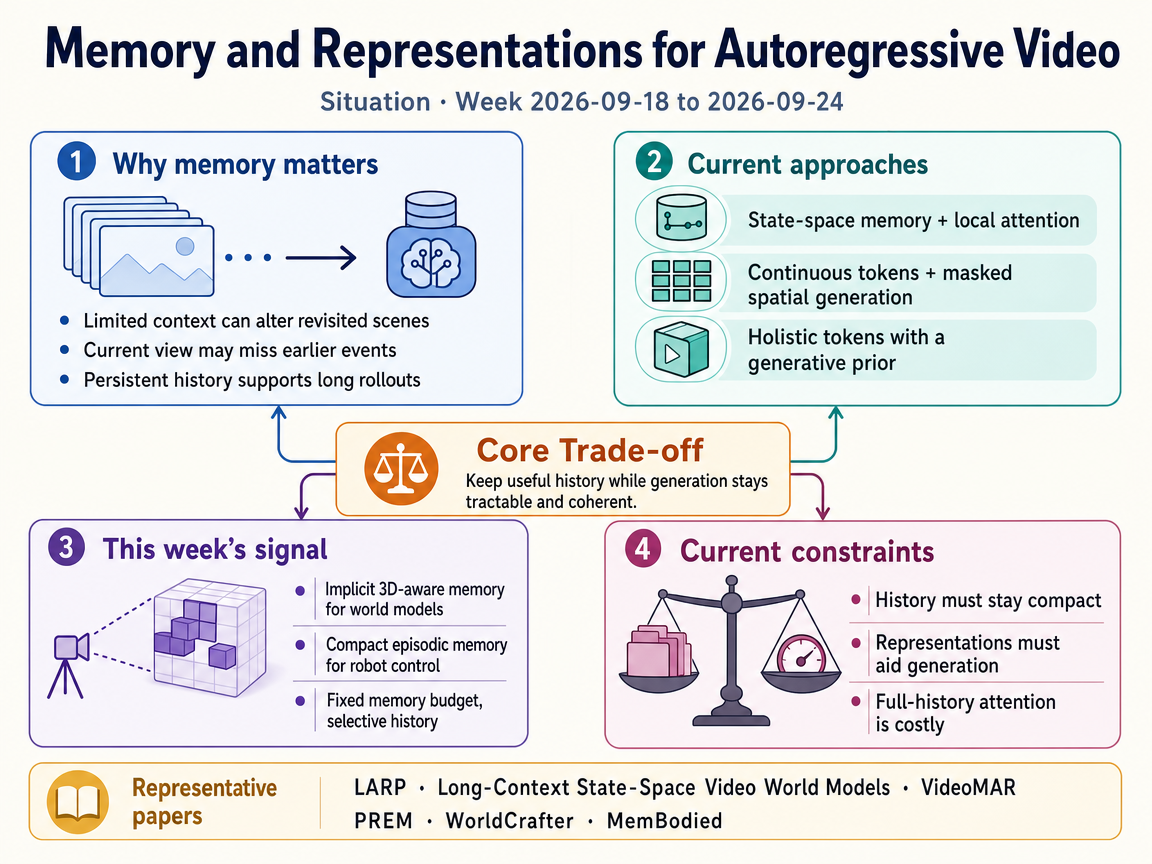
Work on autoregressive video models centers on two linked problems: preserving useful visual history over long rollouts and learning representations that keep generation efficient and coherent. Representative papers explore state-space memory, continuous-token generation, and holistic video tokenization. This week's evidence adds implicit 3D-aware memory for video world models and extends the memory question to history-dependent robot control.
Situation
The representative introductions frame a trade-off between retaining history and keeping autoregressive generation tractable. Long-Context State-Space Video World Models shows how limited attention windows can alter a previously visited scene. It proposes state-space temporal memory combined with local attention. VideoMAR targets the information loss and inference cost of discrete next-token video prediction, using continuous tokens and masked spatial generation. LARP argues that reconstruction-focused, patchwise tokenizers do not necessarily yield latents suited to autoregressive generation. It motivates holistic tokens trained with a generative prior.
The current-week paper MemBodied: Recurrent Associative Memory for Vision-Language-Action Models (2609.28256v1) identifies a related need in robot control, where the current view can omit earlier events that determine the correct action. It proposes a fixed-size associative memory of interactions alongside an initial-scene anchor. This carries the shared emphasis on selective, compact history beyond video generation.
Infographic (English)
Progress
The Past Frames the Future: Memory for Autoregressive Video Generation <See Details on Fugu-MT>
A systematic review organizes memory mechanisms for autoregressive video generation. It defines memory operationally as persistent history across generation steps, rather than treating memory designs in isolation.
MemBodied: Recurrent Associative Memory for Vision-Language-Action Models <See Details on Fugu-MT>
MemBodied brings compact episodic memory to history-dependent vision-language-action control. Its associative interaction memory and initial-scene anchor retain information absent from the current view, at a cost independent of episode length.
WorldCrafter: Consistent Video World Model with Implicit 3D-aware Memory <See Details on Fugu-MT>
WorldCrafter uses camera-queryable implicit 3D-aware memory to improve long-range consistency in video world models. It compresses multiview evidence according to the requested viewpoint within a fixed memory-token budget, rather than attending over full history or relying on explicit geometry.
Outlook
Outlook Summary
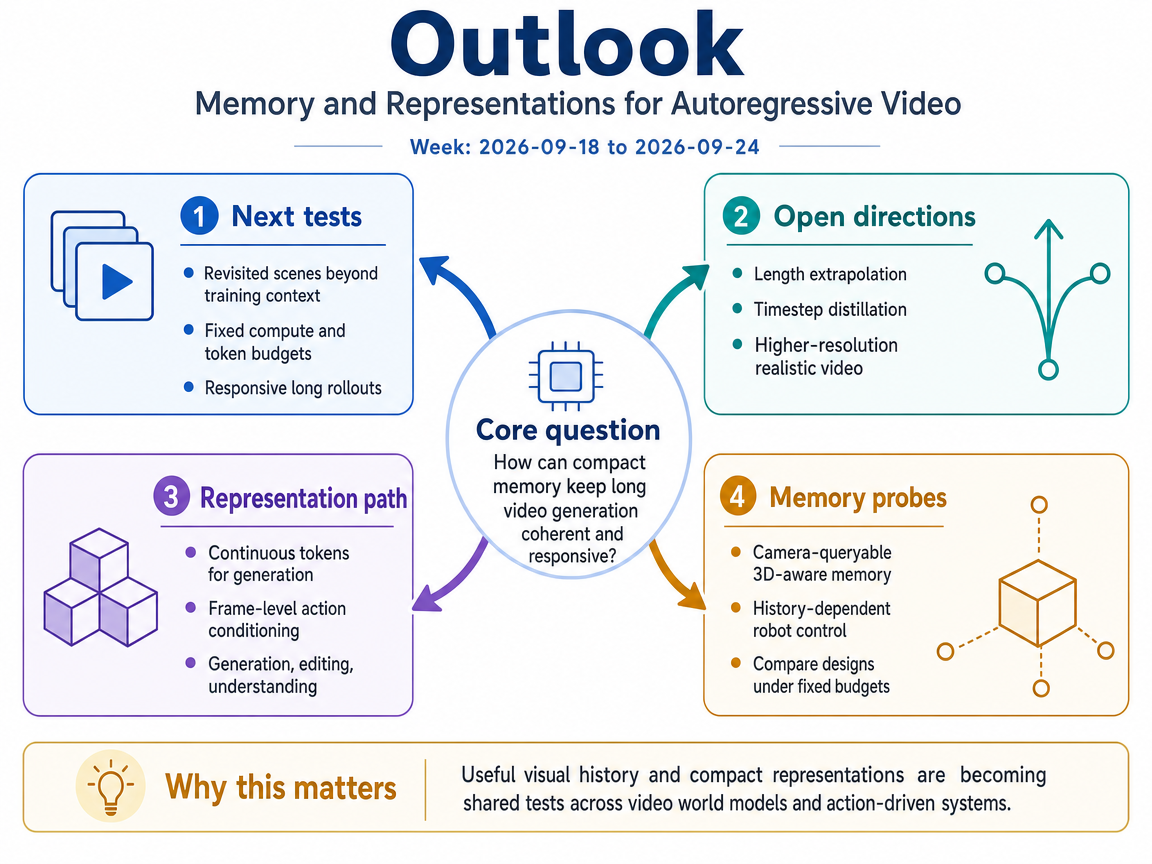
The next tests for video world models should ask whether compact memory preserves revisited scenes beyond training lengths while keeping generation responsive. Camera-queryable 3D memory and few-step generation provide a basis for comparing designs under fixed compute and token budgets, alongside tests at higher resolution. Representation research will explore action-conditioned generation and tokens useful for both generation and understanding. History-dependent robot tasks could probe retained information, but direct transfer from video-generation memory to control remains unproven.
Infographic (English)
Three-Year Movement
The longer-term direction is to test whether compact memory can preserve a scene when a generated camera returns, including after sequences longer than those used in training. Generation must also remain responsive, so remembering more cannot simply mean storing an ever-growing history. Earlier state-space models, which compress history into an internal state, improve spatial retrieval in synthetic environments. Continuous-token generators support efficient frame generation, while learned holistic tokens aim to retain information useful for predicting later video.
These are separate advances, not evidence of a responsive system that maintains a realistic world over time. This week's descriptions of camera-queryable 3D-aware memory and fixed-size interaction memory sharpen the central mechanism: retain limited information and retrieve what a viewpoint or interaction needs. The key monitoring question is whether revisited scenes remain consistent beyond training lengths without sacrificing responsiveness. The supplied narrative does not establish a year-by-year path or provide experiments for the weekly papers. Few-step generation therefore remains a direction to test, rather than a verified weekly result or an established three-year outcome.
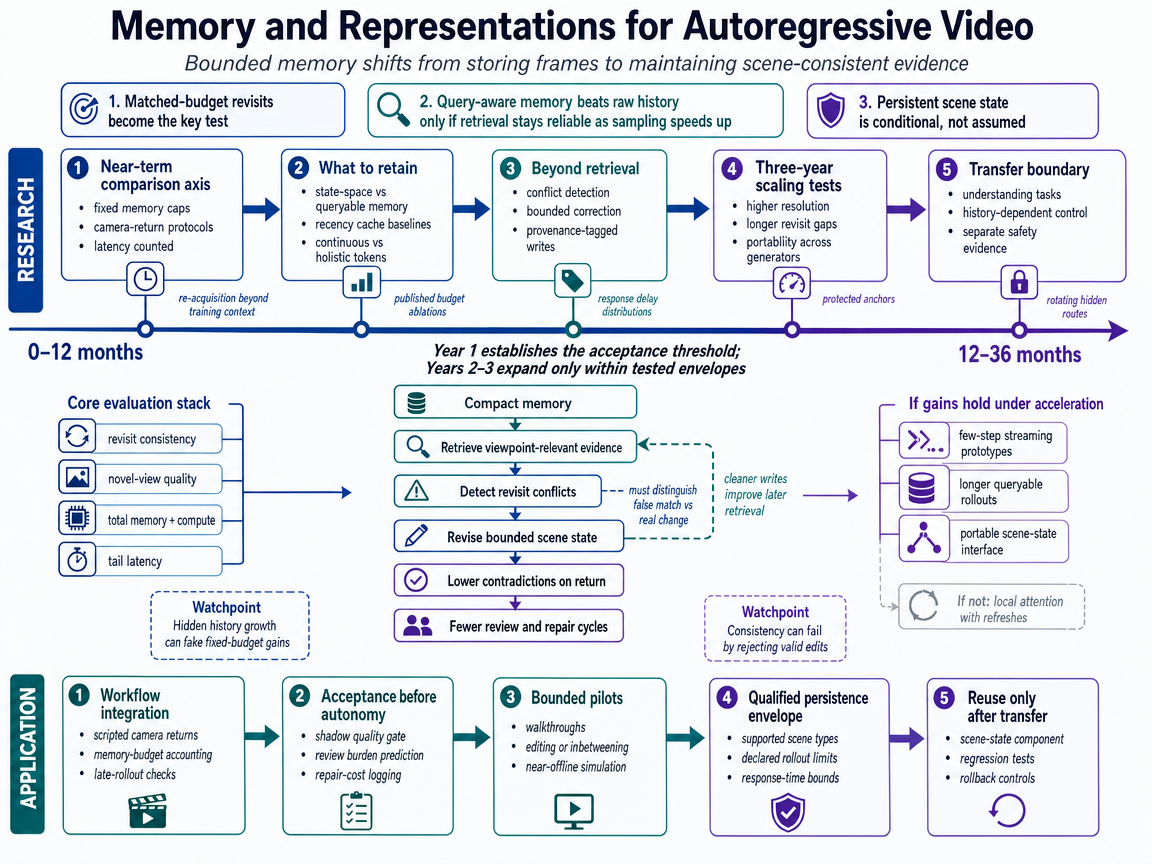
Over three years, this scenario would move compact video memory beyond retrieving past scenes toward detecting conflicting scene information and correcting it before errors spread. Its mechanism comes from simultaneous localization and mapping, or SLAM, where a system builds a map while locating itself within that map. Returning to a known place enables a loop-closure check, which compares the current view with remembered information and reconciles inconsistent estimates. First-year experiments would separate retrieval gains from actual correction, using controlled camera routes that include intentional scene changes and revisits beyond training lengths.
Memory would record whether information came from an initial observation, a user instruction, or generated content, making potentially unreliable updates easier to identify and reject. Progress would require fewer revisit errors at matched total memory and compute, without worse new-view quality or excessive response delays, rather than merely more convincing clips. In the second year, researchers would separate durable scene identity from temporary appearance, then test whether camera or action inputs update only the relevant memory. Application pilots could turn those distinctions into protected scene anchors, authorized edits, and rollback controls, allowing corrections without freezing the scene against legitimate changes. The monitoring cue would be declining corrections per frame during long sessions; repeated repairs at the same location would suggest that errors are circulating rather than disappearing.
By the third year, researchers would transfer the correction interface to another generator or representation and test more varied scenes at higher resolution. Benefits that survive those changes could support a reusable scene-state component for bounded walkthroughs and training simulations, with regression tests and explicit resource limits. Its supported range would describe scene complexity, remembered history, and response delay, rather than promise worlds that persist indefinitely. The main caveat is that generated frames can repeat the system's own mistakes, so apparent agreement cannot replace protected observations or known external interventions. If retrieval alone performs equally well under matched budgets, explicit correction loses its justification; benefits confined to simple layouts would support only a narrower consistency tool.
Over three years, this scenario would make demonstrated scene continuity a practical acceptance requirement, rather than treating a larger memory as proof that generated walkthroughs remain correct. The mechanism is workload-specific qualification: controlled revisit tests would establish whether continuity scores predict human rejection and repair effort under disclosed compute and response-time limits. First-year research would compare compact memory with short-window generation and simpler reference-frame conditioning, using known scenes and revisit gaps longer than those seen during training. A small content team would score outputs alongside human review, without replacing reviewers, and test whether passing configurations reduce rejected or repaired sequences across held-out scene collections.
If those results hold, the second year would connect acceptance teams with model developers through shared defect categories, while keeping some camera routes hidden to test generalization. Developers could then improve retrieval or representation training around repeated failures, such as losing an object's identity after a long absence from the camera's view. Faster sampling would face the same continuity checks, and versioned reports would identify exactly which model configuration passed rather than treating improvements as universally transferable. Interactive pilots would proceed only where complete response-time measurements support them, while useful offline workflows could advance without waiting for an interactive-speed breakthrough.
By the third year, expansion would depend on preserving those gains at higher resolution, across longer revisit gaps, and after deliberate scene changes that make old memories incorrect. Successful systems could support bounded camera and action inputs, but users would extend only the scene types and operating ranges covered by new tests. Updates to the generator or its memory components would require regression checks, and unsupported cases would return to human review or be rejected rather than silently accepted. The central monitoring cue would remain whether revisit scores predict real review burden, with resource comparisons covering the complete generation process rather than only the model. If simple reference conditioning already solves the workload, compact memory need not become preferred; if acceleration damages continuity, the workflow may remain useful but offline. Qualification would stay specific to tested workloads, not establish unrestricted realistic worlds or safe robot control, and any transfer to control would require separate experiments.
1-Year / 3-Year Research-Application Infographic
References
- LARP: Tokenizing Videos with a Learned Autoregressive Generative Prior - Authors: Hanyu Wang, Saksham Suri, Yixuan Ren, Hao Chen, Abhinav Shrivastava, / <See Details on Fugu-MT> / License: CC-BY-SA-4.0
- Long-Context State-Space Video World Models - Authors: Ryan Po, Yotam Nitzan, Richard Zhang, Berlin Chen, Tri Dao, Eli Shechtman, Gordon Wetzstein, Xun Huang, / <See Details on Fugu-MT> / License: CC-BY-4.0
- VideoMAR: Autoregressive Video Generatio with Continuous Tokens - Authors: Hu Yu, Biao Gong, Hangjie Yuan, DanDan Zheng, Weilong Chai, Jingdong Chen, Kecheng Zheng, Feng Zhao, / <See Details on Fugu-MT> / License: CC-BY-4.0
- PREM: Prefix-Steered Recurrent Memory for Long-Video Understanding - Authors: Siru Zhong, Qiongyan Wang, Xiaohui Lv, Yuzheng Zhuang, Shuai Tao, Wulong Liu, Haohuan Fu, Yuxuan Liang / <See Details on Fugu-MT> / License: CC BY 4.0
- WorldCrafter: Consistent Video World Model with Implicit 3D-aware Memory - Authors: Wangbo Yu, Kunhao Liu, Wenbo Hu, Shenghai Yuan, Chaoran Feng, Haiyang Zhou, Yukun Huang, Yiran Wang, Wang Zhao, Yingmin Luo, Ying Shan / <See Details on Fugu-MT> / License: CC BY 4.0
- MemBodied: Recurrent Associative Memory for Vision-Language-Action Models - Authors: Tej Deep Pala, Navonil Majumder, Bryce Goh, Raphael Yee, Jianfei Yang, Liming Chen, Soujanya Poria / <See Details on Fugu-MT> / License: CC BY-SA 4.0