Summary
The theme centers on adapting representations to heterogeneous visual and linguistic inputs rather than relying on uniform processing. This week's papers add script-aware scene-text recognition, routed medical segmentation, and a compact language-based persistent scene map. They build on earlier work in modality-aware medical imaging, multilingual text detection, and code-switched speech translation.
Situation
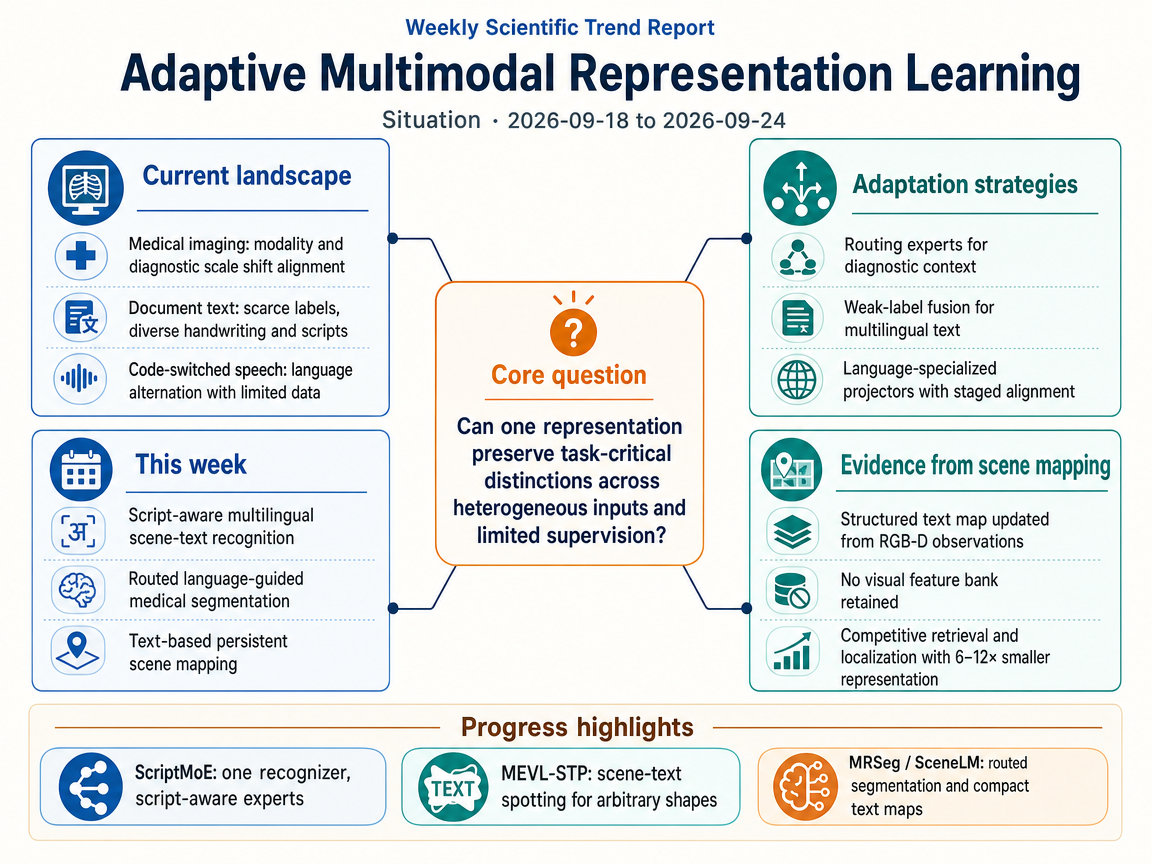
The representative Introductions describe distinct obstacles to shared representations. In medical imaging, image–report alignment varies with imaging modality and diagnostic scale. Multilingual document text detection faces scarce labels and diverse handwriting and scripts. Code-switched speech translation must model language alternation despite limited training data. In response, MedMoE routes local visual features through diagnostic-context experts. TEXTRON combines weak labels from deep-learning and image-processing detectors. The code-switching study uses language-specialized speech projectors and staged speech–text alignment.
As current-week evidence, A Scene Language Model for Open-Vocabulary Scene Mapping (2609.21400v1) makes a different representation choice. It updates a structured textual object map from successive RGB-D observations instead of retaining visual embeddings or feature banks. It reports competitive retrieval and localization with a 6–12× smaller scene representation. Across these works, a recurring question is whether a representation keeps the distinctions each task needs when inputs are heterogeneous and supervision is limited.
Infographic (English)
Progress
All-in-One Multilingual Scene Text Recognition with Script-aware Mixture-of-Experts <See Details on Fugu-MT>
ScriptMoE uses script-aware experts in a single multilingual scene-text recognizer. Instead of one recognizer per language or a large VLM, it pairs a unified model with the synthetic TextMuSS-10M dataset, which covers 10 scripts and 229 languages.
MEVL-STP: Multi-Encoder and Vision Language Model for Arbitrarily Shaped Scene Text Spotting <See Details on Fugu-MT>
MEVL-STP combines multi-encoder segmentation with vision-language recognition to spot arbitrarily shaped scene text. It moves from document text detection to scene-text spotting and reports high performance on Total-Text and ICDAR 2015 without artificial training data.
A Scene Language Model for Open-Vocabulary Scene Mapping <See Details on Fugu-MT>
SceneLM maintains an open-vocabulary scene map by adding, editing, and removing textual object entries as observations arrive. It replaces stored visual feature banks with an updateable text representation, and quadruped experiments show it can run online on an edge device.
Multimodal Routing and Region Refinement for Language-Guided Medical Image Segmentation <See Details on Fugu-MT>
MRSeg routes the adaptation of visual and clinical-text features before dense prediction in language-guided medical image segmentation. It applies routing to segmentation with frozen ConvNeXt-Tiny and PubMedBERT encoders and about 7.11M trainable parameters.
Outlook
Outlook Summary
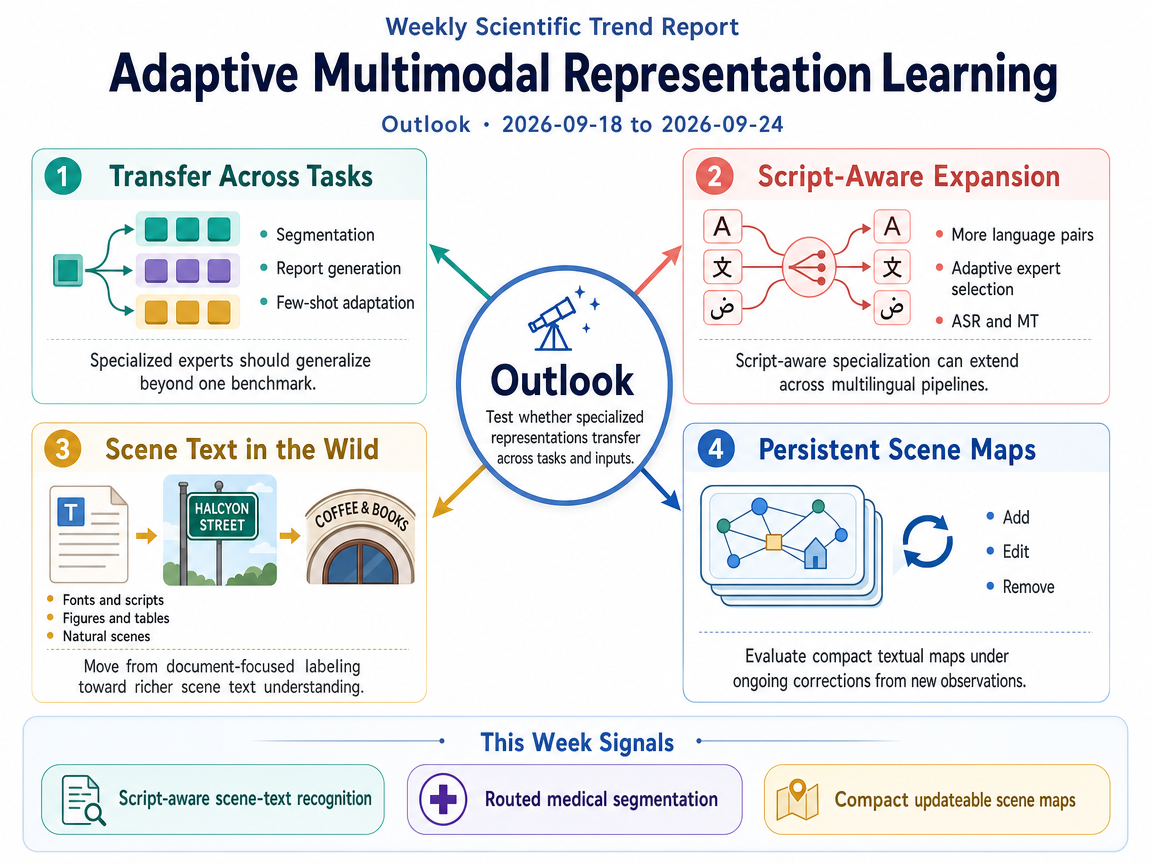
The next test is whether specialized representations work beyond their original tasks. MedMoE proposes segmentation, report generation, and few-shot adaptation, while MRSeg provides a separate routed-segmentation example rather than proof of transfer. Code-switching research aims to broaden language coverage and related tasks, with ScriptMoE offering parallel script-aware specialization. TEXTRON points toward more targeted labeling and a shift from documents to natural scenes, partly addressed by this week's scene-text work. SceneLM adds another test: whether compact textual maps remain useful through repeated corrections as observations change.
Infographic (English)
Three-Year Movement
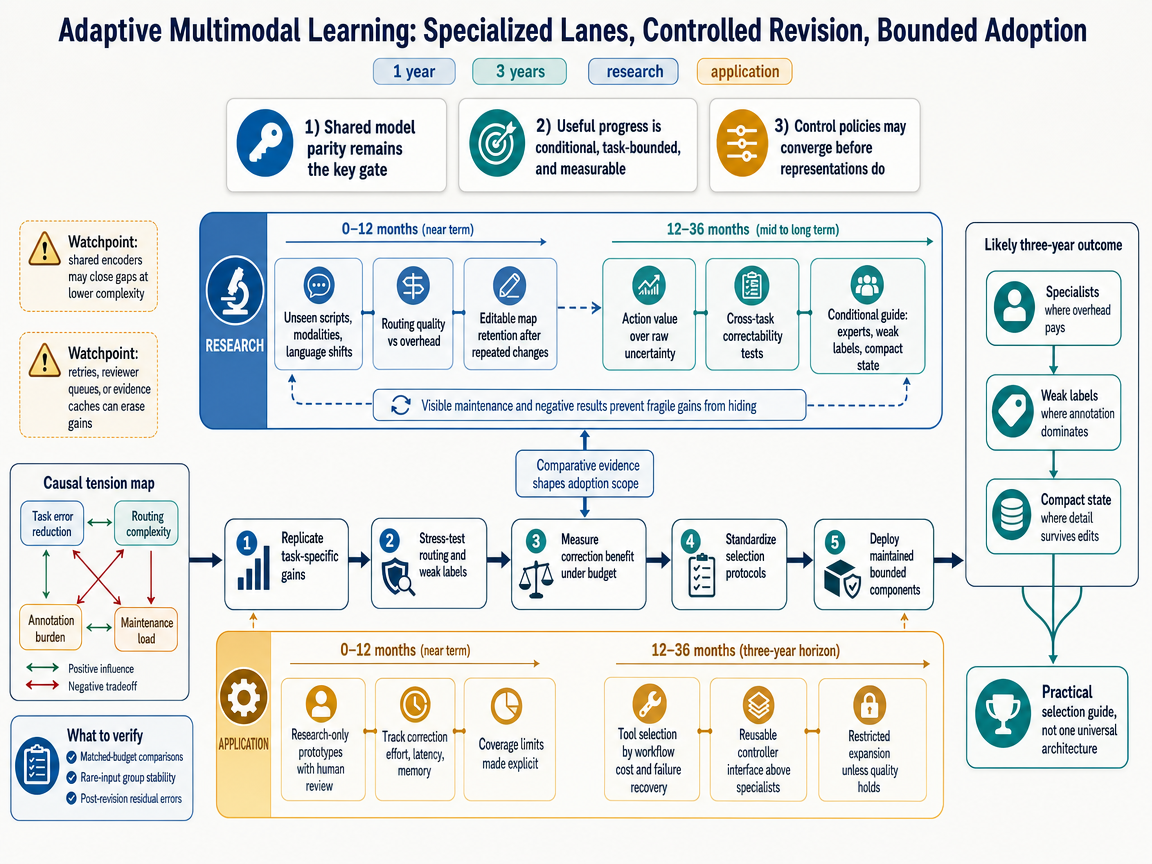
Over three years, this path would turn today's specialized research methods into a practical guide for deciding when specialization is worth its added complexity. The mechanism resembles separate processing lanes: different inputs receive dedicated treatment only when that treatment reduces errors enough to justify additional computation and maintenance. In the first year, researchers would reproduce results and test routers, the components that choose which specialist handles an input, under unfamiliar conditions. Supervised prototypes would also measure correction effort and operating costs, while mapping tests would check whether compact representations survive repeated changes rather than just initial construction.
In the second year, successful comparisons would support extensions within application families, without assuming that a method proven for one task automatically transfers to another. Medical researchers could separately test segmentation and report generation, while document teams could extend weak supervision, which combines imperfect labeling rules to reduce manual annotation. Speech and mapping trials would broaden their coverage and duration, exposing weaknesses that shorter tests might miss and checking whether earlier gains remain useful. Demonstrated gains would encourage further datasets and testing, creating a feedback loop that supports new specialists only while their benefits remain measurable.
By the third year, the likely result would be common test procedures and bounded, maintainable components rather than one architecture spanning every application domain. Teams could use these procedures to choose between specialist routing and simpler shared models, keeping quality measures specific to each task. Each deployed component would need documented coverage and recovery behavior, with unreliable capabilities restricted rather than expanded simply because related research had improved.
A useful monitoring cue would be reproducible error reductions that persist during longer operation and outweigh the extra work of maintaining specialists. Cheaper shared models closing those gaps would weaken this path, and better medical research results alone would not establish clinical readiness.
Over three years, this path would shift attention from producing a specialized first answer to deciding when another processing step can meaningfully correct it. Its mechanism comes from robotics: treat an output as provisional, then use a controller, a software decision layer, to choose whether further processing is worthwhile. First-year tests would expose unfamiliar inputs and repeated map edits, recording which errors can actually be corrected rather than measuring uncertainty alone. Progress would require independent gains in at least two task families at comparable resource limits, without worse results for predefined rare-input groups or hidden human correction effort.
If that threshold is met, second-year research would predict the benefit of available corrective actions, since an uncertain answer does not necessarily become better after reprocessing. Supervised pilots could request another text crop or revisit stored speech, while enforcing retry limits and clear handoffs when automated correction remains unreliable. Correction records would improve action selection, but random audits of accepted outputs would be essential to uncover mistakes in cases the controller already considers easy.
By the third year, successful workflows could share a controller interface even while their underlying specialist models and task-specific quality measures remain different. Operating rules would specify when answers may be revised and when review is required, while also limiting processing time so that correction remains practical. Tests would check whether these rules still work after a specialist model is replaced, making reliable behavior more important than dependence on one architecture. Storage would become selective: stable results could retain little detail, while ambiguous results preserve enough supporting evidence for later correction without overwhelming available capacity.
A useful monitoring cue would be fewer errors remaining after revision at matched resource limits, alongside manageable review queues and evidence-storage demands. Reprocessing the same input cannot recover missing information, and different experts may repeat the same mistake, so external checks must remain available. If benefits disappear under matched resource limits or remain confined to mapping, the three-year outcome should narrow to those demonstrated task-specific successes.
Over three years, this path would make performance on weak input categories more important in purchasing decisions than a strong overall average score. The mechanism resembles a crash-test rating: a system must meet several separate minimum standards, so strength in common cases cannot conceal a serious coverage gap. In the first year, a multilingual digitization program would establish minimum scores for test cells, meaning specified input categories such as handwriting in a particular script. The crucial trigger would be actual supplier selection based on those minimums, giving researchers a reason to compare specialist and shared models on difficult categories.
In the second year, continued category-based selection and a medical reporting initiative could support a common evaluation protocol operated by independent assessors. Suppliers would then have an incentive to repair weak categories selectively, using routed models that direct inputs to specialized components where that approach proves worthwhile. Assessors would measure repair costs and processing delays as well as accuracy, because better category coverage would not by itself justify greater system complexity. More detailed reporting could expose further weaknesses and encourage targeted repairs, while document applications lead practical use and other domains advance through supervised pilots.
By the third year, participating programs could make category minimums routine, provided their scorecards remain credible when systems encounter inputs unlike published evaluation examples. Hidden tests and mixed-input cases would check whether models recognize genuine input differences rather than memorizing examples or exploiting convenient dataset labels. Repeated map corrections would provide a separate durability test, while medical assessment could adopt similar reporting without treating technical scores as proof of patient benefit.
The strongest monitoring cue would be documented selection decisions tied to category minimums, supported by independent testing capacity and measured costs of fixing weak categories. Selection based only on average accuracy would weaken the mechanism, while shared models repairing weak categories more cheaply would weaken the case for specialist architectures. If systems pass published tests but fail on mixed inputs, users could refine the protocol or return to site-specific pilots instead of establishing a durable scoring practice.
1-Year / 3-Year Research-Application Infographic
References
- TEXTRON: Weakly Supervised Multilingual Text Detection through Data Programming - Authors: Dhruv Kudale, Badri Vishal Kasuba, Venkatapathy Subramanian, Parag Chaudhuri, Ganesh Ramakrishnan / <See Details on Fugu-MT> / License: CC-BY-4.0
- MedMoE: Modality-Specialized Mixture of Experts for Medical Vision-Language Understanding - Authors: Shivang Chopra, Lingchao Mao, Gabriela Sanchez-Rodriguez, Andrew J Feola, Jing Li, Zsolt Kira, / <See Details on Fugu-MT> / License: CC-BY-4.0
- Towards Fine-Grained Code-Switch Speech Translation with Semantic Space Alignment - Authors: Yan Gao, Yazheng Yang, Zhibin Lan, Yidong Chen, Min Zhang, Daimeng Wei, Hui Huang, Jinsong Su, / <See Details on Fugu-MT> / License: CC-BY-4.0
- A Scene Language Model for Open-Vocabulary Scene Mapping - Authors: Adam Lilja, Fabio Hübel, Siming He, Junsheng Fu, Claire Tomlin, Lars Hammarstrand, Jitendra Malik, Jonas Frey, Marco Pavone / <See Details on Fugu-MT> / License: CC BY 4.0