Summary
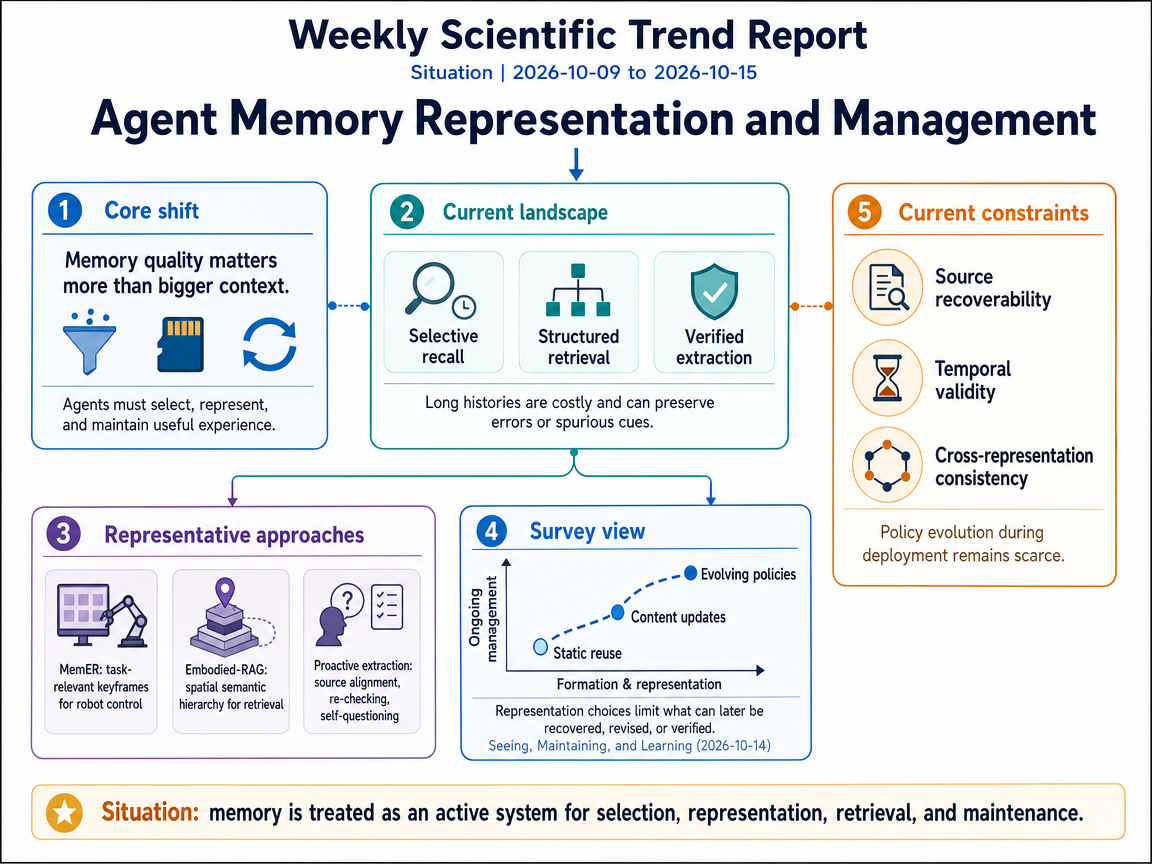
This week's evidence treats agent memory as a problem of selecting, representing, and maintaining useful experience, not simply extending context windows. Representative work connects selective visual recall for robot control, hierarchical embodied retrieval, and verified dialogue-memory extraction. A current-week survey organizes these concerns around coupled memory formation and management.
Situation
Long-horizon agents need information that is missing from their current observations. Retaining full histories, however, is costly. It can also encourage reliance on spurious correlations or carry forward extraction errors. MemER responds with task-relevant keyframe selection inside a hierarchical robot-control framework. Embodied-RAG organizes observations into a spatially structured semantic hierarchy that supports retrieval at different levels of abstraction. Beyond Static Summarization: Proactive Memory Extraction for LLM Agents identifies a complementary failure mode: one-off summaries can omit details or introduce hallucinations. It addresses this with source alignment, re-extraction, and self-questioning. Taken together, these papers make memory quality, not storage capacity alone, a central concern for downstream action and question answering.
As current-week evidence, Seeing, Maintaining, and Learning: The Evolution of Multimodal Agent Memory (2610.19366v1) places these approaches within two coupled dimensions: formation and representation, and ongoing memory management. Its Introduction argues that representation choices constrain what can later be recovered, revised, or verified. It also separates updates to stored content from changes to the policies that manage memory. The survey points toward source recoverability, temporal validity, and cross-representation consistency as directions. It notes that memory-policy evolution at deployment time remains comparatively scarce.
Infographic (English)
Progress
Seeing, Maintaining, and Learning: The Evolution of Multimodal Agent Memory <See Details on Fugu-MT>
A two-axis framework separates multimodal memory formation and representation from memory management. It distinguishes static reuse, content updates under stable policies, and updates under evolving policies.
MemCode: Discrete Semantic Representations for Long-Term Agent Memory <See Details on Fugu-MT>
MemCode rewrites dialogue into atomic memory units and maps them to learned discrete codes for associative retrieval. It adds a discrete representation option and reports the highest overall accuracy on LongMemEval-S and LoCoMo.
Learning How to Remember: Memory Modality Selection for GUI Agents <See Details on Fugu-MT>
SwitchMem dynamically routes GUI-agent memory between textual and visual representations. Its finding that the preferred modality depends strongly on the step extends memory selection beyond deciding which observations to retain.
MemComposer: Learning to Assemble Memories for LLM Agents via Reinforcement Learning <See Details on Fugu-MT>
MemComposer learns which retrieved experiences to include for a query and how to order them. ExPO optimizes this assembly policy with task feedback from complete agent interactions, going beyond fixed retrieval.
MemForm: Benchmarking Memory Formation Poisoning in LLM Agents <See Details on Fugu-MT>
MemForm benchmarks adversarial manipulation at the point where persistent agent memories are generated and committed. It broadens memory-quality concerns from extraction errors and hallucinations to deliberate interference during formation.
Memory Without Curation: Learning Multi-Stream Latent Memory for Robot Policies <See Details on Fugu-MT>
IMprint augments vision-language-action models with a policy-agnostic, multi-stream latent memory. Unlike explicit keyframe selection, it does not constrain in advance what the robot policy should remember.
MemScope: Evolving Agent Memory Architectures through Localized Code Repair <See Details on Fugu-MT>
MemScope evolves existing memory architectures through evidence-grounded, localized code repair. It extends management from updating stored content to modifying the memory architecture itself.
MemAct: Streaming Spatial Understanding with Memory and Active Exploration <See Details on Fugu-MT>
MemAct combines incremental structured memory, historical retrieval, and active exploration for streaming spatial understanding. Rather than only retrieving past observations, it gathers additional evidence through movement and evaluates this on about 20,000 core QA pairs.
Outlook
Outlook Summary
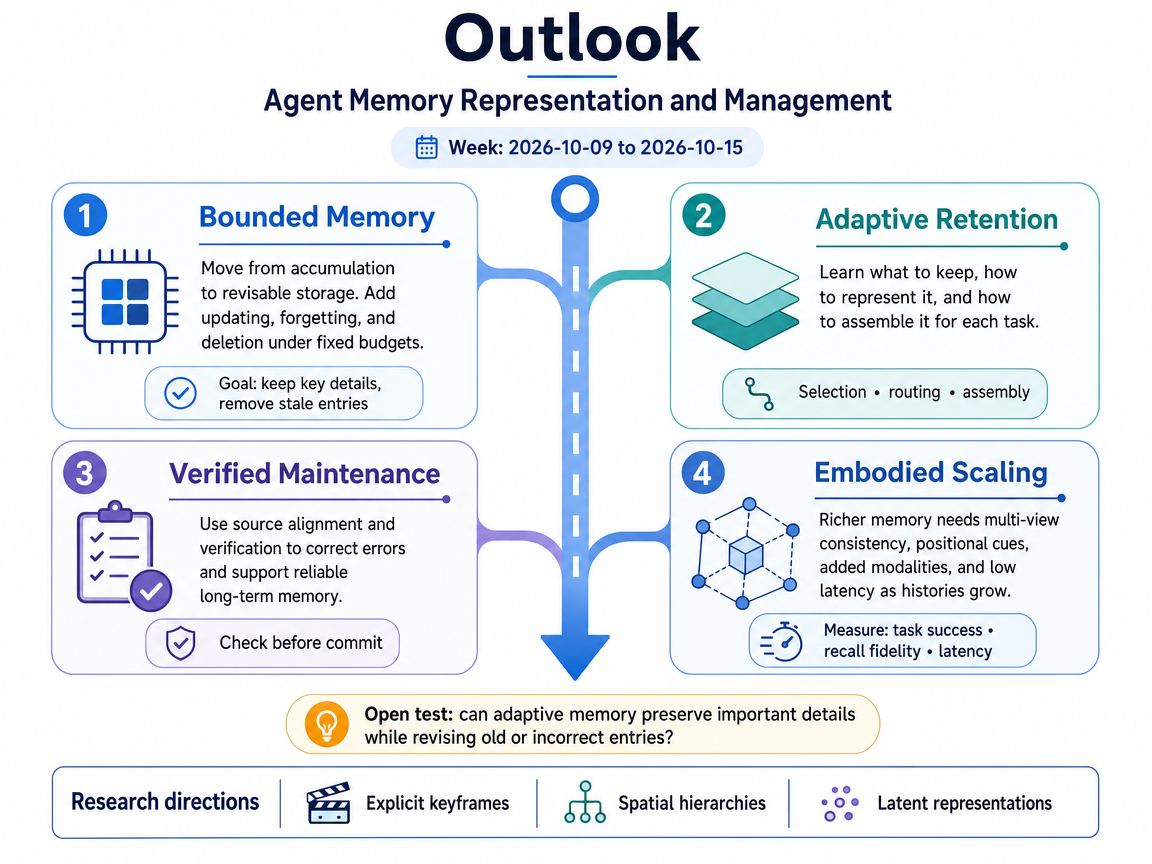
The next direction is bounded, revisable memory rather than continued accumulation. MemER identifies deletion as future work, while Proactive Memory Extraction plans updating and forgetting for lifelong use. Learned memory assembly and representation routing could make retention more task-dependent, but reliable long-term forgetting remains unproven. Tests should check whether systems preserve important details and correct stale entries within fixed storage budgets, using source links and verification where available. Embodied agents also need consistent memory across views and faster access as histories grow. Comparisons between explicit records and compact representations should measure task success and recall fidelity, while separately checking cross-view consistency and latency. Richer sensory inputs and mobile, multi-room tasks remain important directions, not established capabilities.
Infographic (English)
Three-Year Movement
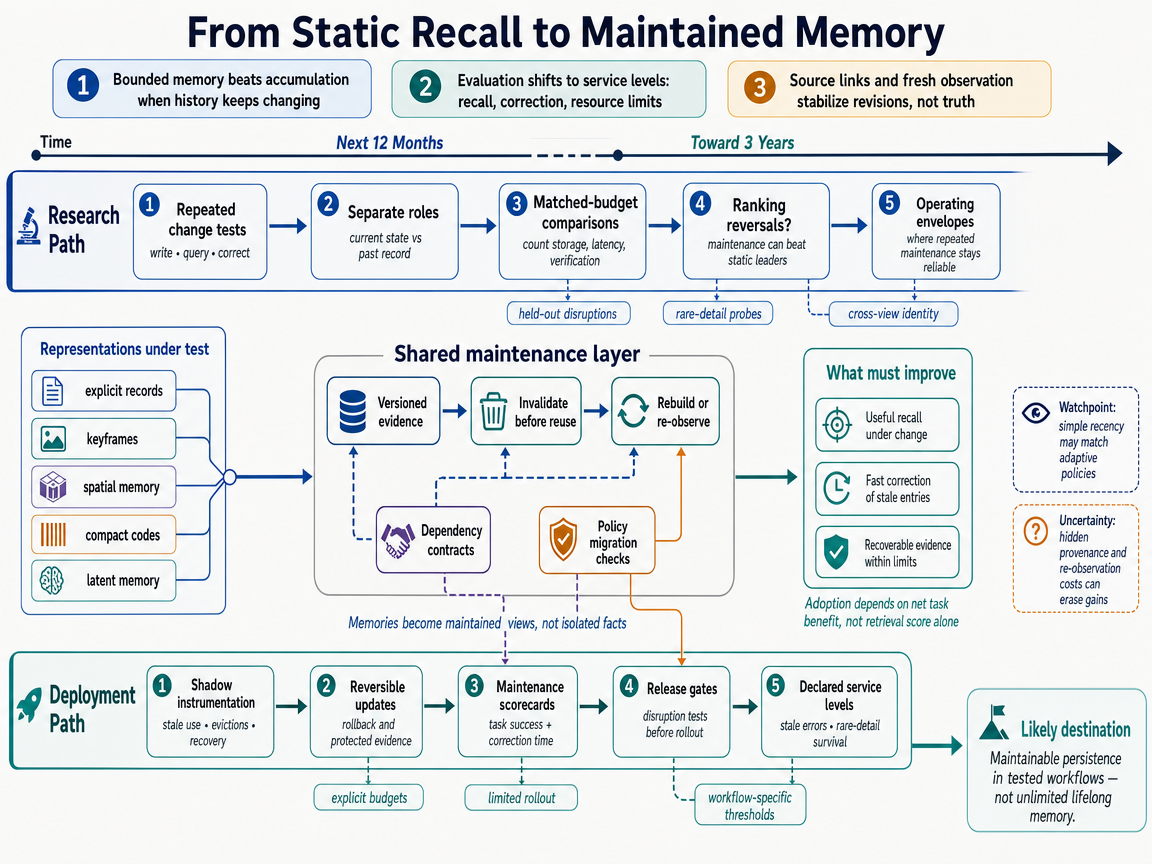
This scenario shifts evaluation from how much an agent remembers to whether useful evidence remains available as tasks and stored information change. Borrowing from the management of perishable supplies, it treats limited capacity and changing needs as reasons to maintain memory rather than simply accumulate it. In year one, researchers would repeatedly revise stored histories and ask delayed questions to expose stale claims and lost rare details. Tests would count supporting records toward storage limits, while verification and fresh observations would also count toward processing and response-time limits.
In year two, progress depends on independent teams showing that methods successful on fixed histories fall behind maintenance-aware methods across at least two task families. The stronger methods must improve task completion within the same resource limits, rather than gain an advantage through uncounted storage or extra observations. Failures from longer pilots could then become reusable tests that teach systems when to revise a claim or gather new evidence. Controlled robot trials would examine whether selective re-observation helps maintain object identity across views without making responses too slow for the task.
By year three, participating teams could require memory changes to pass unseen disruption tests before a limited release, with rollback available when performance deteriorates. These checks would evaluate changes to memory-management policies separately from changes to stored content, because either can introduce failures during continued use. Teams would choose representations according to demonstrated limits, with compact memories retaining enough source links to support precise corrections without preserving every artifact. A key monitoring cue would be shorter recovery times alongside preserved important-detail recall during longer trials under declared resource limits. The scenario weakens if simple recency rules perform equally well, or if apparent gains disappear once hidden costs are counted. Even successful trials would establish bounded maintenance capability, not unlimited lifelong memory or reliable multi-room robot operation.
This scenario treats agent memories like database views: derived representations whose usefulness depends on the records from which they were created. When supporting evidence changes, linked memories would temporarily stop guiding current actions until they have been checked or rebuilt, preventing corrections from remaining isolated. In year one, researchers would attach source versions and validity information to memories, distinguishing a truthful historical record from a claim that remains current. Assistant pilots would first trace repeated errors, then test immediate invalidation followed by slower rebuilding while counting dependency records within the storage budget.
In year two, integration would expand only if this approach reduces stale-memory failures without unacceptable delays or loss of rare details under comparable resource limits. Shared correction rules could then connect different memory representations, while compact latent memories would need clear boundaries for resetting or refreshing affected content. Controlled mobile trials would test whether uncertain object identity should trigger another observation rather than a confident correction based on an unreliable match. Each correction incident could reveal missing dependencies, improving the links that later modules reuse and helping prevent the same mistake from recurring.
By year three, successful pilots could extend these checks to the software that extracts and retrieves memories, rather than maintaining stored content alone. Researchers would test whether a policy change requires rebuilding only affected memories, while applications would introduce migration checks and limited rollback before enabling it. Participating teams could require components to declare their supporting sources and refresh boundaries, making ease of correction part of component selection. A shared maintenance layer would track which versions remain usable, with bounded evidence windows making some older claims explicitly unverifiable rather than silently trusted. The main monitoring cue would be fewer repeated stale-memory errors and shorter correction delays without sacrificing rare-detail recall within the same storage budget. The scenario weakens if simple refreshing costs less, and correctly propagating an update still cannot prove that its underlying observation is true.
This scenario adds an external trigger: buyers and assurance bodies could require agents to retain specific evidence under explicit retention and deletion rules. Like an event recorder, the memory system would preserve enough source material for later review rather than attempt to keep every experience indefinitely. In year one, a memory-specific acceptance profile would connect memories used in consequential actions to their sources and specify how later alterations become detectable. Assistant and GUI pilots would test configurable retention, while robot pilots would check whether recording evidence introduces delays that interfere with control.
In year two, the scenario strengthens if at least two large procurers and one insurer adopt the same profile, creating a shared acceptance target. Permissioned incident records could then reveal failures involving stale information or lost rare details, providing more realistic material for evaluating and improving memory maintenance. This feedback loop depends on records being useful for diagnosis and shareable under appropriate controls; requirements alone do not guarantee either condition. Teams would also distinguish revisions to stored facts from changes to memory-management software, applying offline checks and rollback to the latter before release.
By year three, continued agreement could support two connected tiers: a bounded record for review and working memory optimized for completing the current task. Researchers would check whether relevant working-memory claims can be traced to recorded evidence, while measuring correction accuracy and runtime cost under those recordkeeping requirements. Participating teams could make this reconciliation routine, using compact representations and selective verification to keep evidence requirements from making agents too slow to operate. Mobile, multi-room pilots could follow where profiles cover observation history and position, although those requirements would not themselves solve object matching or navigation. The strongest monitoring cue would combine shared acceptance requirements with usable incident records and acceptable runtime performance across participating deployments. The scenario would narrow if buyers accept separate logs without changing working memory, while tamper evidence would still not establish that the original information was true.
1-Year / 3-Year Research-Application Infographic
References
- Embodied-RAG: General non-parametric Embodied Memory for Retrieval and Generation - Authors: Quanting Xie, So Yeon Min, Tianyi Zhang, Aarav Bajaj, Ruslan Salakhutdinov, Matthew Johnson-Roberson, Yonatan Bisk / <See Details on Fugu-MT> / License: CC-BY-4.0
- MemER: Scaling Up Memory for Robot Control via Experience Retrieval - Authors: Ajay Sridhar, Jennifer Pan, Satvik Sharma, Chelsea Finn / <See Details on Fugu-MT> / License: CC-BY-4.0
- Beyond Static Summarization: Proactive Memory Extraction for LLM Agents - Authors: Chengyuan Yang, Zequn Sun, Wei Wei, Wei Hu / <See Details on Fugu-MT> / License: CC-BY-4.0
- Memory Without Curation: Learning Multi-Stream Latent Memory for Robot Policies - Authors: Yilin Wu, Rutav Shah, Shuaiyi Huang, Sumedh A. Sontakke, Homanga Bharadhwaj, Andrea Bajcsy, Max Simchowitz, Guanya Shi / <See Details on Fugu-MT> / License: CC BY 4.0
- Seeing, Maintaining, and Learning: The Evolution of Multimodal Agent Memory - Authors: Minghao Guo, Qingyue Jiao, Xiujin Liu, Jianhong Pang, Ruimeng Yang, Naihao Xu, Liwei Che, Haochen Xue, Ziqi Wang, Xinying Cai, Jiaxuan Luo, Jiaxin Deng, Xuesong Ye, Jintao Qu, Wenyao Gao, Jingwen Gu, Chenyang Zhao, Shichun Liu, Guibin Zhang, Zefang Liu, Siyin Wang, Wujiang Xu, Danrui Li, Zeru Shi, Woongyeong Yeo, Shuang Liu, Wei-Chieh Huang, Weizhi Zhang, Tianyu Yang, Kangsan Kim, Yebowen Hu, Bowen Wen, Bowen Jiang, Haohao Su, Ming Yin, Sheldon Yu, Mian Zhang, Yuyan Chen, Hanrong Zhang, Kai Mei, Zihao Zhang, Mingyu Jin, Xi Zhu, Hengyi Wang, Tianxin Wei, Linyong Nan, Zhenwen Liang, Zhendong Chu, Ziqi Huang, Yongye Su, Sixun Dong, Shujian Liu, Kaiqu Liang, Jiaojiao Han, Zhaoye Fei, Kun Wang, Shihan Dou, Zhichun Guo, Xingjian Diao, Zeqi Gu, Heng Wang, Tao Feng, Cheng Qian, Hamid Palangi, Silei Xu, Xi Yun, Yi Zhu, Shilong Liu, Qingsong Wen, Sung Ju Hwang, Zuxuan Wu, Yu-Gang Jiang, Yiyu Shi, Dimitris N. Metaxas, Jiaxuan You, Julian McAuley, Mengdi Wang, Jiawei Han, Philip S. Yu, Ziyi Ye / <See Details on Fugu-MT> / License: CC BY 4.0