Summary
This theme centers on making visual generation and reconstruction more practical by replacing slow per-scene optimization with feed-forward Gaussian representations and by improving video diffusion efficiency. Representative papers highlight two pressures: dynamic 3D/video content needs compact, streamable, content-adaptive structure, and modern video generators still need better temporal and physical consistency without costly retraining. This week's progress reinforces the shift toward one-pass Gaussian prediction, broader reuse of video-generation priors, and faster diffusion execution.
Situation
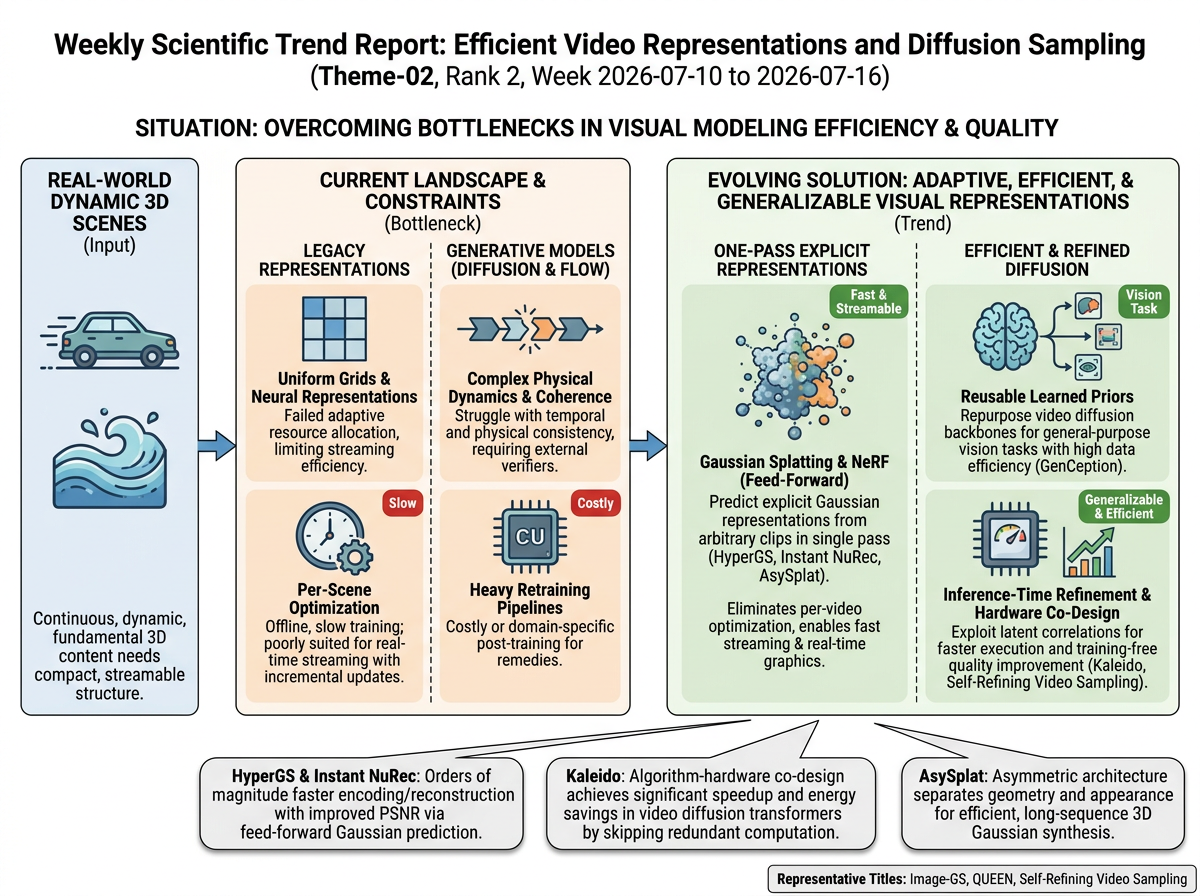
The representative introductions frame a common bottleneck in visual modeling: real scenes are continuous, dynamic, and often fundamentally 3D, but prevailing representations are either built on uniform grids or require expensive per-scene optimization. In free-viewpoint video, dynamic NeRF and Gaussian-based methods can reconstruct 4D scenes well, yet they are largely offline, slow to train, and poorly suited to real-time streaming, where incremental updates, fast rendering, and tight bandwidth are essential. At the image level, uniform pixel grids and many neural image representations likewise fail to adapt resource allocation to local content complexity, limiting efficiency for streaming and real-time graphics.
On the generative side, diffusion and flow-based video models have become strong generators, but they still struggle with complex physical dynamics, temporal coherence, and reliability in downstream use. Existing remedies often depend on rejection sampling with external verifiers or additional post-training, both of which are costly or domain-specific. Together, these papers point to a broader trend: moving toward adaptive, explicit, and efficient visual representations, while also improving video generation quality through training-free inference-time refinement rather than heavier retraining pipelines.
Infographic (English)
Progress
HyperGS: Fast and Generalizable Gaussian Video Representation <See Details on Fugu-MT>
HyperGS predicts explicit Gaussian video representations from arbitrary clips in a single feed-forward pass, eliminating per-video optimization. It improves PSNR by +2.9–3.1 dB over prior video encoders on standard benchmarks while encoding orders of magnitude faster than per-scene Gaussian fitting.
Video Generation Models are General-Purpose Vision Learners <See Details on Fugu-MT>
GenCeption repurposes a pretrained video diffusion backbone as a feed-forward perception model, achieving competitive results across diverse vision tasks. Rather than using video generators only for synthesis, it demonstrates that their learned spatio-temporal priors transfer effectively to visual understanding with high data efficiency.
Instant NuRec: Feed-Forward 3D Gaussian Reconstruction for Driving Scene Simulation <See Details on Fugu-MT>
Instant NuRec converts short multi-view driving logs into layered static/dynamic 3D Gaussian scenes in a single forward pass for closed-loop simulation. It reconstructs 10–20 second multi-camera scenes in roughly 1.5 seconds, reducing computation by 3–4 orders of magnitude versus per-scene optimization while improving PSNR.
Kaleido: Algorithm-Hardware Co-Design for Video Diffusion Transformers by Exploiting Latent Space Correlations <See Details on Fugu-MT>
Kaleido introduces an algorithm-hardware co-design that exploits channel-wise temporal correlations in video diffusion transformer latents to skip redundant computation. It achieves up to 5.9× speedup and 16.0× energy savings over existing accelerator designs while retaining higher generation quality than prior sparse-attention approaches.
AsySplat: Efficient Asymmetric 3D Gaussian Splatting for Long-Sequence Scene Modeling <See Details on Fugu-MT>
AsySplat proposes an asymmetric architecture separating geometry and appearance modeling for generalizable long-sequence novel-view synthesis with 3D Gaussians. It matches optimization-based reconstruction quality on long sequences while achieving roughly 800× faster inference.
Outlook
Outlook Summary
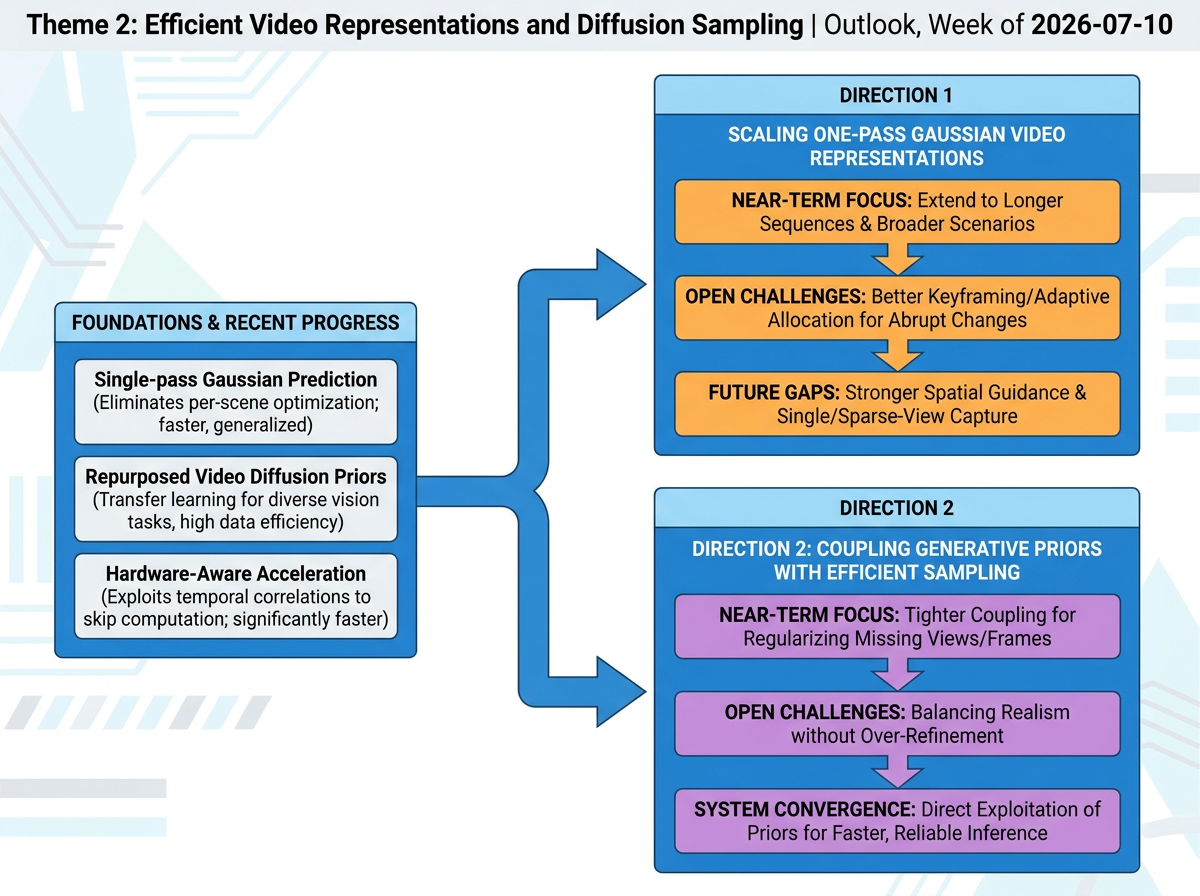
The near-term direction is a shift from slow per-scene optimization toward feed-forward Gaussian video representations that can predict scenes in one pass. Research will extend these methods to longer sequences while improving keyframe resets, content-aware Gaussian placement, and reconstruction from sparse views. A second direction will connect generative video priors with efficient reconstruction and sampling. These priors may fill missing frames or views, but systems need stronger stopping rules to avoid excessive refinement. Hardware-aware execution should also make inference faster and more dependable across practical settings.
Infographic (English)
Three-Year Movement
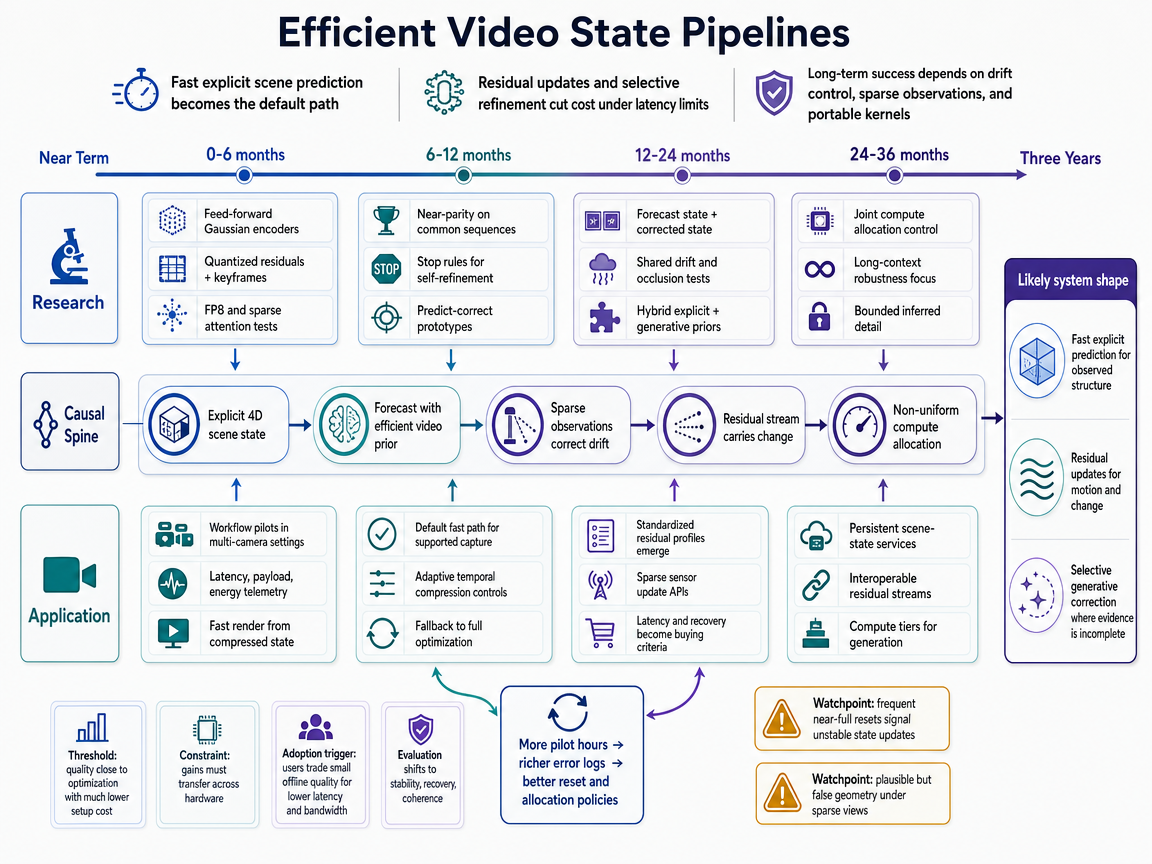
The standard path begins with feed-forward models replacing much of the repeated optimization used for each video scene. An explicit Gaussian representation supplies a fast base state, while compact residual updates encode changes between frames. This resembles a fast estimator followed by small corrections, allowing the system to spend more work only where motion or uncertainty requires it. During the first year, researchers will test longer sequences, adaptive keyframes, and static-versus-dynamic scene separation. Success will mean approaching the visual quality of slower methods while retaining major gains in preparation time, transmission size, or rendering speed.
By the second year, wider pilot use should create records of drift, abrupt scene changes, and reset decisions. Those records can improve how systems allocate Gaussians and decide when a new keyframe is necessary. Generative video priors may also help recover limited missing observations, but they will remain constrained by geometric checks. Progress should therefore move from complete multi-camera capture toward less complete settings, rather than immediately reaching unrestricted single-view reconstruction. A useful monitoring cue will be the appearance of shared long-sequence benchmarks and residual formats that test recovery after difficult changes.
Around the third year, stable systems should use non-uniform computation throughout the pipeline. They will vary representation density, temporal compression, and refinement strength according to scene complexity and confidence. Evaluation will place more weight on long-term stability, topology changes, and recovery from incomplete views instead of judging isolated frames alone. The main caveat is that plausible generated detail can still be geometrically false, unlike corrections governed by strict physical rules. Frequent full resets, growing residual drift, or efficiency gains that disappear on different hardware would weaken this path. If those problems recede, the likely outcome is a practical division of labor: fast explicit prediction for observed content, residual updates for change, and selective generative correction for small evidence gaps.
The contender path combines explicit video representations with a persistent predict-and-correct loop. A Gaussian or continuous field stores the current scene, a learned video prior predicts how it changes, and sparse observations correct the prediction. The mechanism resembles data assimilation in weather forecasting, where a forecast is periodically adjusted using new measurements. During the first year, researchers will test uncertainty-weighted updates and short correction windows. The main threshold will be lower end-to-end latency or computation at matched persistence quality, rather than a speedup confined to one processing step.
Early applications will remain controlled because the system must know when its prediction is becoming unreliable. Instrumented telepresence, simulation, and bounded robotics environments offer observations that can be checked against known conditions. These pilots may send an initial scene state followed by small residual updates, calling the learned prior only when evidence is missing. Confidence thresholds and maximum forecast intervals will limit drift before a keyframe or full reset occurs. By the second year, successful systems should separate a forecast state from an observation-corrected state and develop clearer rules for local updates.
Around the third year, this could become a distinct class of state-estimation video engines. Their central measure will be the assimilation window, meaning how long the scene can advance before a sensor correction or hard reset is required. Systems should record which geometry was directly observed and which parts were inferred, especially when outputs affect later automated actions. A strong monitoring cue would be new benchmarks that measure persistence through occlusion while also reporting bandwidth and latency. The reinforcing mechanism is that cheaper corrections permit more frequent updates, while more frequent updates reduce drift and keep the persistent state useful for longer. The main caveat is that learned video priors lack the firm physical equations available to weather models and can create convincing but false geometry. Results showing that nearly complete observations are still required, or that simpler estimators perform better during abrupt topology changes, would disconfirm this path.
The maybe path depends on efficiency becoming a repeatable system requirement rather than only a paper-level result. Feed-forward Gaussian reconstruction, compressed scene updates, and faster diffusion execution already provide measurable gains. The scenario mechanism is a common test cycle that evaluates energy use, bandwidth, and output quality under controlled conditions. Large organizations can then use those results when selecting systems for trials. During the first year, researchers will need to report complete workload costs alongside hardware settings and output quality, making comparisons easier to audit.
Pilots should test longer sequences and abrupt scene changes rather than only favorable clips. They will also examine whether low-precision execution and sparse computation retain their gains on different accelerators. The key first-year threshold is a substantial operational request that combines a resource ceiling with a quality floor. If that occurs, repeated trials can guide engineering toward the same measurable targets. By the second year, common Gaussian-residual profiles and practical energy tests may support interoperability between implementations. Research will then focus on weaknesses exposed by hidden test content, including drift, topology changes, and sparse-view capture.
Around the third year, systems should allocate computation unevenly but deliberately. Easy frames may use fewer Gaussians or stronger compression, while difficult motion receives more capacity or uncertainty-gated refinement. Generative priors may reconstruct limited missing content, but quality tests and provenance controls should restrict unsupported detail. A monitoring cue will be the appearance of versioned test suites with rotating hidden clips and minimum quality requirements. Such controls reduce the chance that a system recognizes a test and switches to an artificially cheap mode. The main caveat is that no single score can capture energy, bandwidth, latency, and visual quality as hardware changes. This path would weaken if standards never produce interoperable profiles, operational requests omit numeric efficiency limits, or rival tests yield incomparable results. If the test cycle remains current and comparable, predictable feed-forward processing should dominate live use by Month 36, while slower scene-specific optimization remains mainly an offline reference.
1-Year / 3-Year Research-Application Infographic
References
- Image-GS: Content-Adaptive Image Representation via 2D Gaussians - Authors: Yunxiang Zhang, Alexandr Kuznetsov, Akshay Jindal, Kenneth Chen, Anton Sochenov, Anton Kaplanyan, Qi Sun, / <See Details on Fugu-MT> / License: CC-BY-4.0
- QUEEN: QUantized Efficient ENcoding of Dynamic Gaussians for Streaming Free-viewpoint Videos - Authors: Sharath Girish, Tianye Li, Amrita Mazumdar, Abhinav Shrivastava, David Luebke, Shalini De Mello, / <See Details on Fugu-MT> / License: CC-BY-4.0
- Self-Refining Video Sampling - Authors: Sangwon Jang, Taekyung Ki, Jaehyeong Jo, Saining Xie, Jaehong Yoon, Sung Ju Hwang, / <See Details on Fugu-MT> / License: CC-BY-4.0