Summary
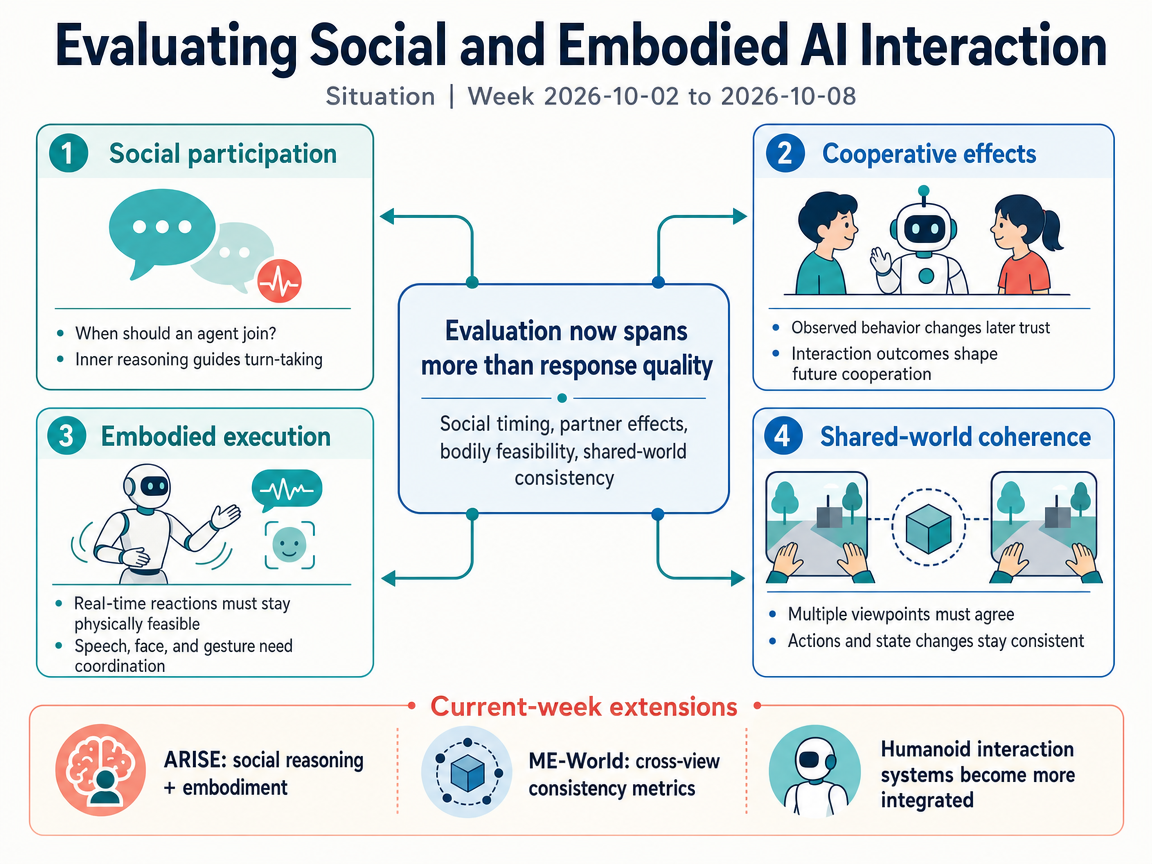
This week's theme links socially appropriate AI participation, cooperative effects on human partners, and physically feasible embodied behavior, framing evaluation as more than response quality. Current-week work extends this toward integrated humanoid systems and multi-agent world models, where actions, environments, and interaction outcomes must stay consistent across participants' viewpoints.
Situation
The representative Introductions frame interaction quality as a combination of social timing, cooperative consequences, and physical feasibility. In "Cooperation Through Indirect Reciprocity in Child-Robot Interactions," a study with 131 children finds that observing a robot's cooperative or non-cooperative behavior toward another child shapes subsequent cooperation with that robot, and these observed rates then inform multi-armed bandit simulations of robot learning strategies. "Proactive Conversational Agents with Inner Thoughts" targets the limits of passive prompting and next-speaker prediction in multi-party chat, having agents generate and evaluate internal thoughts to decide when to participate. "Towards Immersive Human-X Interaction" adds the embodied challenge: real-time reactions must be temporally coordinated and physically feasible, not merely plausible as kinematic motion. Together, these works motivate evaluating how agents participate and affect partners, not just what they generate.
Current-week evidence from "Multi-Agent Egocentric World Model with Fine-Grained Embodied Interaction" (2610.12299v1) extends this picture to shared-world consistency. ME-World couples multiple first-person video streams through joint generation, shared action conditioning, and shared environment memory, and introduces metrics for whether newly generated environment regions and interaction-induced state changes stay consistent across views. The supplemental ARISE Introduction (2610.05964v1) offers a complementary direction on the Sophia humanoid, combining multimodal social reasoning, long-term memory, and proactive engagement with embodiment-aware gesture planning and speech synchronized to facial animation. These additions broaden evaluation toward coherence across social decisions, bodily execution, and shared environments.
Infographic (English)
Progress
From Social Reasoning to Embodied Interaction: An Agentic Framework for Social Robots <See Details on Fugu-MT>
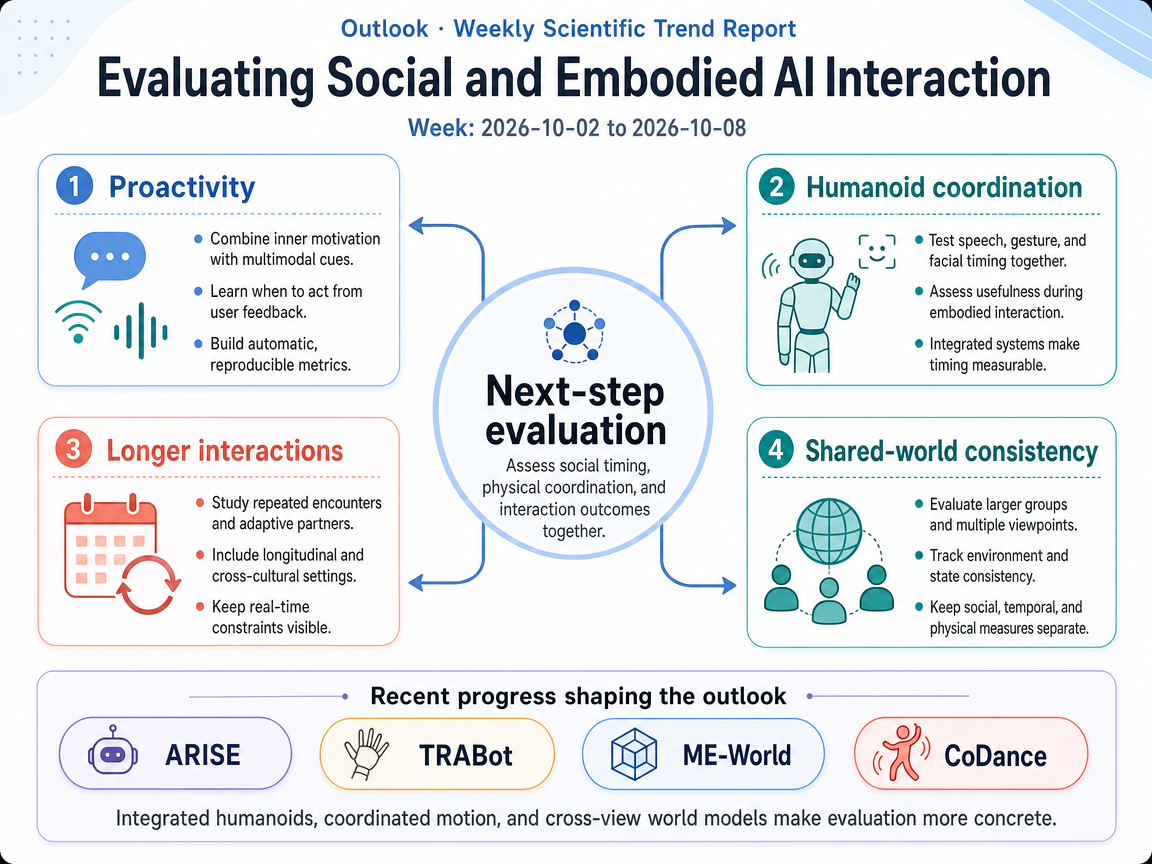
ARISE connects agentic social reasoning with embodied interaction on the Sophia humanoid robot. It unifies multimodal context, long-term memory, and reactive plus proactive engagement with coordinated speech, facial animation, and gestures, capabilities previously studied largely in isolation.
Talk, Render, Act: Integrating Social Gesture and Digital Face with Synchronized Speech for Conversational Humanoid Robot <See Details on Fugu-MT>
TRABot targets coherent humanoid responses that combine speech, facial animation, and body gestures. It assigns these to specialized agents for dialogue generation, motion planning, and facial animation within one agent-based framework.
Multi-Agent Egocentric World Model with Fine-Grained Embodied Interaction <See Details on Fugu-MT>
ME-World extends embodied interaction modeling to jointly generated first-person views of a shared world. Beyond single-agent prediction, it introduces shared-world metrics for environment and state-update consistency, plus identity preservation on a synthetic benchmark.
CoDance: Learning Reactive and Compliant Human-Humanoid Interaction from Video <See Details on Fugu-MT>
CoDance learns reactive and compliant human-humanoid interaction from video, using partner dancing as a demanding testbed. It reports sustained two-hand dancing with a human partner, including repeated forward and backward transitions.
Outlook
Outlook Summary
A likely next direction is to evaluate socially appropriate participation alongside coordinated physical execution. Research would combine internal participation decisions with audiovisual cues, learn participation thresholds from user feedback, and develop reproducible measures of proactivity. Integrated humanoid systems make it possible to test contribution timing and usefulness alongside speech–gesture coordination, while richer context must still support real-time responses. Evaluation also needs longer interactions and larger groups, including repeated encounters with changing partners and cross-cultural studies. Immediate cooperation cannot establish lasting effects. Checks of consistency between agents’ views offer one useful step, but social, temporal, and physical outcomes should remain separate rather than become one score.
Infographic (English)
Three-Year Movement
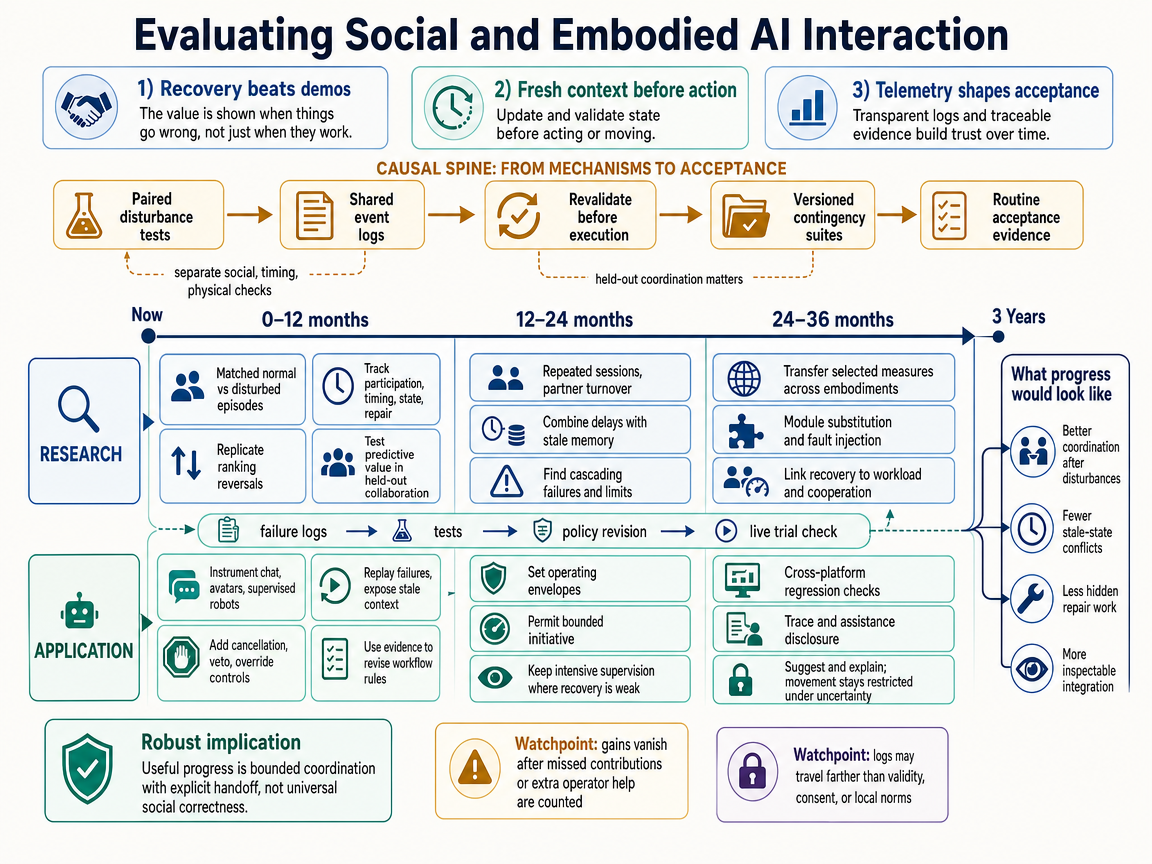
This path connects appropriate participation with coordinated physical execution by testing whether small disruptions cause errors to spread across connected modules. Borrowing from electricity-grid contingency testing, it checks whether coupled parts remain within their own limits after a disturbance rather than assuming successful demonstrations establish reliability. In the first year, researchers would compare ordinary interactions with matched episodes containing one controlled change, such as a delayed cue. Synchronized logs would help explain failures while keeping useful participation, coordination timing, and human repair effort as separate measures.
In the second year, validated tests would expand to repeated sessions and changing partners, where people adapt and longer memory may slow responses. Researchers would also combine disturbances to discover whether a late cue and an outdated object location cause failures that neither produces alone. Those findings could define task-specific operating boundaries: when an agent may act, when it must ask, and when a person must take over. Trial failures would become reusable tests, and later sessions would check whether revised policies improve coordination without simply reducing useful participation.
By the third year, selected tests could transfer between avatar workflows and experimental robots, although every robot would still need its own execution evidence. Participating teams could routinely run versioned test suites before updates or expanded responsibilities to detect the return of previously corrected failures. Permission could remain selective, allowing an agent to explain a situation while preventing movement when identity or location is uncertain. A key monitoring cue would be independently reproduced cases where a small disturbance reverses which system performs better and predicts failures in new interactions. The path weakens if disturbed tests add no predictive value or apparent gains depend on greater human assistance. Its outcome would be better-supported boundaries for useful interaction, not proof of universal social correctness or physical safety.
This path asks whether an appropriate intention becomes wrong while waiting for speech or movement to begin because its supporting context has changed. Its mechanism comes from optimistic concurrency control in distributed systems: modules prepare contributions in parallel, then check their required context before execution. In the first year, researchers would record observation and execution times to distinguish stale context from mistakes already present in the original decision. Replay tests would compare this final check with ordinary cancellation and synchronization, rather than assuming a new coordination layer is necessary.
In the second year, expansion would depend on reduced conflicts across two bounded workflows without unacceptable delay or missed useful contributions. Researchers would make checks selective so that an unrelated object moving does not cancel a useful comment, while uncertain speaker identity triggers reconsideration. Each planned contribution could carry an expiration time reflecting how quickly its supporting observations become unreliable under the conditions being tested. Supervised repeated sessions would then reveal whether better dependency descriptions reduce unnecessary cancellations and encourage teams to instrument more interactions with changing partners.
By the third year, independent laboratories would test whether the same interface still prevents conflicts after dialogue or motion components are replaced. If it transfers, reusable tools could help developers declare required context, set expiration times, and report how canceled actions are handled. Pilot teams might request these records from component suppliers, making integration easier to inspect without treating them as evidence of general social competence. Monitoring would compare conflict reductions with useful participation and operator repair effort to expose improvements achieved mainly by doing less or shifting work to people. The path weakens if consequential errors already exist when intentions are generated, or simpler improvements work equally well with less delay. Final checks would govern machine commitments rather than human behavior, while separate physical safety controls would remain necessary because actions cannot always be undone.
This path uses the flight-recorder idea to make interaction failures replayable and comparable, so evaluation infrastructure could eventually influence acceptance for use. In the first year, researchers would build shared evaluation harnesses, meaning software that records interactions and tests different aspects of performance separately. These records would connect useful participation with coordination evidence without collapsing social judgments and physical feasibility into a single score. Early validation would require automatic participation measures to agree with human judgments across conversation and task collaboration, while threshold adjustments preserve useful contributions.
In the second year, progress would depend on those results holding outside the original teams, including checks that recorded consistency reflects observed coordination. Shared records could support common failure definitions that distinguish an unhelpful but well-timed comment from a useful response with a mistimed gesture. The reinforcing mechanism is straightforward: visible failures guide repairs, and episodes from repaired systems provide fresh evidence for improving the tests. Application teams could begin using these tests for pilot acceptance, but stronger influence would require program organizers to demand portable logs and disclosed human intervention.
By the third year, validated harnesses could become routine acceptance procedures in participating avatar and robot programs rather than optional tools for debugging demonstrations. Researchers would examine cultural differences and changing evaluator behavior while making hidden operator assistance visible in the evidence used to assess systems. The proposed shift is that accepted measurement procedures gain influence over deployment decisions, alongside the platforms that produce impressive demonstrations. A monitoring cue would be independent agreement with human judgments followed by actual acceptance requirements that apply across participating teams rather than one platform. The stronger outcome would fail if metrics lose that agreement or incompatible recording formats prevent meaningful comparison between laboratories. Shared records could still improve research workflows, but recording requires consent and access controls, and logged evidence cannot replace independent physical assessment.
1-Year / 3-Year Research-Application Infographic
References
- Proactive Conversational Agents with Inner Thoughts - Authors: Xingyu Bruce Liu, Shitao Fang, Weiyan Shi, Chien-Sheng Wu, Takeo Igarashi, Xiang `Anthony' Chen / <See Details on Fugu-MT> / License: CC-BY-4.0
- Towards Immersive Human-X Interaction: A Real-Time Framework for Physically Plausible Motion Synthesis - Authors: Kaiyang Ji, Ye Shi, Zichen Jin, Kangyi Chen, Lan Xu, Yuexin Ma, Jingyi Yu, Jingya Wang / <See Details on Fugu-MT> / License: CC-BY-4.0
- Cooperation Through Indirect Reciprocity in Child-Robot Interactions - Authors: Isabel Neto, Alexandre S. Pires, Filipa Correia, Fernando P. Santos / <See Details on Fugu-MT> / License: CC-BY-4.0
- From Social Reasoning to Embodied Interaction: An Agentic Framework for Social Robots - Authors: Ziyu Cheng, Yuewen Guo, Zhirui Liu, Dong Zhang, Haotao Lu, Jingyi Yu, Ye Shi, Jingya Wang / <See Details on Fugu-MT> / License: CC BY 4.0
- Agentic RSR: Real-to-Sim-to-Real through Scene Reconstruction and Execution-Grounded Robot Policies - Authors: Yihan Li, Yating Feng, Shengjiu Sun, Jianing Chen, Hao Ren, Bowen Yang, Weisheng Xu, Qiwei Wu, Hui Cheng, Renjing Xu / <See Details on Fugu-MT> / License: CC BY 4.0
- From Solo to Ensemble: A Hierarchical Framework for Composable Multi-Agent Human-Object Interaction - Authors: Zekai Deng, Kangyi Chen, Ye Shi, Jingya Wang / <See Details on Fugu-MT> / License: CC BY 4.0
- Multi-Agent Egocentric World Model with Fine-Grained Embodied Interaction - Authors: Dahyun Chung, Siyoon Jin, Hyunwook Choi, Honggyu An, Junyoung Seo, Hyunsung Kim, Seung Wook Kim, Seungryong Kim / <See Details on Fugu-MT> / License: CC BY 4.0