Summary
This theme centers on making 3D/4D reconstruction and rendering more practical under sparse-view or monocular conditions by moving beyond purely photometric fitting. Representative papers pair 3D Gaussian Splatting with stronger motion, physics, and interaction priors to improve dynamic consistency, physical plausibility, and rendering efficiency.
Situation
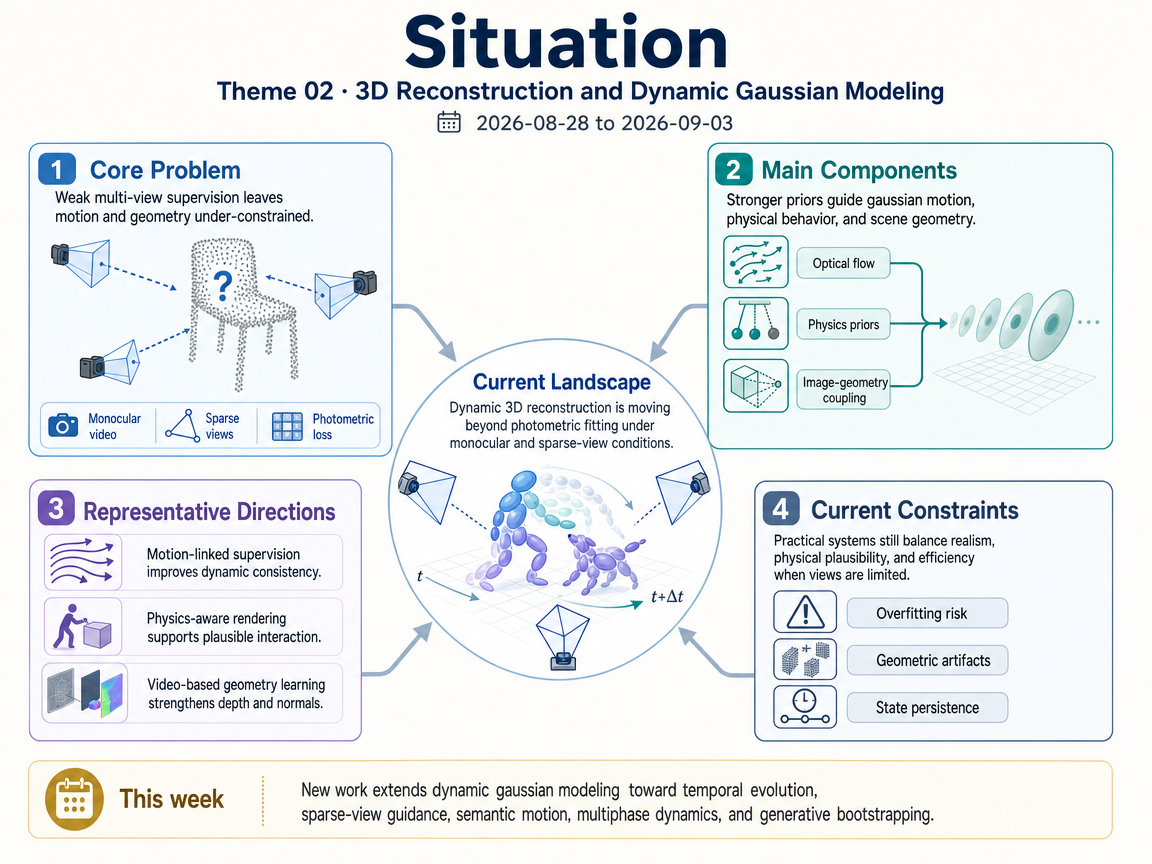
Representative work frames the core problem as reconstructing dynamic 3D content when multi-view supervision is weak, expensive, or unavailable. GaussianFlow argues that standard 4D NeRF and 4D Gaussian methods are efficient but under-constrained on dynamics when trained mainly with photometric loss, especially for monocular or sparse-view videos; it introduces optical-flow-based supervision that directly links Gaussian motion to pixel velocities. PhysMotion and HOGS push the same line further by making 3D Gaussian pipelines more physically grounded: PhysMotion targets single-image-to-video generation with simulator-based 3D dynamics plus diffusion refinement, while HOGS addresses sparse-view human-object rendering by enforcing plausible contact and reducing interpenetration.
Current-week evidence broadens the theme from dynamic rendering to upstream geometry estimation. In "Video Generative Models as Geometry Learner" (2608.28549v1), the authors argue that monocular depth and normal prediction suffer when image diffusion models treat geometry as a special image without modeling image–geometry interaction; they instead repurpose a video generative model so geometry is predicted as a next-frame task, leveraging temporal-attention priors for joint image–geometry modeling.
Infographic (English)
Progress
VersaGauss: A Versatile Framework for Generating Multiphase Dynamics with 3D Gaussians <See Details on Fugu-MT>
VersaGauss provides a unified Gaussian-based framework for generation, simulation, and rendering of physics-based dynamics including multiphase interactions. It extends physically grounded Gaussian pipelines beyond single-object or pairwise settings to multiphase dynamics.
EvoGS: Modeling Deformation Evolution for Dynamic Gaussian Splatting <See Details on Fugu-MT>
EvoGS models Gaussian deformation as a temporal evolution process, maintaining persistent deformation states and correcting predictions with per-origin observations. Unlike per-frame deformation approaches, it carries historical state forward, improving dynamic novel-view synthesis quality.
GSPotential: Camera Potential Field for Sparse-View 3D Gaussian Splatting <See Details on Fugu-MT>
GSPotential addresses sparse-view 3DGS by introducing a camera potential field that quantifies view-supervision imbalance. It provides an explicit mechanism to guide Gaussian optimization under limited views, reducing overfitting and geometric artifacts.
SMG: Semantic Motion Graph for Monocular Dynamic Gaussian Splatting <See Details on Fugu-MT>
SMG models Gaussian motion as low-rank semantic motion via a semantic motion graph, targeting monocular dynamic scenes. It introduces a structured semantic prior that achieves state-of-the-art monocular dynamic Gaussian splatting on real-world benchmarks.
InceptionGS: Generative Bootstrapping for Large-Scale Gaussian Splatting under Unstructured View Sampling <See Details on Fugu-MT>
InceptionGS tackles large-scale Gaussian reconstruction under unstructured view sampling by bootstrapping reconstruction with generation. It selectively repairs under-observed regions while preserving quality elsewhere, addressing weak-view coverage at scene scale.
Outlook
Outlook Summary
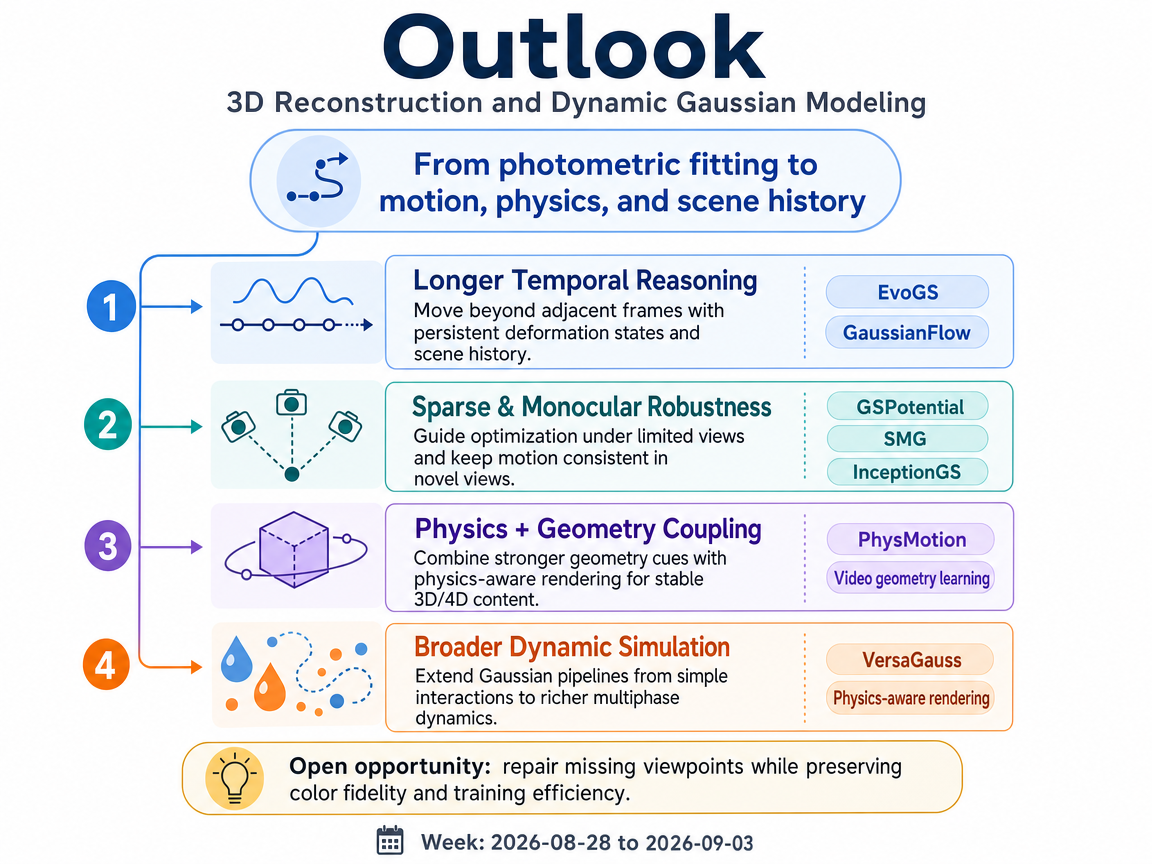
Dynamic Gaussian reconstruction is moving toward longer motion histories and better handling of missing viewpoints, especially with monocular or sparse-view input. Longer-range motion supervision and view-conditioned guidance could keep scene deformation consistent while limiting repair to poorly observed regions. A second direction combines stronger geometry estimates with physical constraints and efficient training. PhysMotion and HOGS highlight the need to preserve color during appearance refinement, reduce multi-stage processing, and extend beyond simple interactions. Together, these advances could produce more stable, physically plausible 3D/4D scenes from fewer observations, provided that added guidance improves temporal consistency without introducing excessive computational cost.
Infographic (English)
Three-Year Movement
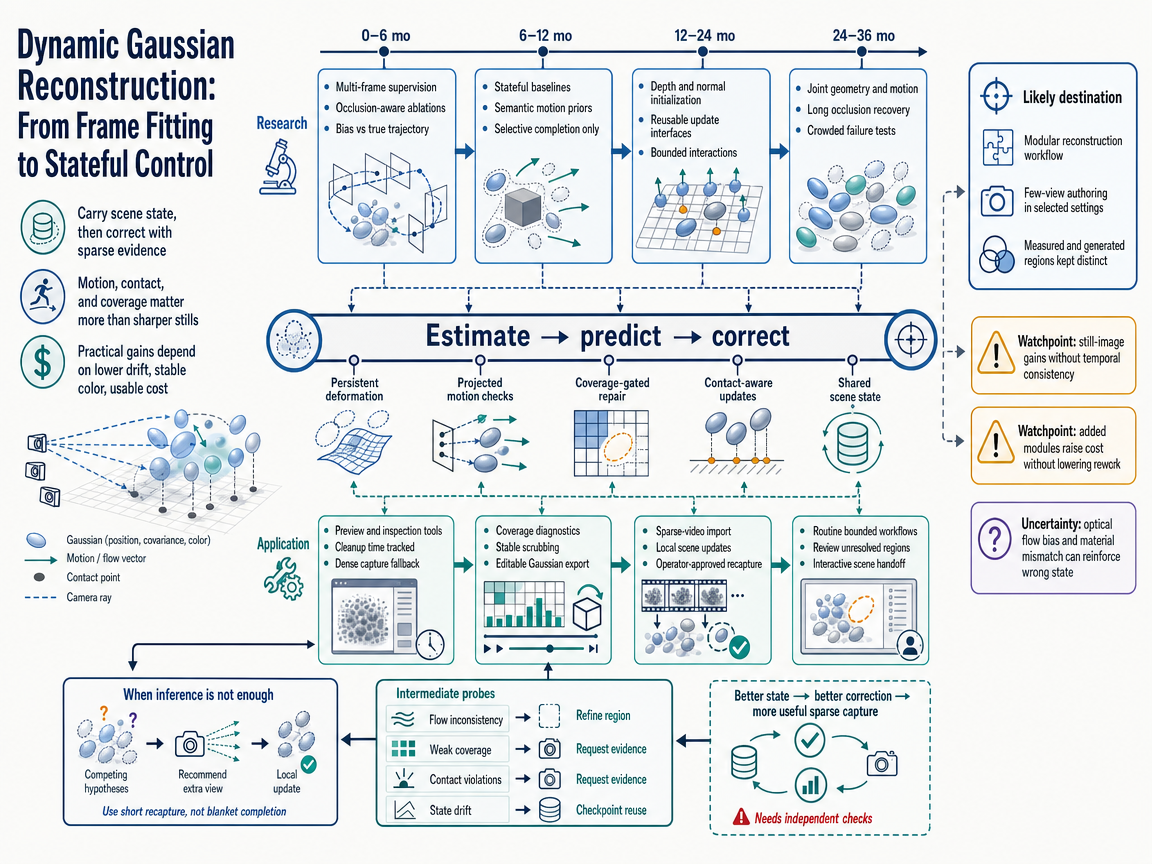
Over roughly three years, separate advances in dynamic Gaussian reconstruction could converge into a modular workflow that maintains a scene estimate across time rather than repeatedly fitting individual images. The mechanism resembles weather data assimilation: predict how a scene changes, then correct that prediction using incomplete camera observations while retaining its motion history. In the first year, researchers would extend motion checks across multiple frames and test whether remembered deformation improves consistency in regions with weak camera coverage. Appearance refinement would need to preserve simulated motion and color, with success judged by steadier playback and less manual cleanup rather than sharper still images alone.
In the second year, initial depth and surface-orientation estimates from monocular video could give the persistent scene model a stronger geometric starting point before Gaussian optimization begins. Researchers would then test whether updates to that shared model can handle limited multi-object interactions without letting incorrect contact or material assumptions distort the reconstruction. Selected content-creation tools could turn sparse video into scenes with less identity flicker, while retaining human correction and treating visual plausibility as distinct from physical accuracy.
By the third year, successful components could share a common scene representation, while generated repairs and appearance adjustments remain separately controllable so that errors are easier to isolate. Bounded uses such as previsualization and sports replay could become more routine, supported by capture guidance and visible indications of regions that still require review. More consistent scenes could improve the motion and contact estimates used in later corrections, creating a useful feedback loop that still needs independent checks. A key monitoring cue would be reduced long-term motion drift and fewer contact errors at a usable total processing cost, alongside stable color. The scenario weakens if still-image quality rises without temporal gains, or if users face the same capture and cleanup burden despite the added machinery.
Over roughly three years, reconstruction could shift from processing a fixed recording to guiding the collection of evidence that resolves uncertainty about a scene. The mechanism comes from robotics: choose an action that distinguishes competing explanations, such as a short camera movement that reveals whether an apparent contact is real. In the first year, researchers would test whether disagreement between candidate reconstructions predicts errors in unseen views, rather than merely responding to poor texture or changing illumination. A decisive monitoring cue would be prospective capture tests in which recommended shots outperform random or coverage-only guidance under equal time and movement limits on two controlled scene collections.
Early tools would flag uncertain regions and suggest supplemental shots for human approval, initially in repeatable tabletop interactions or controlled sessions involving a person and an object. In the second year, a persistent scene record would let new observations update the existing reconstruction without losing scene identity or restarting the entire fitting process. A few controlled actions, such as rotating an object or releasing a grasp, could then help distinguish contact explanations that another camera angle cannot resolve. This creates a feedback loop in which informative observations improve the scene estimate, better estimates improve capture recommendations, and fewer wasted shots encourage operators to follow the guidance.
By around 36 months, reusable capture modules could learn when to request another observation and when the available evidence is sufficient for a defined quality target. Tools could choose between another shot, further constrained fitting, or clearly labeled generated completion, while retaining unresolved alternatives when no available action can distinguish them. Acceptance checks would cover specified views and interactions, and measured regions would remain distinguishable from generated ones rather than implying that the entire scene is verified. The path weakens if simple coverage guidance works equally well, or if incorporating another shot repeatedly requires near-complete retraining that erases the capture savings. Its natural scope is repeatable, controllable capture, because archival recordings and unrepeated events generally cannot provide the additional evidence that this workflow needs.
The possible longer-term shift is from separate reconstruction methods to a shared process-control layer that checks intermediate scene estimates rather than judging only the finished images. Current work supplies parts of this direction through motion supervision, contact constraints, and persistent deformation, but the supplied evidence does not yet establish a combined system. The mechanism resembles semiconductor process control: measurements taken during processing can help locate an error and guide a correction before the final output is produced.
In reconstruction, a probe would be a reusable module that detects a suspected failure, such as unsupported geometry or inconsistent motion. Around the three-year horizon, the scenario's central possibility is that such probes become common platform components instead of remaining checks built for individual papers. The clearest monitoring cue would be their reuse across shared reconstruction workflows, where intermediate measurements can guide corrections. This remains conditional because several reported advances are directional signals rather than detailed demonstrations that a common control layer works.
1-Year / 3-Year Research-Application Infographic
References
- GaussianFlow: Splatting Gaussian Dynamics for 4D Content Creation - Authors: Quankai Gao, Qiangeng Xu, Zhe Cao, Ben Mildenhall, Wenchao Ma, Le Chen, Danhang Tang, Ulrich Neumann, / <See Details on Fugu-MT> / License: CC-BY-4.0
- PhysMotion: Physics-Grounded Dynamics From a Single Image - Authors: Xiyang Tan, Ying Jiang, Xuan Li, Zeshun Zong, Tianyi Xie, Yin Yang, Chenfanfu Jiang, / <See Details on Fugu-MT> / License: CC-BY-4.0
- Physics-Aware Human-Object Rendering from Sparse Views via 3D Gaussian Splatting - Authors: Weiquan Wang, Jun Xiao, Yueting Zhuang, Long Chen, / <See Details on Fugu-MT> / License: CC-BY-4.0
- Video Generative Models as Geometry Learner - Authors: Haosen Yang, Jifei Song, Zhensong Zhang, Xiatian Zhu, Jiankang Deng / <See Details on Fugu-MT> / License: CC BY 4.0